
X-Ray traces mark some downstream calls as errors (client 4xx) and others as faults (5xx). Why does that classification matter for a municipal incident?
Select an answer to reveal the explanation.
Short Explanation
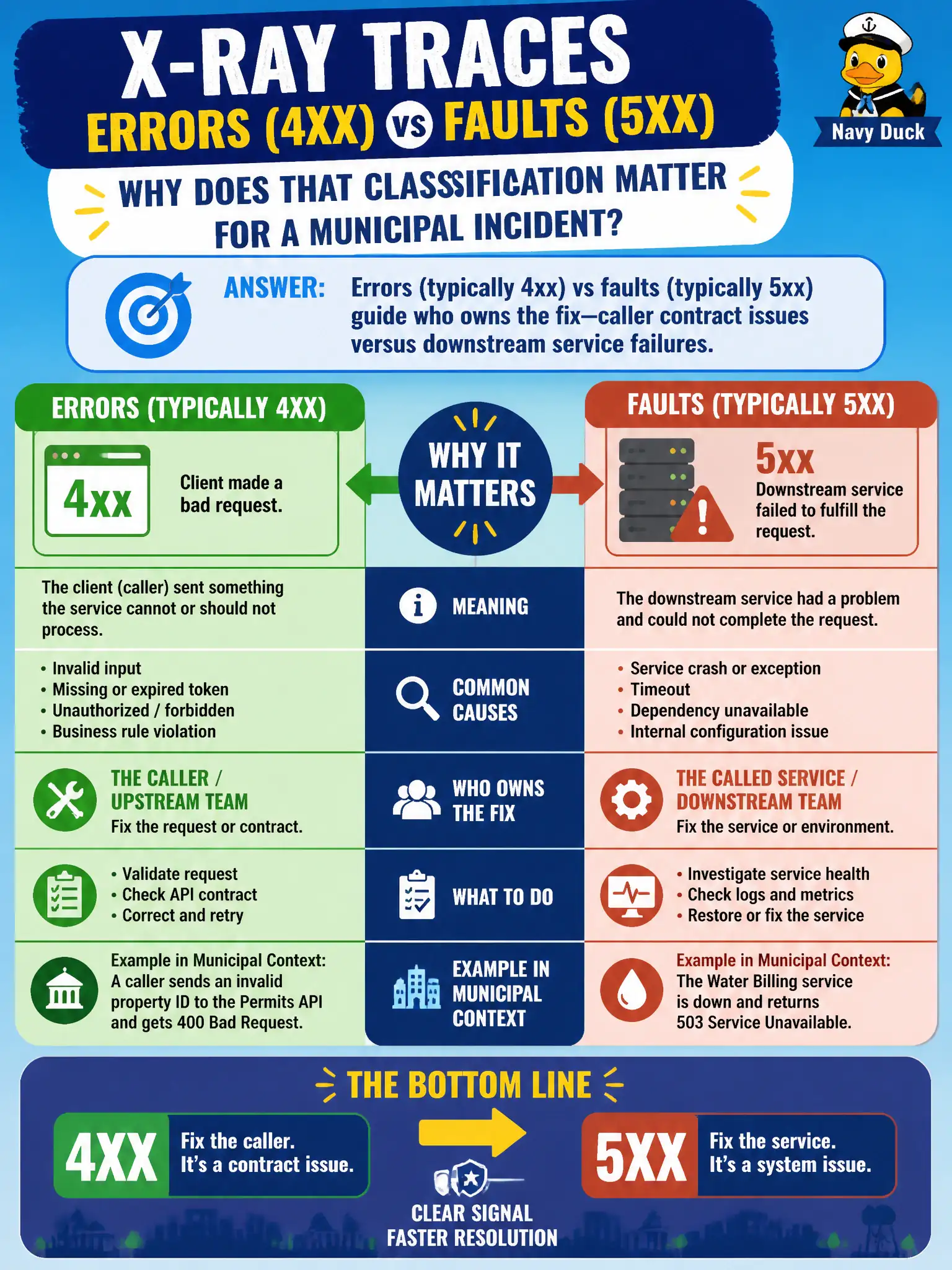
In X-Ray, 4xx-style errors and 5xx-style faults point different fingers—bad caller contract versus sick downstream. Classification tells the municipal team who should dig first.
Full Explanation
X-Ray marking some downstream calls as errors (typically client 4xx) and others as faults (typically 5xx) matters because the classification guides ownership during a municipal incident. Errors often mean the caller sent a bad request or hit a client-side contract problem; faults often mean the downstream service failed. That split prevents the wrong team from thrashing—application developers fix contract misuse, while platform or vendor owners chase true service failures.
X-Ray does not use error and fault merely as synonyms for billed GB-seconds; the labels are diagnostic categories on segments.
Faults do not always mean the Lambda runtime was deleted from the account; that would present as broader invoke failures.
Errors are not limited to times when CloudFormation stacks are REVIEW_IN_PROGRESS; they reflect request outcomes on traced calls.
Exam caveat: Know X-Ray's error versus fault distinction for assigning incident owners quickly.
Operational check: Open failing traces for the civic API, separate 4xx-style errors from 5xx-style faults, route tickets to caller versus callee owners, and track whether fixes reduce the corresponding class first. Keep the civic/municipal context in mind: shared city platforms serve many departments; clear ownership labels reduce war-room chaos.