
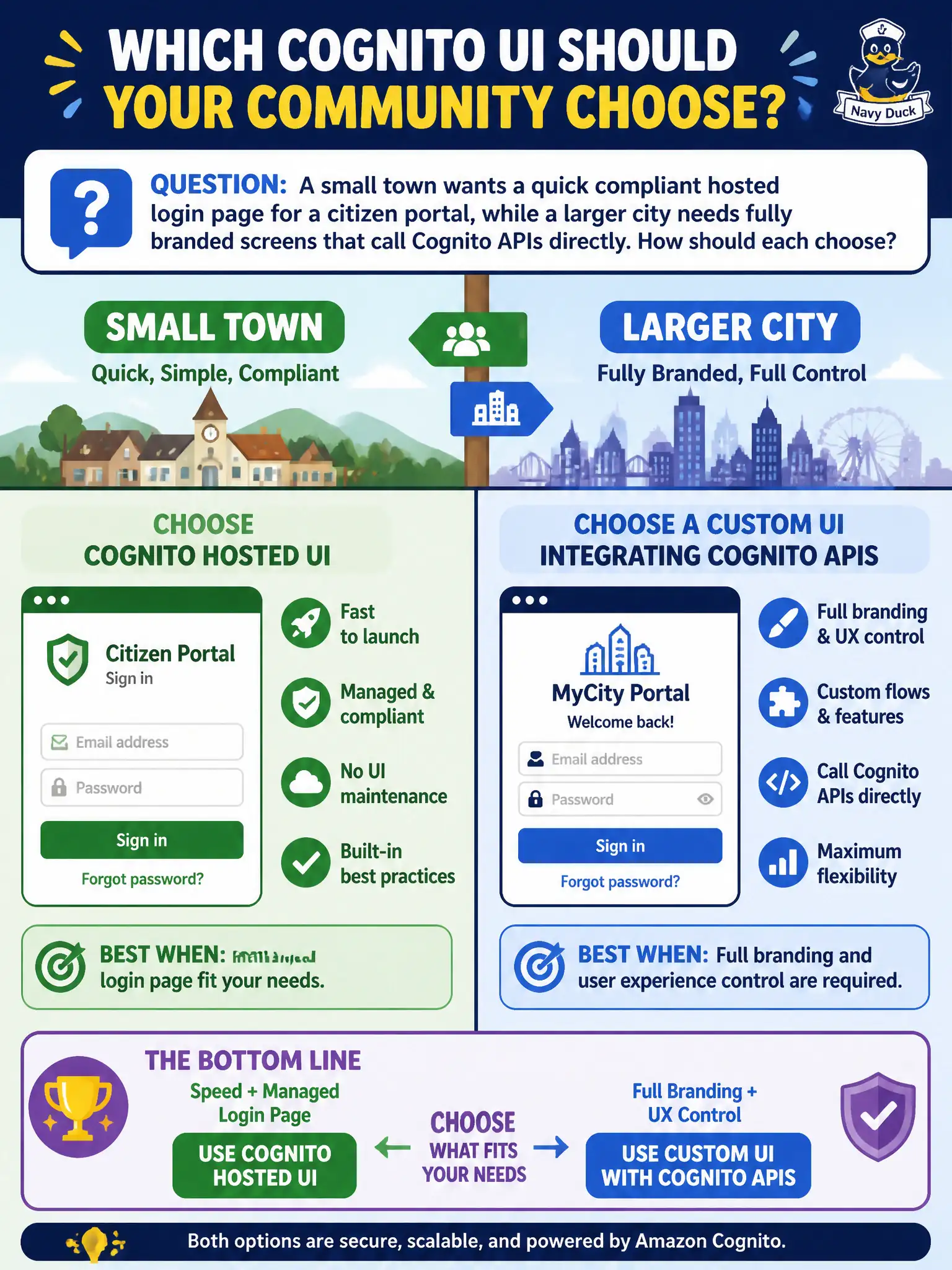
A small town wants a quick compliant hosted login page for a citizen portal, while a larger city needs fully branded screens that call Cognito APIs directly. How should each choose?
Select an answer to reveal the explanation.
Short Explanation
Hosted UI is the town-hall prefab counter—fast and compliant enough for many portals. Custom UI is the full remodel when branding must own every pixel and still talk to Cognito APIs. Pick based on UX needs, not habit.
Full Explanation
Amazon Cognito supports both a managed hosted UI and fully custom user interfaces that call Cognito APIs. A small town that wants a quick, compliant hosted login page should use Cognito hosted UI to reduce build time. A larger city that needs fully branded screens should implement a custom UI integrating Cognito’s authentication APIs while Cognito remains the identity store and federation hub. Choose based on UX control versus speed-to-launch rather than inventing a third identity system.
Claiming both must always build a custom UI because Cognito never offers a hosted login page is false. Disabling Cognito in favor of HTTP Basic Auth in front of DynamoDB is not an appropriate citizen-portal identity design. Embedding IAM user passwords in each city’s mobile WebView confuses AWS IAM with end-user authentication.
Exam caveat: hosted UI is faster but less brand-flexible; custom UI costs more engineering but keeps full control—both still require server-side token validation on APIs. Operational check: stand up hosted UI for a pilot town app and complete login; for the branded city app, complete OAuth or SRP via custom pages and confirm identical JWT validation at API Gateway for protected routes.