
A parks department needs a public HTTPS endpoint that maps HTTP routes to Lambda handlers and can add JWT authorizers later. Which integration should the developer choose?
Select an answer to reveal the explanation.
Short Explanation
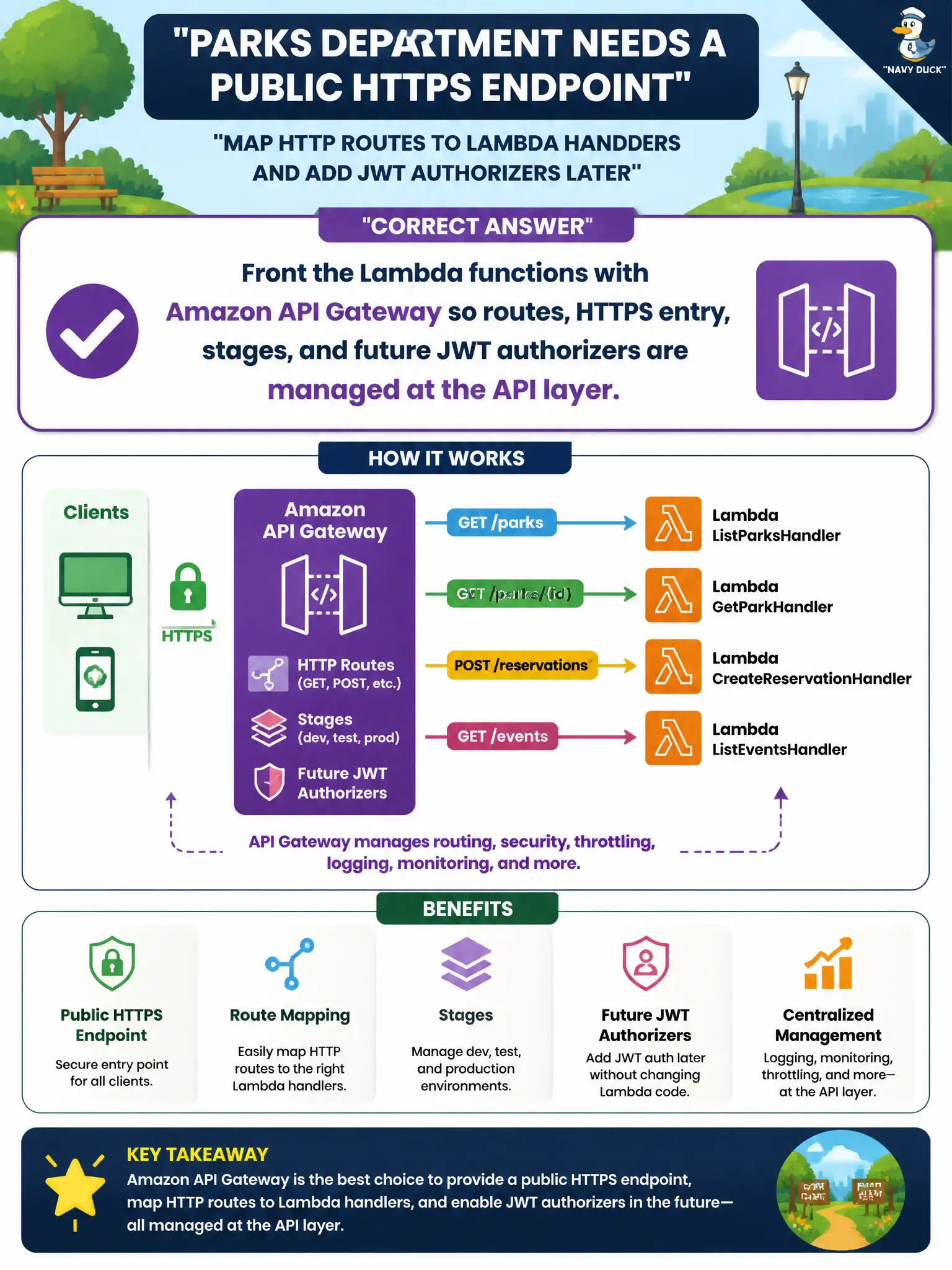
Citizens need a proper HTTPS front door, not a DIY Lambda ARN in DNS. API Gateway maps routes to handlers, gives you stages, and is where JWT authorizers plug in later. Function URLs or SSH-to-EC2 are the wrong shape for that roadmap.
Full Explanation
A parks department that needs a public HTTPS endpoint mapping HTTP routes to Lambda handlers—and that plans JWT authorizers later—should front the functions with Amazon API Gateway. Gateway provides HTTPS termination, route and stage management, throttling hooks, and a clear attachment point for JWT/Cognito/custom authorizers as citizen identity matures. Lambdas stay focused on reservation and program logic while the API layer owns the public contract and promotion between stages.
Exposing each Lambda only through a raw Function URL without planned API routes, stages, or authorizer hooks underserves the routing and future-auth requirements. Hosting handlers on long-running EC2 behind SSH port forwarding is not a public citizen HTTPS design. Publishing Lambda ARNs on a status page and requiring citizens to invoke with the AWS SDK and IAM user keys is unusable and unsafe for the public internet.
Exam caveat: choose HTTP API or REST API based on authorizer and feature needs; both integrate with Lambda. Function URLs remain useful for simple private tooling—not this multi-route public API with planned JWT. Align Gateway timeouts with Lambda timeouts.
Operational check: create API Gateway routes to the handlers; deploy a stage with HTTPS; prove a health route; stub a JWT authorizer in non-prod; and document how parks will promote auth settings to production.