
A business-license renewal must run identity check, fee calculation, payment, then license PDF generation in a fixed order, and the help desk needs a visible workflow state to inspect. Which pattern fits best?
Select an answer to reveal the explanation.
Short Explanation
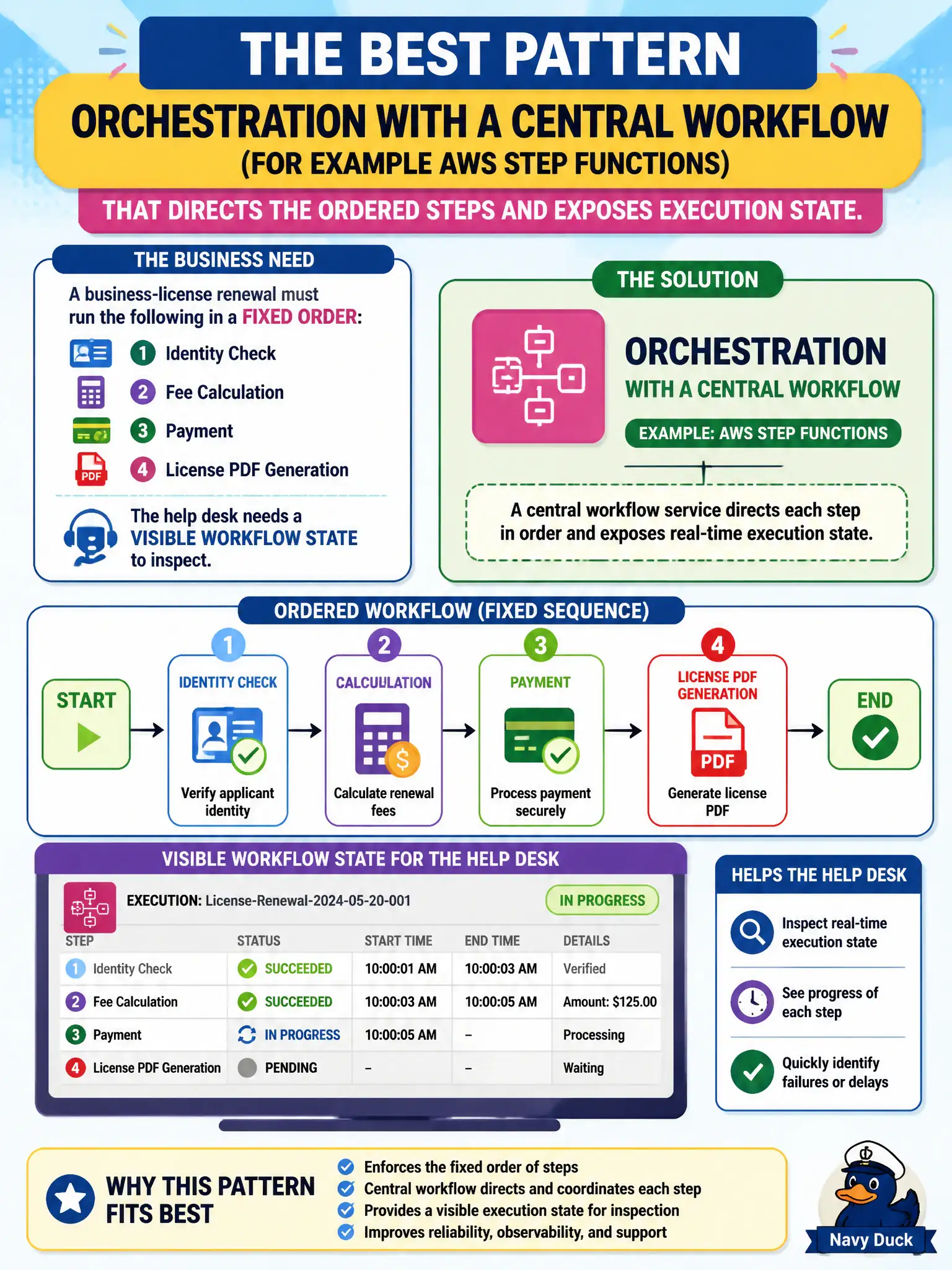
When steps must go in a strict line and someone at the help desk needs to see which light is green, you want a conductor — not a free-for-all. Step Functions-style orchestration keeps order and shows workflow state. That is the pattern for this renewal.
Full Explanation
A business-license renewal that must run identity check, fee calculation, payment, then PDF generation in a fixed order—with help-desk visibility into workflow state—fits orchestration. A central workflow such as AWS Step Functions directs the ordered steps, persists execution state, and exposes which state is running, succeeded, or failed. That visibility is what clerks need when a citizen calls about a stuck renewal: they can see “waiting on payment” versus “PDF generation failed” without grepping three disconnected logs. Ordered compensation and explicit fail states also protect fee and licensing integrity.
Pure choreography with no central state fails the help-desk requirement: each service may finish, but there is no single execution history showing where the renewal stalled. Storing the entire renewal only in one Lambda container’s memory loses state on freeze/recycle and cannot survive multi-minute human or payment waits. A single synchronous browser form post that never persists intermediate server state forces the citizen session to hold the whole pipeline and offers no durable recovery if the browser drops mid-payment.
Exam caveat: orchestration does not forbid emitting events; many Step Functions tasks still publish domain events. The distinguishing feature is a central definition of order and state. Do not pick choreography merely because “events are modern” when the stem demands ordered steps and inspectability.
Operational check: model renewal as an explicit state machine with named states for identity, fees, payment, and PDF; grant help-desk read access to execution history; set timeouts and retries per state; and ensure terminal fail states notify staff with the case ID rather than silently stopping.