
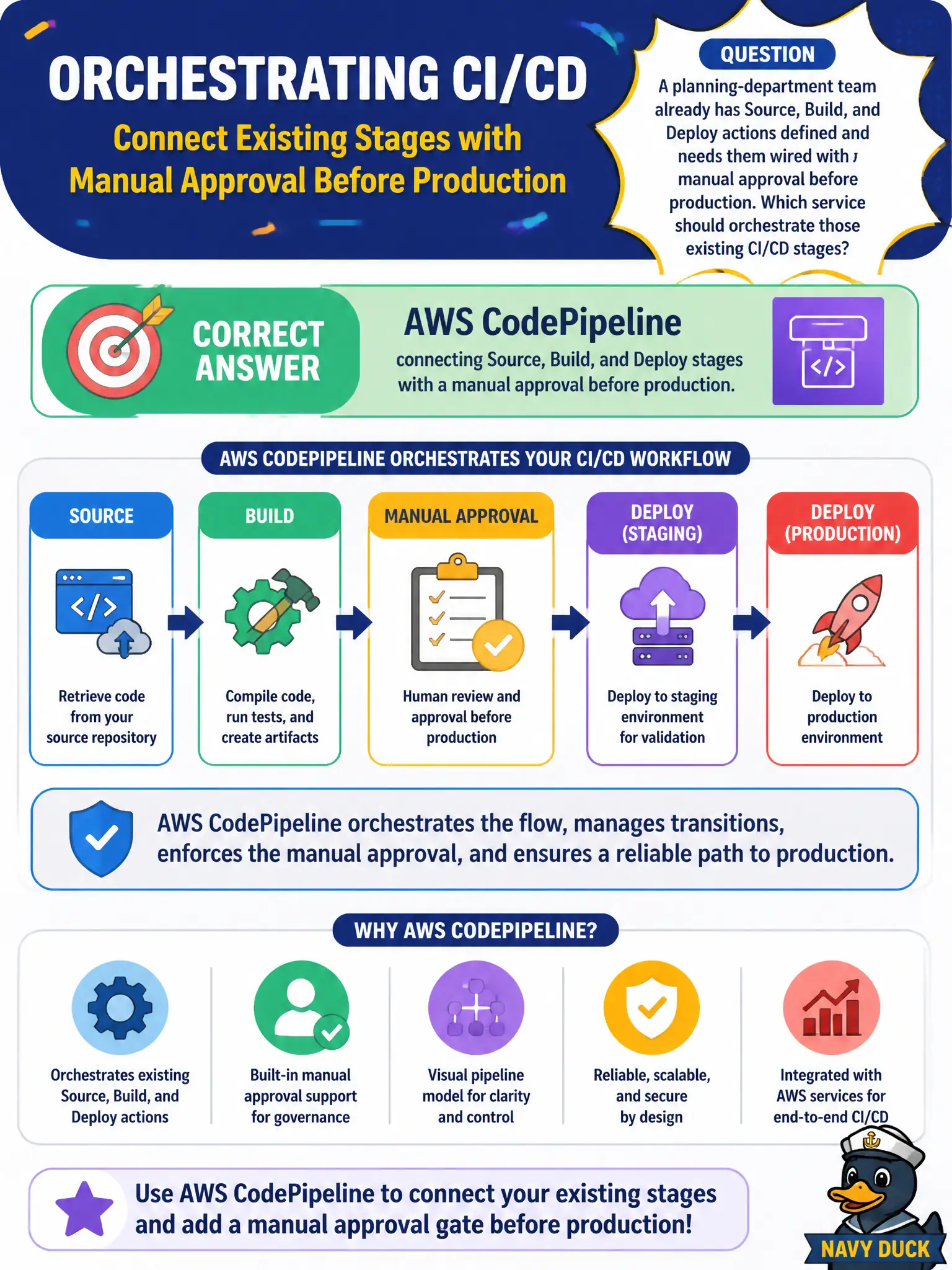
A planning-department team already has Source, Build, and Deploy actions defined and needs them wired with a manual approval before production. Which service should orchestrate those existing CI/CD stages?
Select an answer to reveal the explanation.
Short Explanation
CodePipeline is the stage manager: Source, Build, Deploy, then a human "yes" before the production curtain. You consume and configure that orchestration—you are not redesigning an org-wide DevOps platform on this exam.
Full Explanation
A planning-department team that already defined Source, Build, and Deploy actions needs an orchestrator that sequences them and inserts a manual approval before production. AWS CodePipeline connects those actions into stages, models transitions, and supports manual approval actions so humans authorize citizen-facing production deploys. The team consumes existing CI/CD building blocks rather than inventing a bespoke scheduler or clicking each tool in isolation.
Amazon Elastic Transcoder arranges media conversion jobs, not application release stages. AWS Data Pipeline (classic) targets data workflows such as EMR log movement, not general app deploy orchestration for Associate-level CI/CD questions. Amazon QuickSight dashboards visualize analytics; they should not trigger production deploys without a real pipeline and approval gate.
Exam caveat: orchestration (CodePipeline) is distinct from build compute and deploy agents; a stem that lists stages and a human gate points squarely at CodePipeline.
Operational check: wire Source → Build → Deploy(test) → Manual approval → Deploy(prod), verify a commit progresses to approval and stops, and confirm only authorized reviewers can approve the planning-department production stage.