
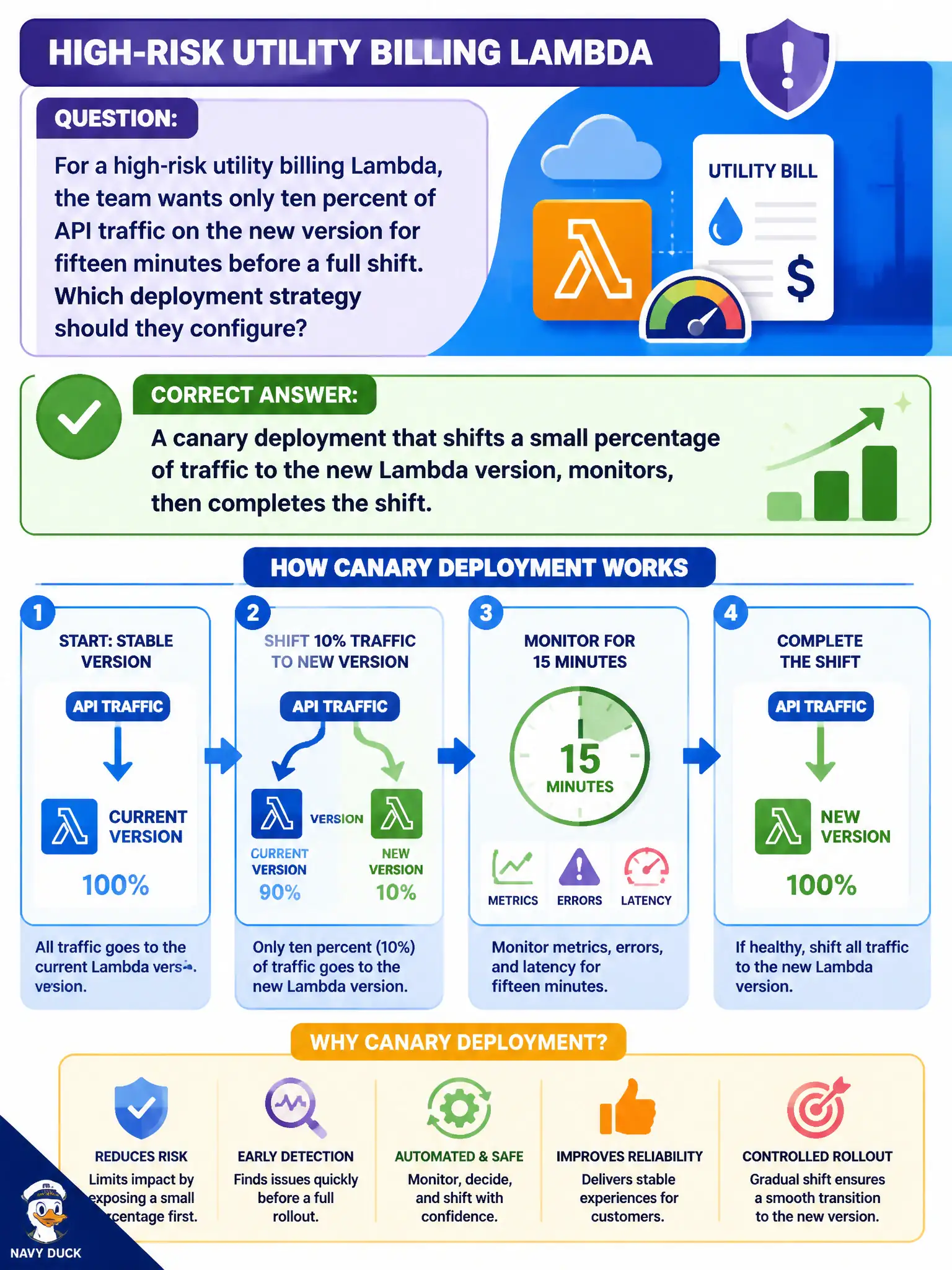
For a high-risk utility billing Lambda, the team wants only ten percent of API traffic on the new version for fifteen minutes before a full shift. Which deployment strategy should they configure?
Select an answer to reveal the explanation.
Short Explanation
Canary is a taste-test: ten percent of citizens hit the new Lambda for a bit while you watch the meters. If the taste is bad, you never serve the whole city. All-at-once is the opposite of that sip.
Full Explanation
High-risk utility billing Lambdas benefit from canary deployments: shift a small percentage of API traffic (here ten percent) to the new version, monitor errors and latency for a soak window (fifteen minutes), then complete the shift only if signals stay healthy. Alias traffic weighting (or CodeDeploy canary configurations) implements that partial exposure so most citizens remain on the proven revision while operators watch billing correctness.
An all-at-once alias update with no partial traffic period maximizes blast radius for billing defects. A rolling EC2 instance refresh ignores Lambda versioning entirely and answers the wrong compute model. A blue/green cutover that moves one hundred percent immediately with no canary interval may be valid elsewhere, but it does not satisfy the explicit ten-percent-for-fifteen-minutes requirement.
Exam caveat: canary emphasizes gradual percentage exposure and metrics gates; blue/green emphasizes dual environments and fast full cutover/rollback—do not treat the labels as interchangeable on the exam.
Operational check: configure the canary weights and bake time, watch CloudWatch alarms on the new version during the fifteen-minute window, automatically or manually abort back to 100% prior version on error-budget burn, and only then promote full traffic for utility billing.