
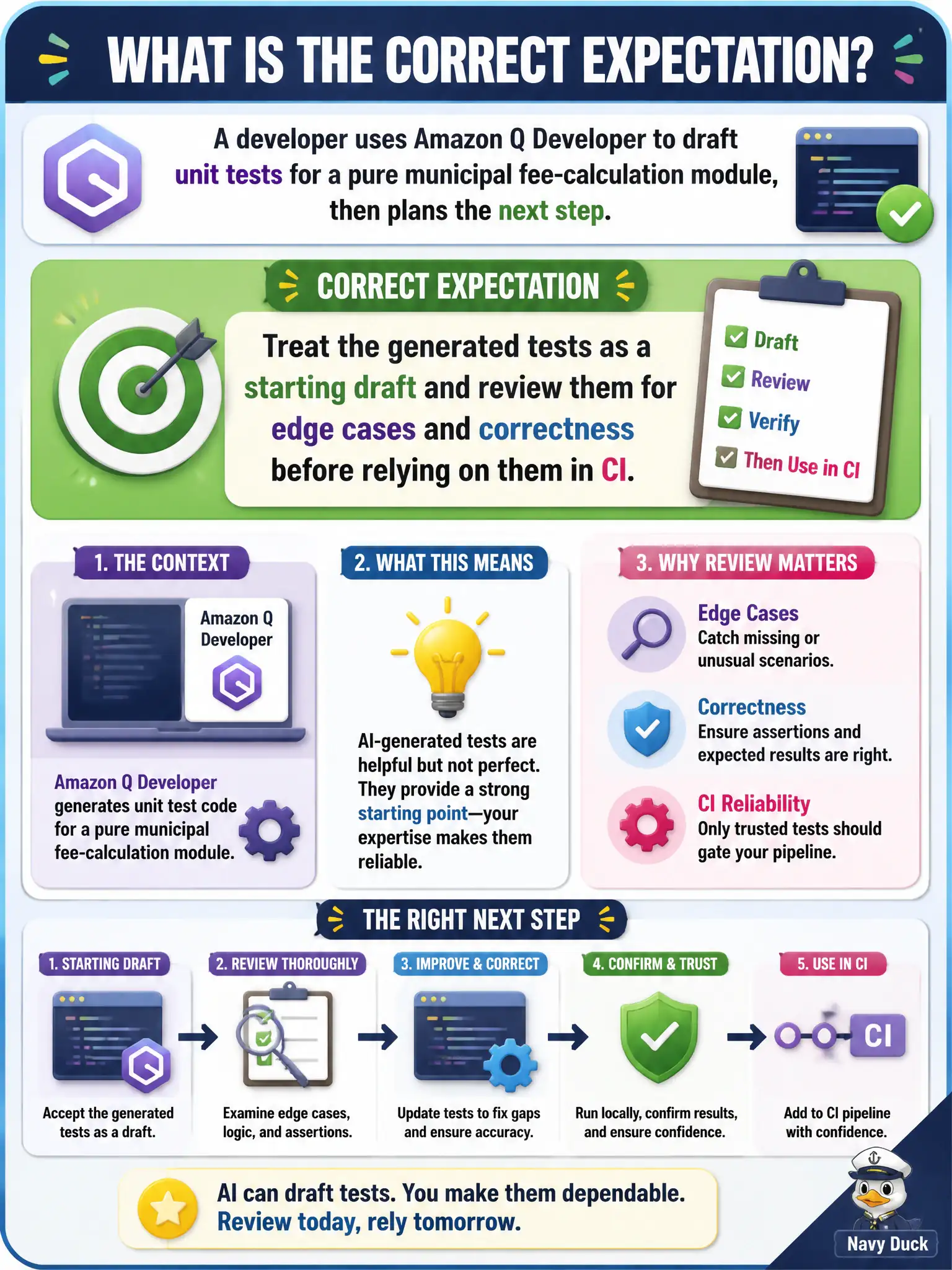
A developer uses Amazon Q Developer to draft unit tests for a pure municipal fee-calculation module, then plans the next step. What is the correct expectation?
Select an answer to reveal the explanation.
Short Explanation
Q Developer is a helpful junior who types fast—still read the homework. Use the draft tests, then hunt edge cases yourself before CI trusts them. Blind commits are how wrong fees ship.
Full Explanation
When a developer uses Amazon Q Developer to draft unit tests for a pure municipal fee-calculation module, the correct expectation is to treat the generated tests as a starting draft and review them for edge cases and correctness before relying on them in CI. Generative assistance accelerates boilerplate but does not absolve municipal engineers from verifying fee logic, boundary conditions, and assertion quality. CI should trust reviewed tests, not unread machine output.
Committing the generated tests unread because Amazon Q Developer output is always complete coverage fails because generated suites often miss civic edge cases (proration, waivers, rounding). Avoiding unit tests entirely once any sample assertions were suggested fails conceptually by abandoning testing after a partial draft. Replacing the fee module with Amazon Q Developer chat responses at runtime instead of tested code fails as a non-deterministic, non-deployable design.
Exam caveat: generative tests may assert implementation details rather than behavior—prefer reviewing for stable, requirement-based assertions on fee outputs. Operational check: run the draft tests, add missing cases from the fee ordinance matrix, peer-review the suite, then enable it as a required CI gate.