
During council week, a PDF generation service on Elastic Beanstalk or ECS falls behind because tasks were sized with too little CPU. What should developers declare for the artifact?
Select an answer to reveal the explanation.
Short Explanation
If the oven is too small, the pizza backlog is not a messaging bug. Size Beanstalk instances or ECS task CPU/memory for council-week PDF spikes, then tune queues. Stretching visibility timeouts alone will not mint missing cores.
Full Explanation
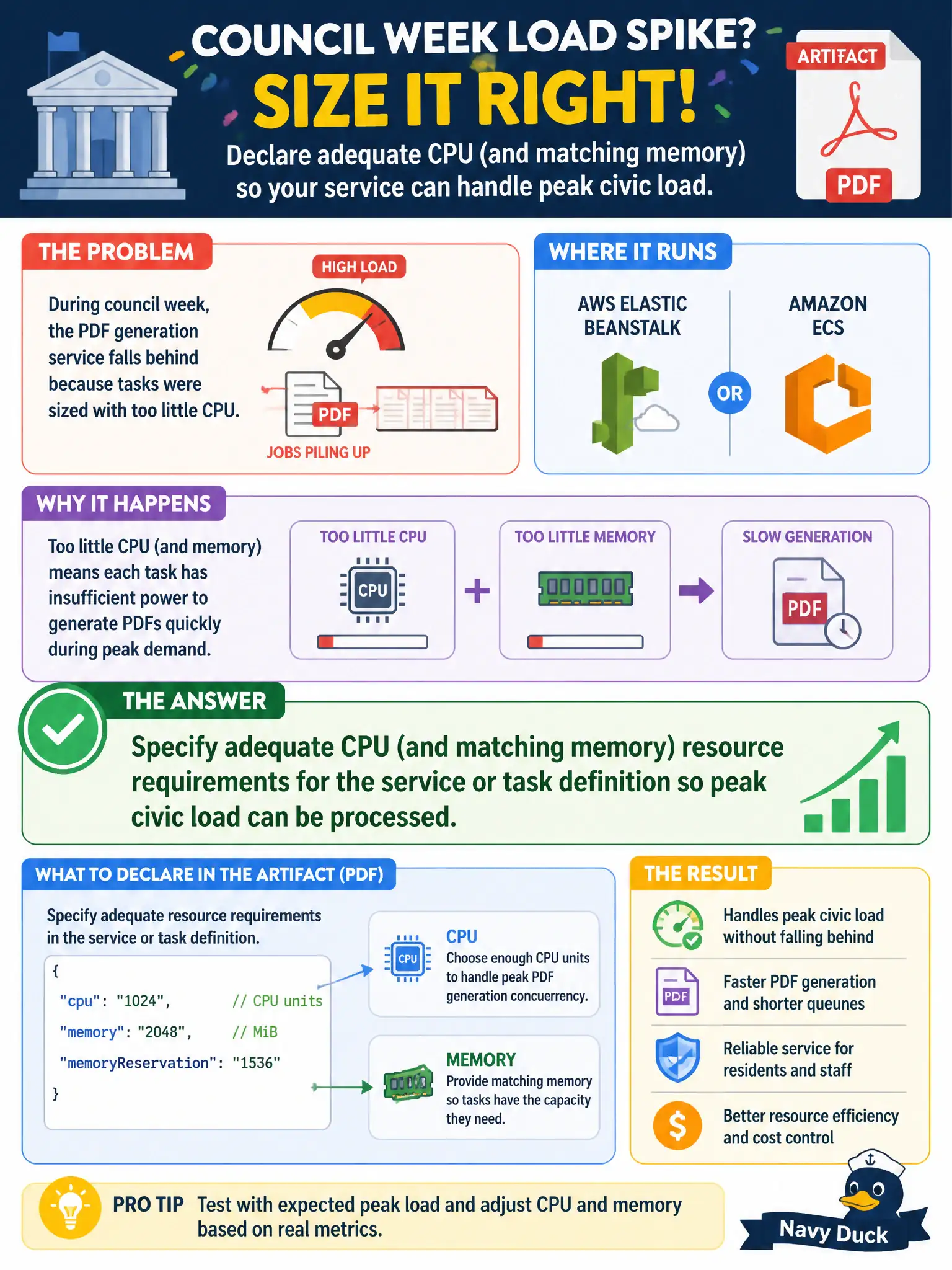
Preparing application artifacts includes declaring adequate CPU and matching memory for an Elastic Beanstalk environment or ECS task definition so a PDF generation service can process peak civic load during council week. Under-provisioned compute causes queue backlog even when messaging is healthy. Developers should right-size resource requirements for expected municipal peaks and monitor utilization rather than treating CPU as optional metadata.
Leaving CPU unset and relying solely on increasing the SQS visibility timeout fails because visibility timeout addresses message retry timing, not insufficient compute to render PDFs. Reducing worker concurrency to one globally fails conceptually—it may hide contention metrics while lowering throughput further. Replacing the PDF service with a synchronous API Gateway mock integration fails because mocks do not generate required documents under load.
Exam caveat: CPU and memory must be raised together when the platform couples them; unbalanced settings can still throttle. Operational check: review task/environment sizing against council-week metrics, load-test PDF generation in pre-prod, and set alarms on CPU and queue depth before the next peak.