
Two departments both request 'immutability' for their backup copies: one answers to an external regulator, the other just wants junior admins unable to delete last month's restore points. How should the platform's retention lock options be applied?
Select an answer to reveal the explanation.
Short Explanation
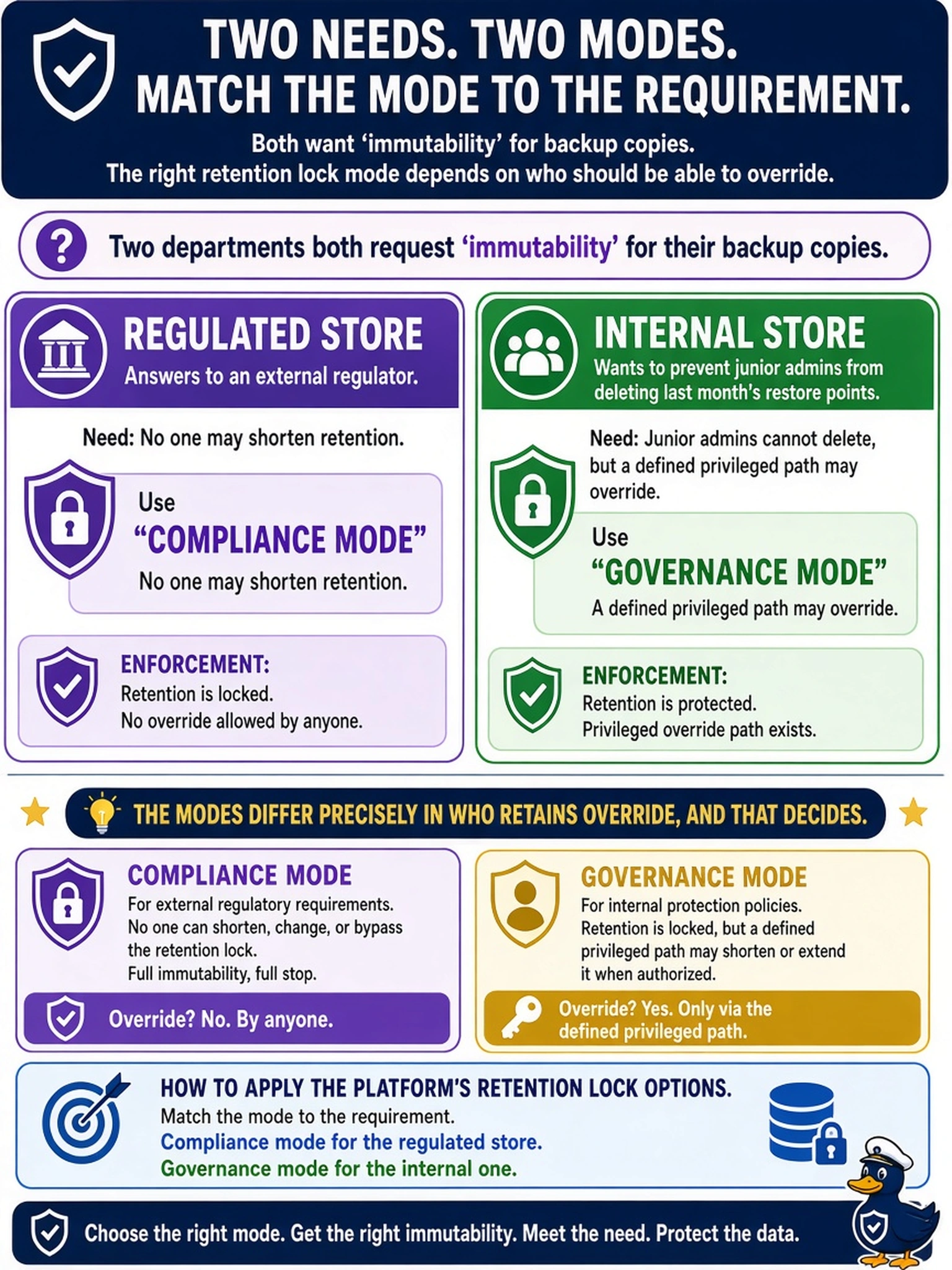
Same word, different jobs. The regulator needs compliance mode - nobody shortens, period. The junior-admin problem is exactly what governance mode is for: the lock is real, but the defined owner can override it. Pick the mode by asking 'who, if anyone, can shorten?' - that answer decides for you.
Full Explanation
Retention lock's two modes exist because immutability requirements genuinely differ in override authority. Governance mode blocks casual deletion while preserving a privileged, audited path for legitimate operational cleanup - the right fit against junior mistakes. Compliance mode removes that path for the retention period, which is the only defensible reading of a regulatory non-erasability requirement. Modes are configured where retention itself is configured, so different stores on the same system can carry different regimes. Blanket compliance mode sounds safe but costs real flexibility: when the internal department needs legitimate early cleanup, no one can act - the 'no downside' claim collapses the first time a locked dataset must be fixed. Blanket governance mode under-serves the regulator: the escalation path is exactly what their wording rules out, so an identical-looking lock answers a different question. Treating the mode as one global switch is a factual error - retention lock is configured per storage area, which is what enables mixed-mode estates. Exam caveat: mode and period attach to data at lock time, so both choices precede the data; converting a live store's regime afterward is a project, not a checkbox. Operational check: list each locked store with its mode and intended owner, then on test objects confirm governance honors the authorized override path while compliance refuses the same operation.