
A customer's key-management standard requires that an enterprise KMIP server hold all encryption keys while the appliance keeps only encrypted data. Before the appliance can actually run under that standard, what must exist?
Select an answer to reveal the explanation.
Short Explanation
Handing the keys to an enterprise vault is excellent policy - and it only works if your appliance can actually reach and authenticate to that vault. Set up the servers, exchange the certificates, name the keys, and test all of it before your data needs them. Key management by surprise is key management by outage.
Full Explanation
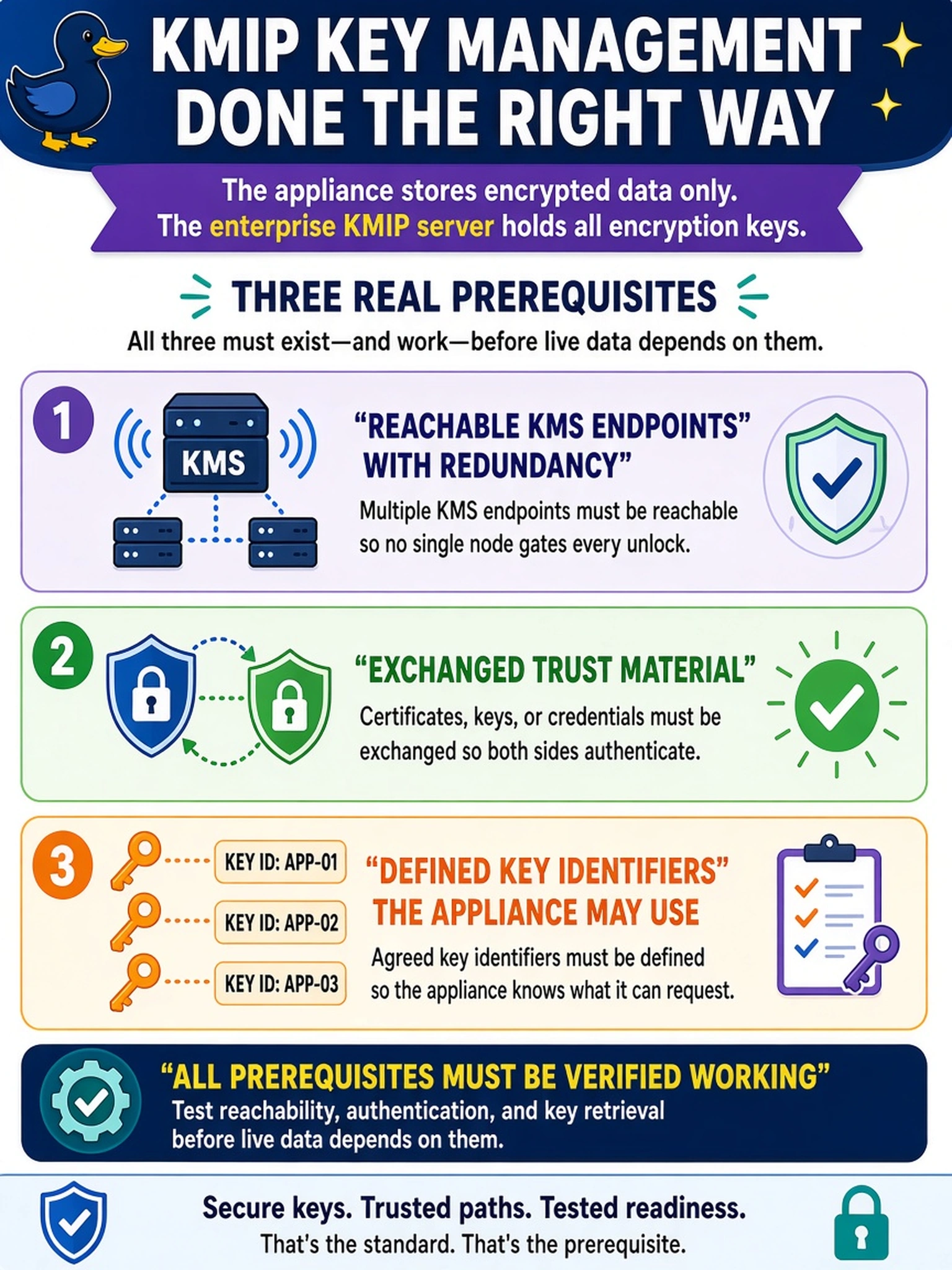
External key management through KMIP is an integration with setup obligations on both sides. The appliance is configured with the KMS address or cluster, client and server exchange trust material so each authenticates the other, and a key identifier is designated for its wrapped keys; verification tooling confirms retrieval before production depends on it. Redundant KMS endpoints are part of correct configuration because every unlock path through a single server makes that server a production dependency. Automatic issuance gets the mechanism backwards: a KMS authorizes enrolled clients against explicit key objects, and an unauthenticated server will not mint keys for strangers - reachability is not integration. Fallback key copies on appliance boot media violate the standard's premise: if keys ride with the encrypted data, a thief takes both halves, and the system reverts to internal key management. Alternating modes day by day yields two inconsistent unlock dependencies, an audit trail no reviewer can follow, and data whose accessibility depends on which mode wrote it. Exam caveat: confirm KMIP version compatibility and KMS high availability before cutover - external keys change the unlock procedure, not just the backend. Operational check: in a controlled window, unlock the appliance with KMIP as the serving key source and verify key-manager status shows the expected server and key identifier.