
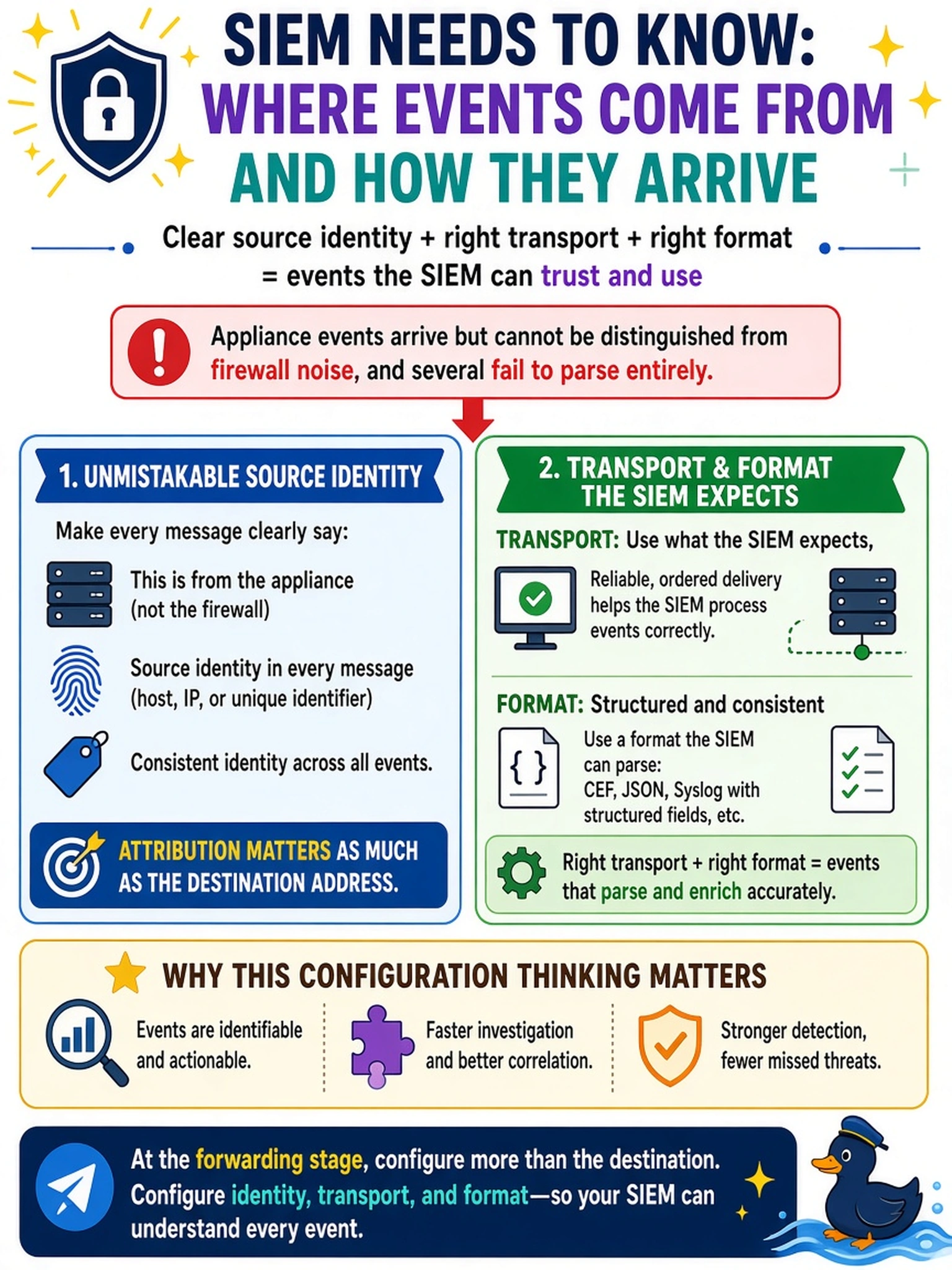
The security operations center gladly ingested the appliance into its SIEM, then reported a problem: appliance events arrive but cannot be distinguished from firewall noise, and several fail to parse entirely. What configuration thinking was skipped at the forwarding stage?
Select an answer to reveal the explanation.
Short Explanation
The SIEM isn't ignoring your appliance - it can't tell who is talking. Configure the forwarded events with a clear source identity, the transport and format your collector expects, and attribution falls out of it. Destination address is where the contract starts, not where it ends.
Full Explanation
A SIEM is an attribution machine: an event it cannot place - by source, schema or format - is noise, and a stream of noise is indistinguishable from an unapproved attack surface. Configuring forwarding therefore means three decisions, not one destination: messages must carry an unmistakable source identity consistent with the asset inventory; transport and format must match what the collector expects - protocol, facility, timestamp conventions; and the forwarded event classes should be the ones the SOC will actually use. With those in place, events arrive parsed, routed and attributable, and 'invisible among firewall logs' becomes a filter query. 'Destination is the whole job' abdicates the rest of the contract: correct IP and port still yield unparseable, unattributable messages - exactly the failure the SOC reported. Forwarding literally every event class is the opposite error: volume without schema discipline adds to the very noise the SOC complained about, and a wider firehose never helps the parser. Pull-based copies to a shared folder sacrifice timeliness, ordering and integrity - batch files are a forensic archive, not a monitoring feed, and each copy raises provenance questions. Exam caveat: time synchronization between appliance and collector decides whether events correlate at all - verify NTP on both ends first. Operational check: from the SOC side, filter for a fresh appliance login event and confirm it is attributed to this host and parsed cleanly end to end.