
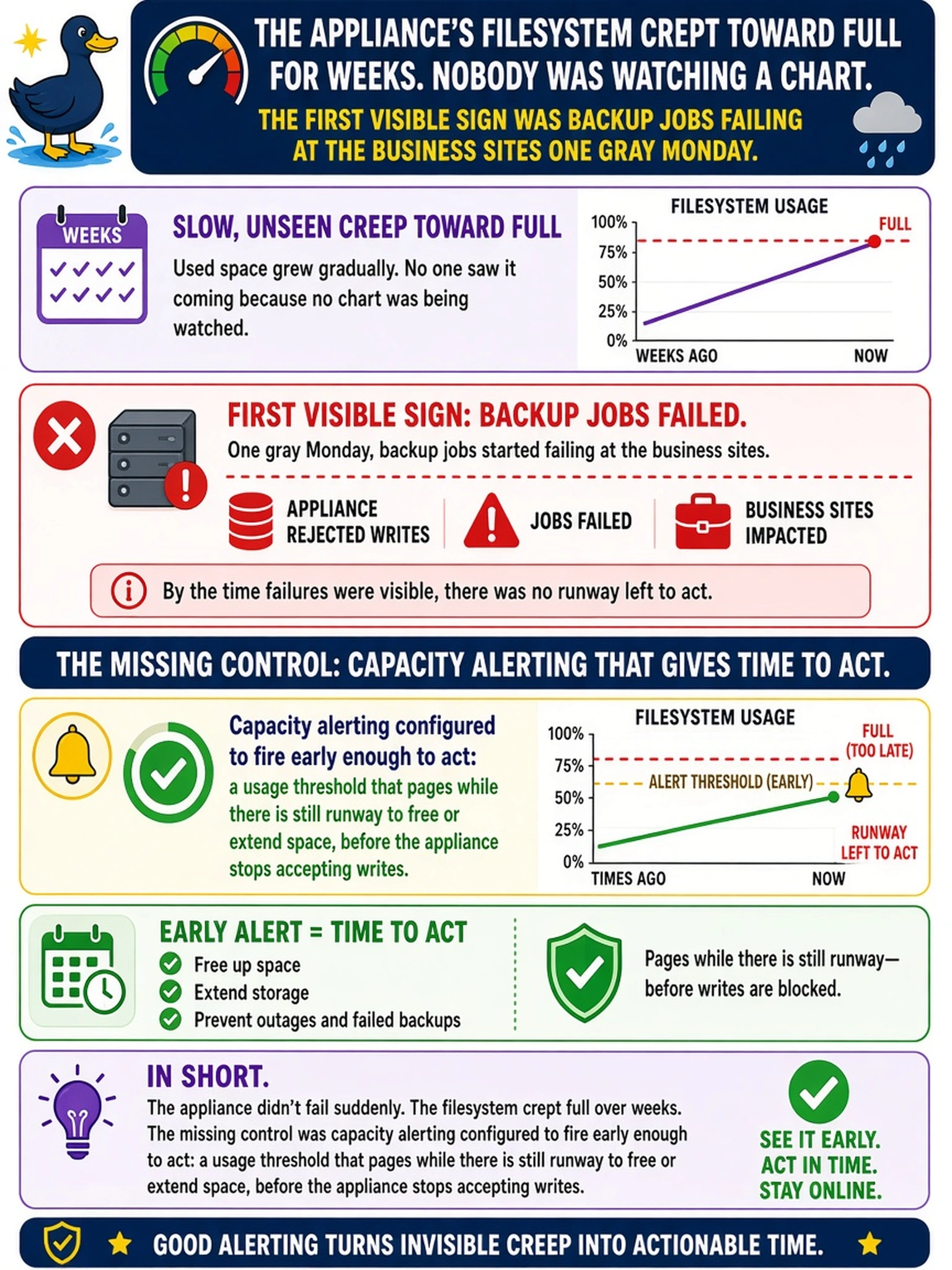
The appliance's filesystem crept toward full for weeks. Nobody was watching a chart. The first visible sign was backup jobs failing at the business sites one gray Monday. What control was actually missing?
Select an answer to reveal the explanation.
Short Explanation
A full filesystem doesn't creep up on you - your alerting was asleep. Configure a usage threshold that pages while there's still runway to free retention or extend capacity, and make sure the page has a written response behind it. Retries and weekly reports both convert your slow certainty into someone else's Monday crisis.
Full Explanation
The full-filesystem condition is a certainty that behaves like a surprise: capacity climbs quietly, nobody watches the curve, and the appliance's own protection - refusing new writes as it fills - converts a datacenter problem into business-visible backup failures. The missing control was configured capacity alerting: a threshold that fires while runway remains for the actual remedies - expiring retention where policy allows, extending capacity, or shedding ingest deliberately. This is a tooling threshold decision, not a habit. Retry logic on backup clients treats a deterministic condition as transient: resubmits into a full filesystem fail again, and the retry layer hides the signal from the people who could clear it. A weekly manual report re-introduces the human attention gap the incident demonstrated - discipline is not a control, and the weeks of creep fell between readings. Trusting deduplication to keep growth gradual is a forecasting fallacy: dedupe and compression depend on the data mix, encrypted or already-compressed sources dedupe poorly, and one new application can break an annual forecast in a quarter - which is why live monitoring exists. Exam caveat: set thresholds with retention-lock data in mind, since locked content cannot be deleted to manufacture space. Operational check: with usage metrics in monitoring, configure warning and critical thresholds and verify a test alert reaches the on-call path well before the filesystem's write protection engages.