
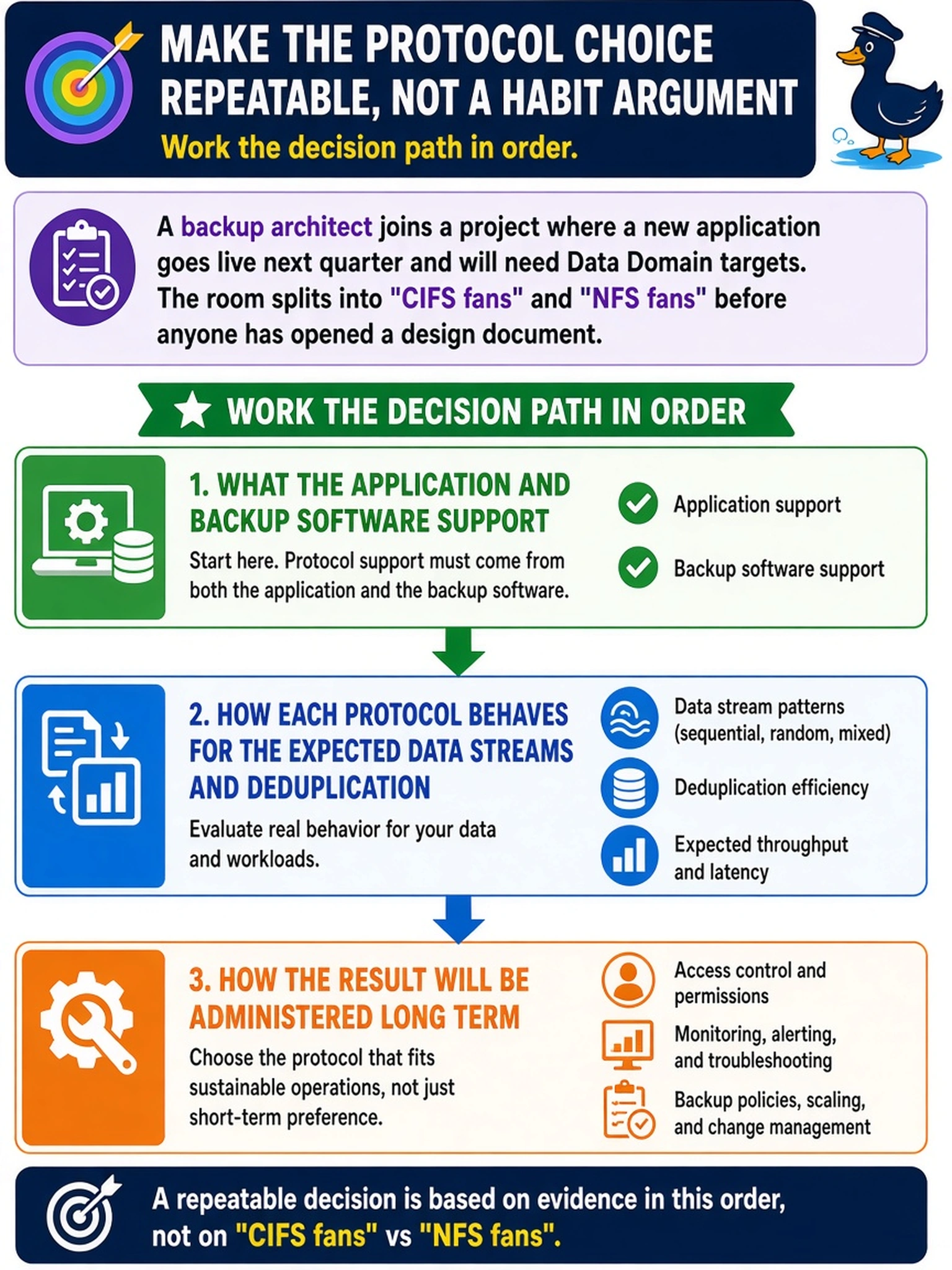
A backup architect joins a project where a new application goes live next quarter and will need Data Domain targets. The room splits into CIFS fans and NFS fans before anyone has opened a design document. What makes the protocol choice repeatable instead of a habit argument?
Select an answer to reveal the explanation.
Short Explanation
Treat a protocol debate like a triage list, not a popularity contest. You start with what the application and backup software actually support, then weigh how each path handles your data stream, then think about who has to administer it for the next five years. Skip the first step and you're just voting.
Full Explanation
A repeatable protocol decision follows a fixed order of inputs. First comes the support matrix: what the application and the backup software are documented to consume decides which access types are even on the table. Second comes efficiency for the expected data stream - a supported optimized client path can change the throughput and deduplication picture compared to a plain file share, so the comparison has to happen after support is settled, not instead of it. Third comes the management model: who administers shares, exports, credentials, and patching for the life of the system. Deciding by team habit repeats whichever input happened to dominate the last argument; two projects using the same protocol proves nothing about support for a third application. Mount speed is a one-time convenience measured in seconds, set against lifetime efficiency and supportability, and it never outranks the support matrix. Building to the fewest configuration screens inverts design: application requirements are fixed inputs, and adapting an application around an arbitrary target converts a deployment decision into a permanent workaround. Exam caveat: when the application has a documented optimized integration, that option belongs at the top of the comparison, not hidden inside step two. Operational check: record the chosen protocol in the design document together with the support statement and efficiency rationale that produced it.