
An engineer enables a file protocol in the appliance's settings, runs the first test write from a client within ten seconds, and when the write fails immediately opens a network ticket accusing the intermediate firewall. Before blaming anything in the middle of the path, what should have been confirmed first?
Select an answer to reveal the explanation.
Short Explanation
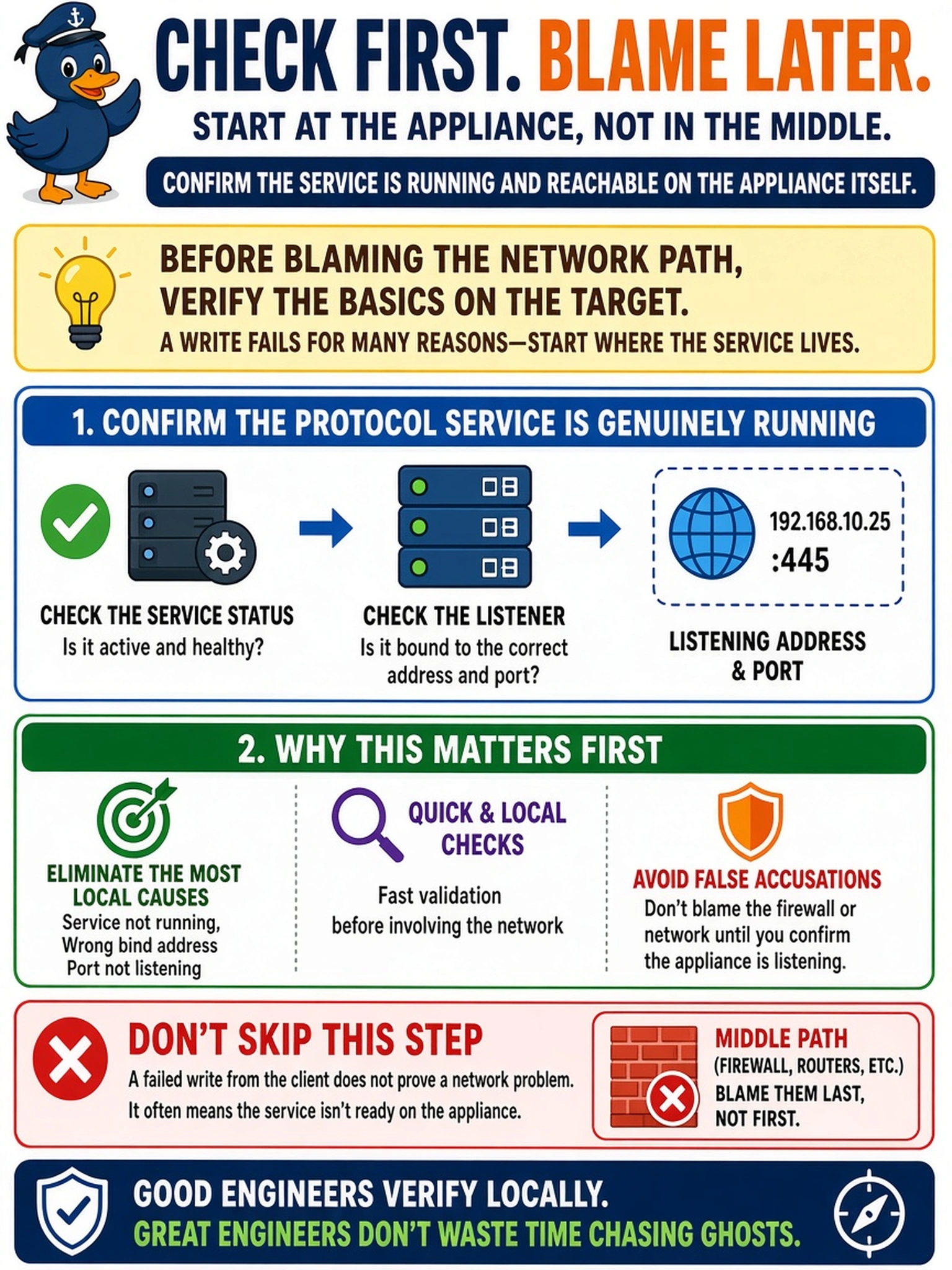
Ten seconds after enabling a service, your first suspect isn't the middle of the network, it's the service itself: did it actually start, and is it listening on the interface you think it is? Check the box's own status first, then prove both ends of the path before you open that firewall ticket with evidence instead of vibes.
Full Explanation
Enabling and running are not the same state: a protocol service can fail to start or bind where expected because a prerequisite is missing, an interface assignment is wrong, or a dependency such as authentication configuration is unsatisfied, and the appliance's own status commands answer that question in seconds. Only after the service demonstrably listens on the intended address does it make sense to test the endpoint from the client, then the path between, an order that yields evidence rather than accusations. Endpoint security tools can indeed obstruct first writes on some clients, but they are a later check, not the first, because the shortest causal chain runs through the system that was just reconfigured moments earlier. Name problems announce themselves as resolution errors and are tested instantly at the client; they do not masquerade as generic write failures in a way that would outrank confirming your own service state. The every-service-licensed-and-silently-disabled claim overstates reality, since base file services do not switch off through the mechanism described, though checking entitlements for optional features is fair housekeeping. Exam caveat: know which interfaces carry data versus management traffic on your design, because listeners bound to the wrong interface mimic firewall loss perfectly. Operational check: from the appliance verify service status and listener port, then from the client test the port before any path escalation ticket.