
A backup application is configured with the appliance's fully qualified hostname. The name resolves to the correct address, yet the deployment review still flags the name-service configuration for this system. Which resolution problem would the review be concerned about?
Select an answer to reveal the explanation.
Short Explanation
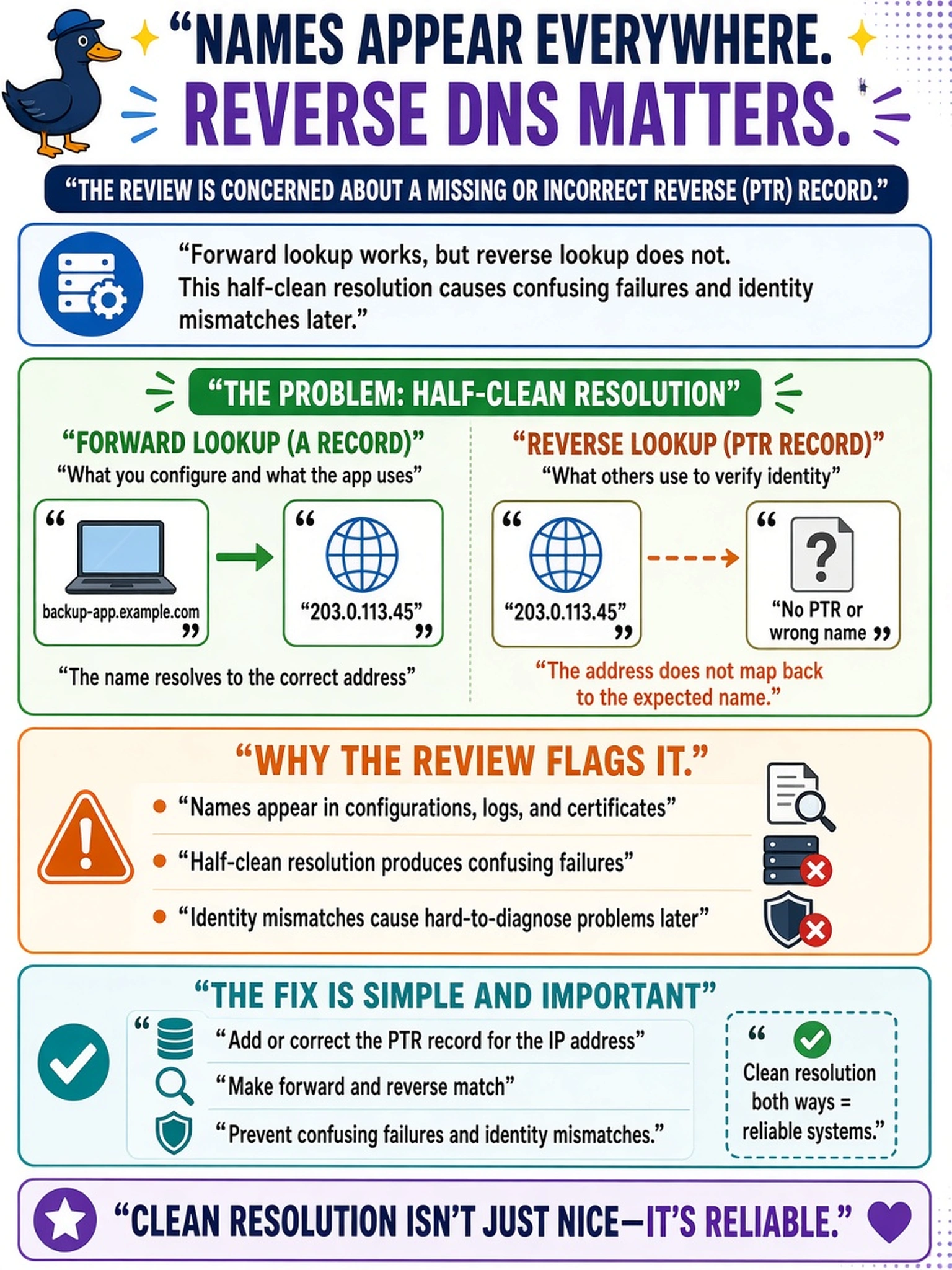
DNS is a two-way street, and plenty of installs only pave one direction. Your forward record says 'the name lives at this address' — the reverse record has to agree. Half-clean resolution behaves quietly today and argues with you during an incident, so check both directions before the apps depend on the name.
Full Explanation
A managed appliance lives in a name-based world: the application configuration carries a fully qualified hostname, that name appears in logs and alerts, and the TLS certificate binds to it. Clean resolution therefore means the full pair — a forward record answering name to address and a reverse record answering address back to the same name. A missing or mismatched PTR record yields half-clean resolution: today everything works, while reverse-looking tools, log correlation, and application checks that validate identity in both directions misbehave during incidents in ways that burn hours. The alias-rejection claim fails by mechanism — canonical-name records resolve through ordinary lookups and many estates front services behind aliases deliberately. A duplicated search domain does not create round-robin behavior; search suffixes are consulted in listed order, with no load-balancing property. The DNSSEC claim fails architecturally — DNSSEC operates between servers and zones in queries upstream, and nothing about it must be bypassed for a storage device's management name. Exam caveat: a certificate is only as clean as the name clients actually type; perfect PTR records cannot rescue a certificate issued for the wrong hostname. Operational check: resolve the appliance name to its address, resolve the address back to a name, confirm both answers agree, and only then hand the name to application configuration.