
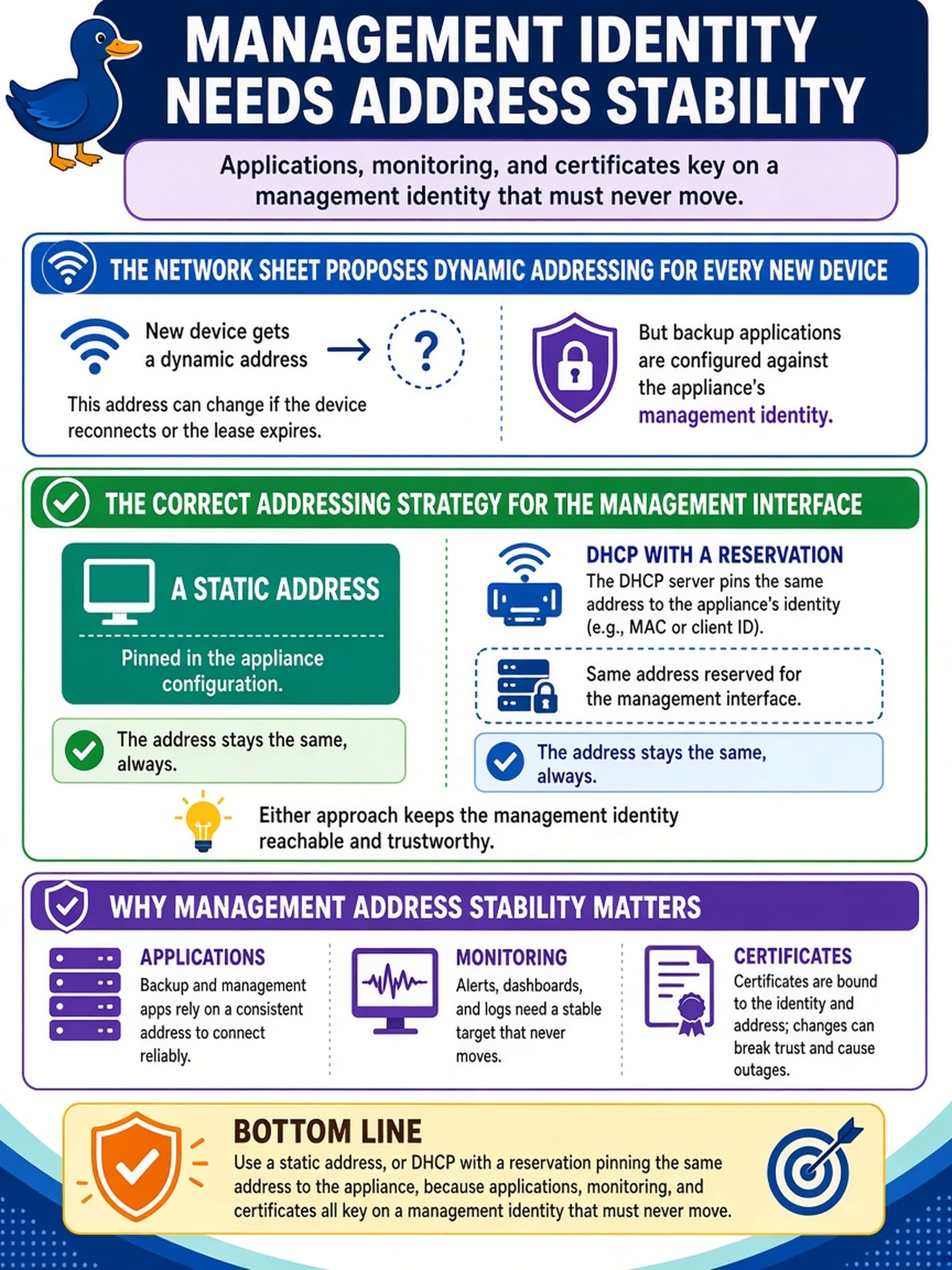
The customer's network sheet proposes dynamic addressing for every new device, but the backup applications will be configured against the appliance's management identity. What is the correct addressing strategy for the management interface?
Select an answer to reveal the explanation.
Short Explanation
Think of the management address as the appliance's mailbox — the one spot your apps, monitoring, and certificates all knock on. A mailbox that moves every night isn't a mailbox, it's a scavenger hunt. Pin it with a static address or a DHCP reservation so the identity your whole backup setup leans on never wanders off.
Full Explanation
The management address functions as an identity: backup application configurations store it or its name, monitoring polls it, alerts originate from it, and the web certificate binds to its name. It therefore has to be predictable for the operational lifetime of the system, which a static assignment — or DHCP with a reservation pinning the same address to the appliance — provides while still honoring the customer's address-administration process. The re-resolve-and-retry claim fails by mechanism: most application configurations capture the target at setup time, and a changed endpoint surfaces as failed jobs and incident tickets rather than graceful re-lookup; even name-based configs depend on the name resolving to a stable endpoint. Dual addresses on one interface manufactures the exact ambiguity the strategy exists to remove — two possible answers to 'where is the appliance', with traffic and certificates split unpredictably between them. Retreating permanently to the service port inverts the objective: the task is to place management on the network in a controlled, documented way, and hiding on a service port defeats monitoring, alerting, and routine administration. Exam caveat: static versus reserved is a site policy choice; the exam demands a stable effective address, not a specific mechanism. Operational check: record the chosen address in the IP plan, confirm it survives an appliance restart, and let the first application configuration reference the verified address or its unique name.