
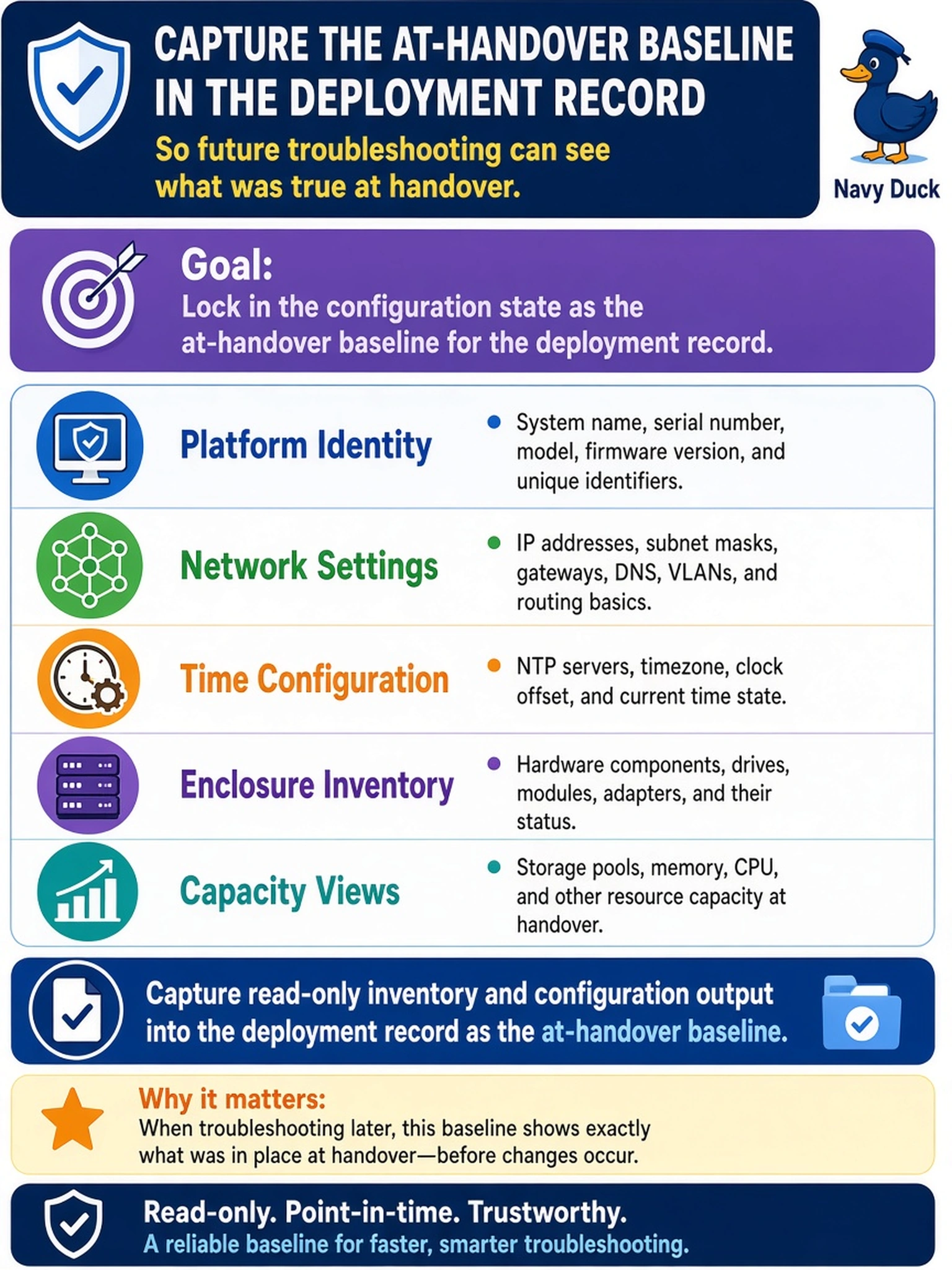
Initial access and setup of a new appliance are complete, and the team wants the deployment record to capture the configuration state so future troubleshooting can see what was true at handover. Which practice achieves that?
Select an answer to reveal the explanation.
Short Explanation
Think of the at-handover baseline like the photos you take of a rental car at pickup. You take them while everything is still good, because every scratch you can't see later becomes an argument. Save that show output now, while it's cheap, so tomorrow's troubleshooting has a 'before' picture to point at.
Full Explanation
The value of a handover record is that it is captured at the moment the state is known-good, using read-only views that show what the system itself believes: platform identity, interface state and addresses, enclosure and shelf inventory, and usable capacity. Troubleshooting months later is comparison work, and comparison requires a reference point; without this snapshot, every change since install day is indistinguishable from a fault. Exporting an encrypted restore image as documentation conflates a recovery artifact with a record — the restore image exists to rebuild the system, is opaque to a human reader, and captures far more than the configuration intent anyone needs to diff; nobody answers an address question by opening one. The automatic-inventory claim fails because the deployment record must exist regardless of whether any vendor-side inventory ran, and locked-down or air-gapped sites never upload anything at all. A landing-page screenshot fails on coverage: management network, time, and inventory details live on separate screens, and anything not captured may as well not have been configured. Exam caveat: capture text output rather than images where possible, because text can be searched and diffed later. Operational check: save the show outputs into the deployment folder with dated names and note in the handover document where the baseline lives.