
The new Data Domain appliance reports healthy clock sync with the corporate NTP servers, yet every support case pulled from it shows log timestamps exactly six hours ahead of what the on-site team expects for their US Central site. What is the most likely cause?
Select an answer to reveal the explanation.
Short Explanation
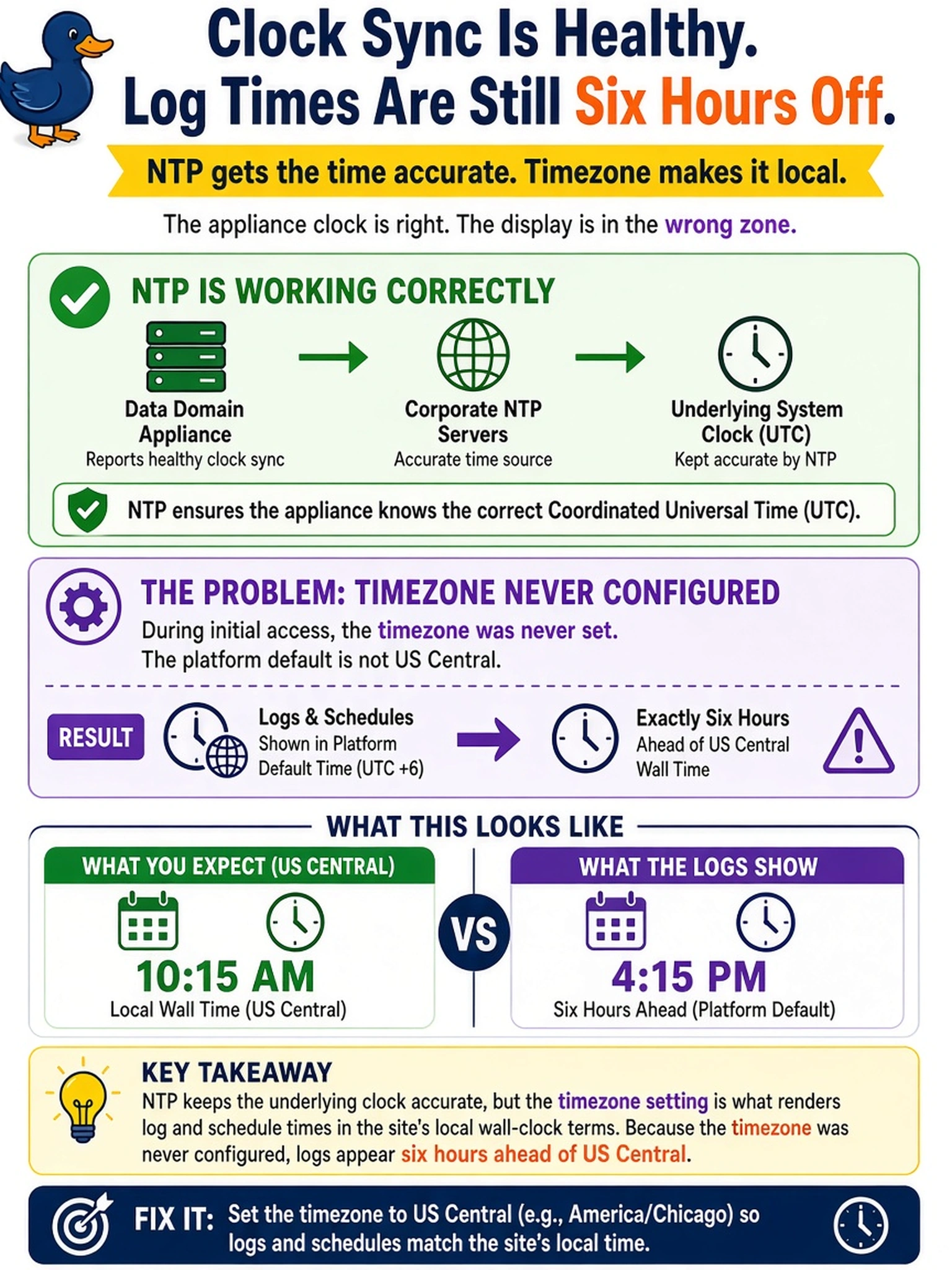
Think of NTP as the thing that keeps your watch accurate, and the timezone as the wall you hang it on. The mechanics are correct — the box just never learned where the customer lives. A synced clock is not the same as a correctly-localized one, so check the timezone before you chase the time source.
Full Explanation
Time synchronization and local time presentation are two separate settings on the appliance. NTP disciplines the underlying clock against the site's authoritative sources, while the timezone selection decides how that time is rendered for humans in log entries, event timestamps, and schedule displays. When a correctly synchronized system produces wall-clock readings off by exactly one region's offset, the missing step is almost always timezone assignment during initial access setup — the default zone is not the customer's site, and nothing shouts about it. The claim that UTC-based NTP cannot handle daylight saving fails by concept: timezone-aware systems apply regional rules when presenting time, so the servers' UTC discipline is not the defect. Real-time-clock drift does not produce a steady regional-scale offset; drift is small and accumulates gradually, which is what NTP exists to correct. Declaring DST unsupported is a false platform limitation — regional rules are part of timezone support, and offsets for observing regions shift twice a year by design. Exam caveat: half-hour and forty-five-minute zones exist, so an offset of thirty or forty-five minutes is still a timezone issue, not a sync failure. Operational check: after setting the timezone, generate a known event and confirm its timestamp matches the site's wall clock, and record the configured zone in the deployment record.