
The static management address works perfectly now, and someone suggests unplugging the head's service-port cable 'for tidiness.' What is the strongest reason to leave it connected?
Select an answer to reveal the explanation.
Short Explanation
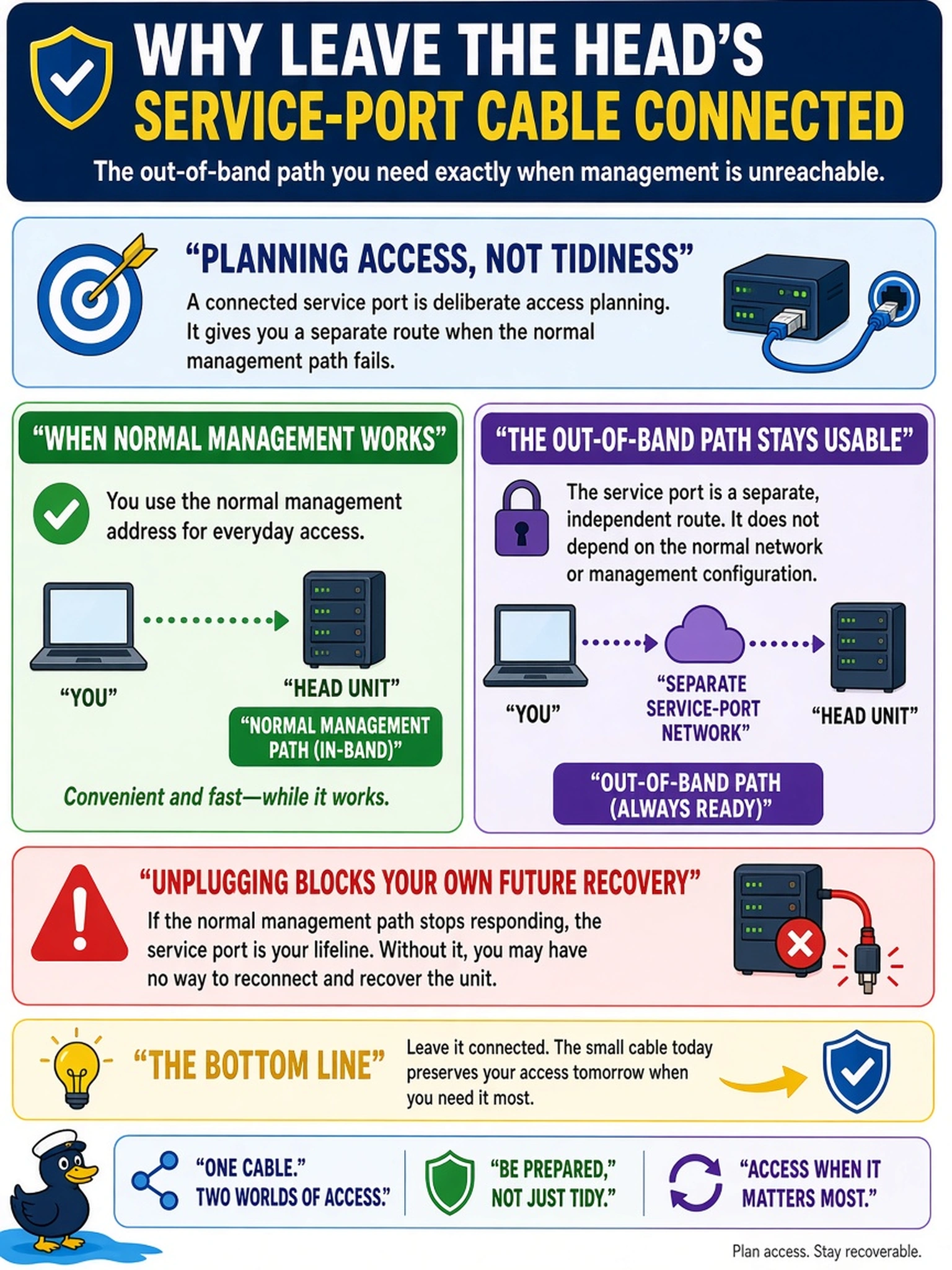
Tidiness is lovely; an unreachable recovery path is not. The service cable is the one you'll be glad for the day management becomes unreachable — which is precisely when unplugging it would have been inconvenient. Don't let cable dressing unplug your escape hatch.
Full Explanation
Access planning is judged on the worst day, not the calm one. The service path is the out-of-band route for exactly the scenarios where normal management fails — wrong VLAN, mistyped address, switch maintenance, certificate trouble — and its value exists only if it is physically present when those days arrive. Unplugging the service cable because management currently works optimizes for appearance while disabling the recovery path the deployment access task exists to guarantee. Automatic disabling upon static configuration fails the mechanism on this platform: the service path does not retire itself when in-band management starts working — it remains a parallel door, which is the point. A lifecycle ending at license application invents a dependency: licensing and out-of-band access are unrelated, and the need for recovery does not expire. Requiring the service link for NTP fails as invention: time sync arrives over the configured network, not through a service cable. Exam caveat: the correct pattern in the access task is that the service path stays connected, labeled, and documented as part of the design. Operational check: physically verify the service cable is dressed in and labeled, then from a laptop on that path confirm the head answers while the management interface is also up.