
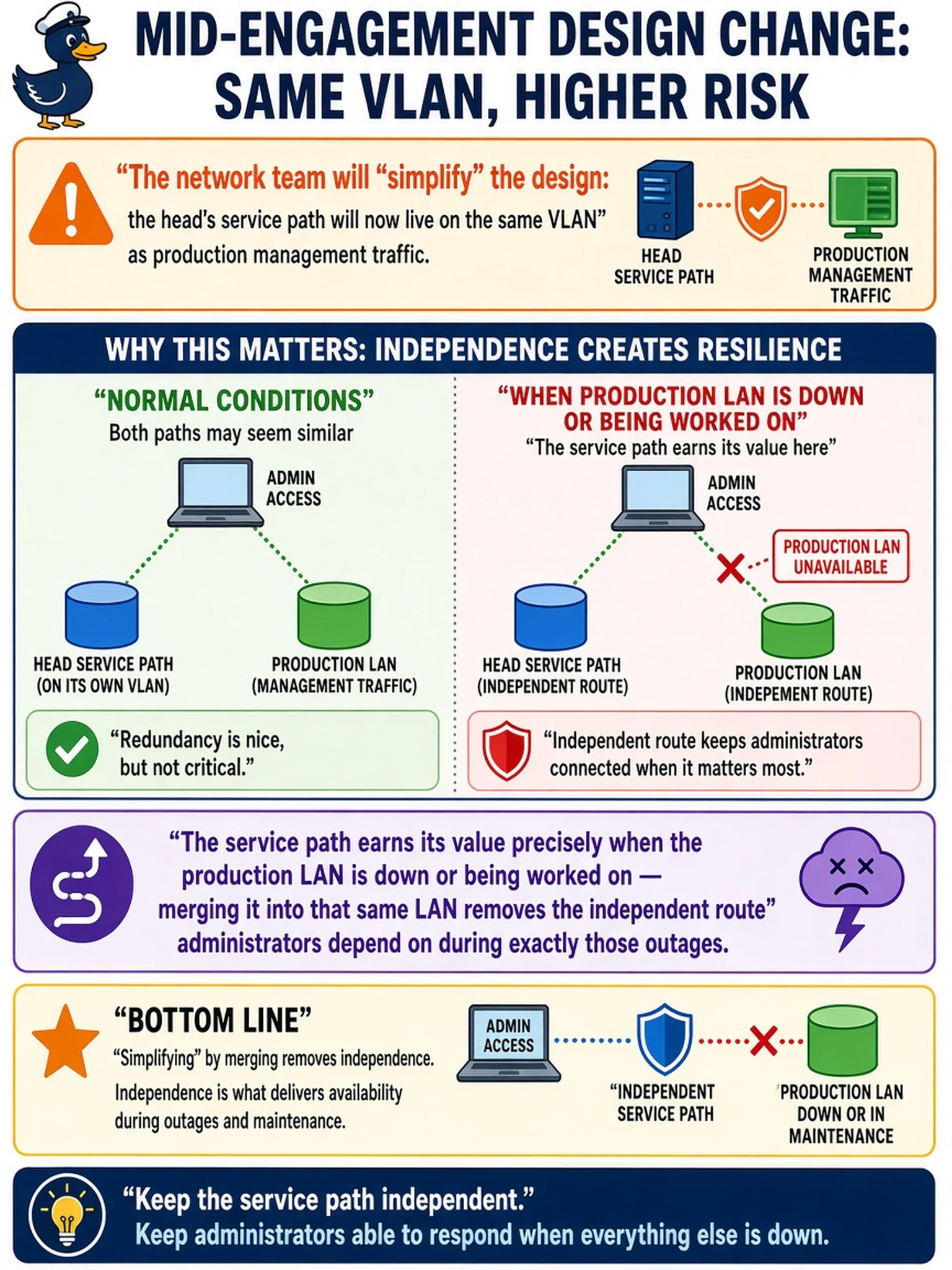
Mid-engagement the network team announces it will 'simplify' the design: the head's service path will now live on the same VLAN as production management traffic. What is the most important objection?
Select an answer to reveal the explanation.
Short Explanation
Think of the service network like the fire station's back door — its whole value is that it works when the front door is blocked. Merge it into the production management VLAN and you've welded the escape route to the very network that might be on fire. You don't 'simplify' your way out of an outage path.
Full Explanation
Network separation is purchased for a specific moment: when the production LAN is down, congested, or being reconfigured, administration and support access must still reach the appliance. A service network kept on its own VLAN or physical boundary stays reachable while the production management VLAN is exactly what is broken — that independence is its entire value. Collapsing it into production management traffic welds the rescue path to the failure domain: a single misconfigured switch, broadcast storm, or maintenance window now blinds normal administration and service access simultaneously. Labels making separation unnecessary fails by ontology — broadcast domains and forwarding policy are functional properties of traffic flow, not paperwork, and a label changes no failure behavior. Exhausting broadcast space is an invented capacity failure: merging two management-class flows creates no new exhaustion mode; the real defect is the coupling of availability domains. A mandated lower MTU for service traffic is an invented rule; frame sizes are set consistently by design across VLANs, and MTU is unrelated to the separation question. Exam caveat: separation is judged by independence during an outage, not by convenience on a normal day. Operational check: impair or disable the production management VLAN in a maintenance window and confirm the service path still reaches the head independently.