
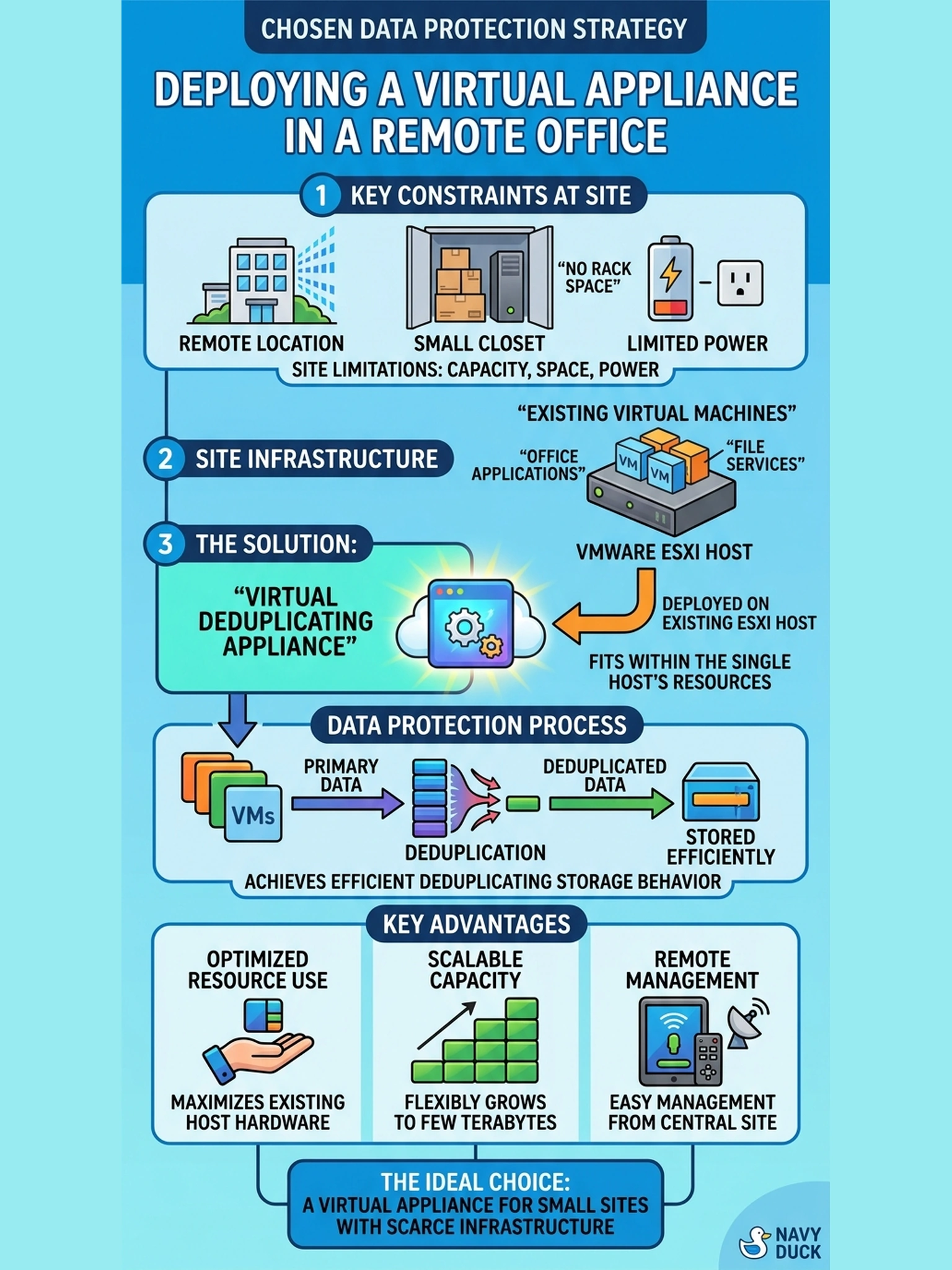
A small remote office wants Data Domain deduplicating backup behavior for a few terabytes, but the site has a single VMware host, a small closet, no rack space, and no spare power. Which form-factor decision do the captured pre-deployment requirements support?
Select an answer to reveal the explanation.
Short Explanation
Not every office has room for a refrigerator, and that's exactly why the appliance also comes as software. DD VE runs on the customer's own ESXi host and brings the same deduplicating behavior in a footprint a few-terabyte remote site can actually feed. Let the requirements you captured pick physical or virtual—don't force the closet to grow around the box.
Full Explanation
Form factor is a requirement-driven decision, and the captured facts—a few terabytes, an existing VMware host, no rack space, no spare power—point to DD Virtual Edition, a virtual edition of DD OS that runs on ESXi and provides the same deduplicating storage pool and the same protocol surface as a physical head at small scale. Shipping the smallest physical shelf regardless fails because the survey documented no space, power or rack for it, and the virtual edition is a supported integration path for backup applications at remote sites, not a second-class citizen. Attaching a generic disk pool fails by concept because Data Domain behavior—global deduplication, encryption, retention features, replication—lives in DD OS, and no unmanaged array substitutes for the operating system running the pool. Falling back to a tape library fails because the requirement explicitly asked for disk-based deduplicating behavior, which removable media does not provide. Exam caveat: DD VE carries documented host resource and capacity limits, so the ESXi host must be validated against them before deploying the image. Operational check: verify the ESXi version and available CPU, memory and data store capacity against the published DD VE requirements, and record the result in the design.