
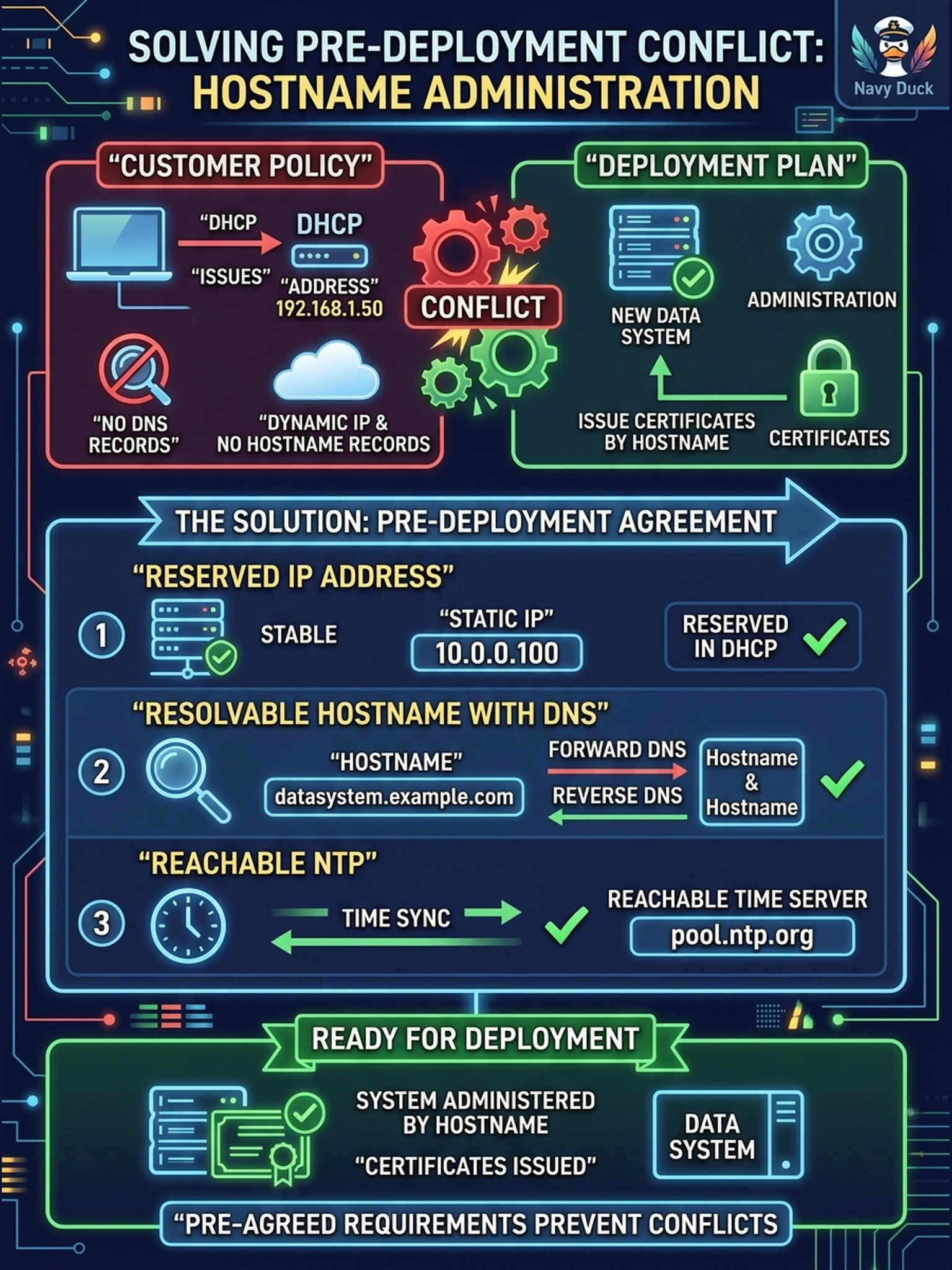
The customer's policy issues every device an address through DHCP with no DNS records, but the deployment plan wants to administer the new Data Domain system and issue its certificates by hostname. Which pre-deployment requirement resolves this conflict?
Select an answer to reveal the explanation.
Short Explanation
Certificates and hostnames work like a name tag plus a guest list—if the badge doesn't match the list, the door stays shut. You need DNS answering for the system's reserved name in both directions, plus NTP so those certificates are actually valid. Set that up as a prerequisite, not as an apology after the install.
Full Explanation
Administrative access and TLS certificates for a Data Domain system are built around a resolvable hostname, so the pre-deployment prerequisites include a reserved address with matching forward and reverse DNS records, plus reachable NTP so system clock drift cannot push certificates outside their validity period. A DHCP-only policy without records conflicts with that prerequisite, and the resolution is agreed before arrival—typically a DHCP reservation combined with DNS registration. Claiming IP-address administration removes the need fails because certificate subject names and named services still require resolution even when the console is opened by address. A static ARP entry fails by concept because ARP operates at layer two on a local segment and neither creates names nor supports certificate validation. Disabling certificate validation fails because it converts a visible warning into silent exposure of administrative sessions while solving nothing the plan asked for. Exam caveat: forward records are commonly provided while reverse records are forgotten, yet both are expected for full operation. Operational check: from an admin workstation, resolve the name to the address and the address back to the name, and confirm the NTP source is reachable and permitted.