
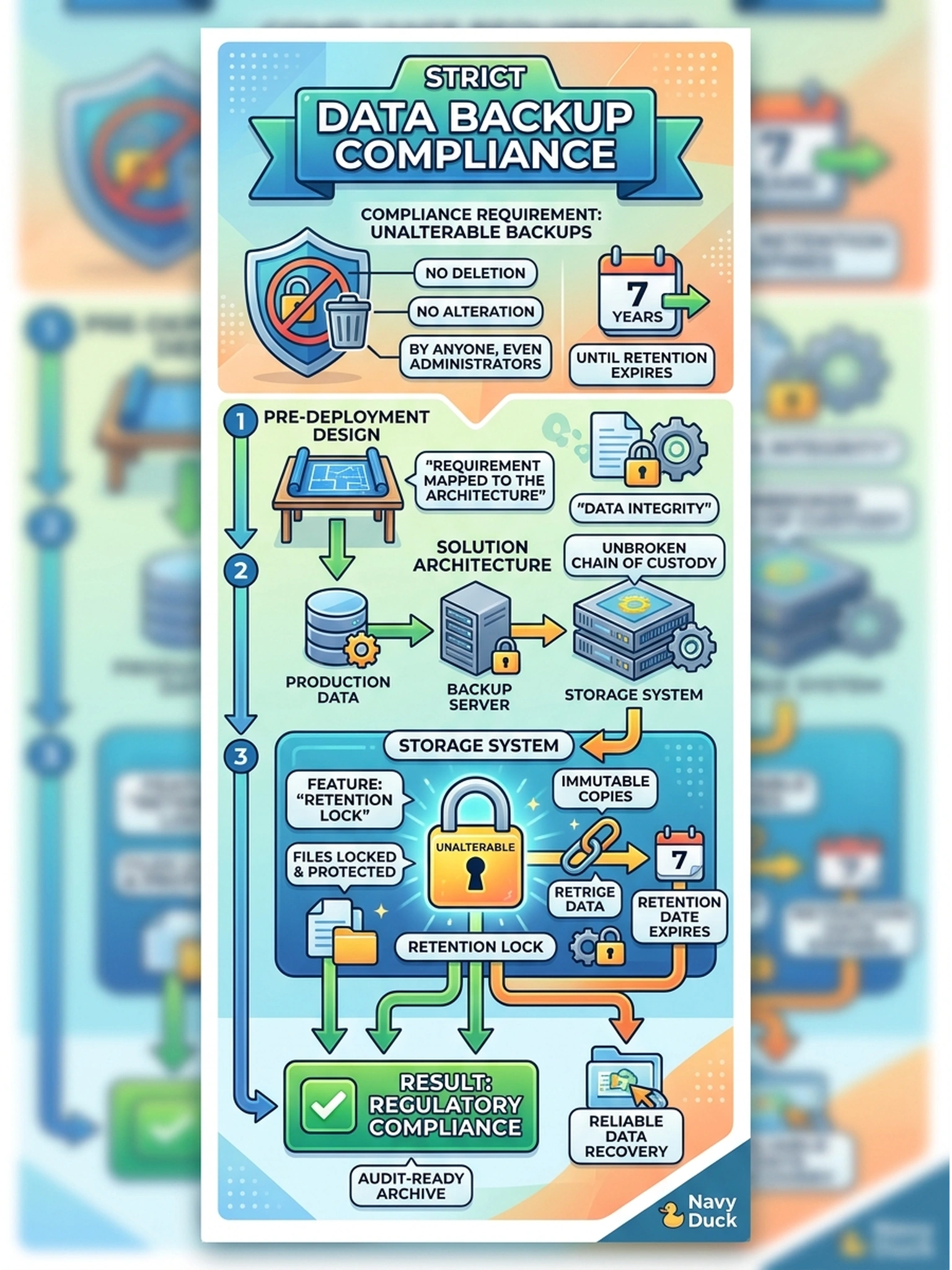
A compliance officer in a regulated industry insists that no backup copy may be deleted or altered by anyone, including the backup administrator, until seven-year retention has fully expired. Where does this requirement belong in the deployment plan, and what feature answers it?
Select an answer to reveal the explanation.
Short Explanation
Notice the words your compliance team just used: nobody, not even the admin, can delete before the date. That is Retention Lock territory, where files carry an enforced retention date the system itself refuses to unlock early. It's a pre-deployment decision, because Compliance mode is a one-way door that must be planned, licensed, and tested before auditors come asking.
Full Explanation
Retention Lock makes files immutable by stamping each one with a retention date that DD OS enforces inside the file system; until that date passes neither backup administrators, privileged users, nor policy changes can remove the data, and Compliance mode additionally hardens the configuration so the enforcement cannot be loosened. Because the mechanism lives on the appliance and the mode choice is permanent, the requirement belongs in the pre-deployment design. Placing immutability only in backup software fails by concept because application-level policy protects only what that application sees and cannot stop deletion at the storage layer. Planning to enable the feature after go-live and back-date it over existing data fails because retention is applied as data is written, so historical copies cannot be retroactively covered the way the distractor suggests. Routing the requirement to WORM tape fails because disk-based retention lock is a recognized immutability mechanism for backup copies and need not be deferred to removable media. Exam caveat: once Compliance mode is enabled it cannot be disabled, so the customer must explicitly accept that permanence. Operational check: confirm the required license is on the order, document which MTrees and retention classes will be locked, and validate the behavior with a delete attempt against a locked file during commissioning.