
A requirements interview finds that backups will come from NetBackup, from Veeam, and from a legacy NetApp filer that runs no backup agent. The engineer must record which Data Domain connection methods each source needs. Which mapping belongs in the design?
Select an answer to reveal the explanation.
Short Explanation
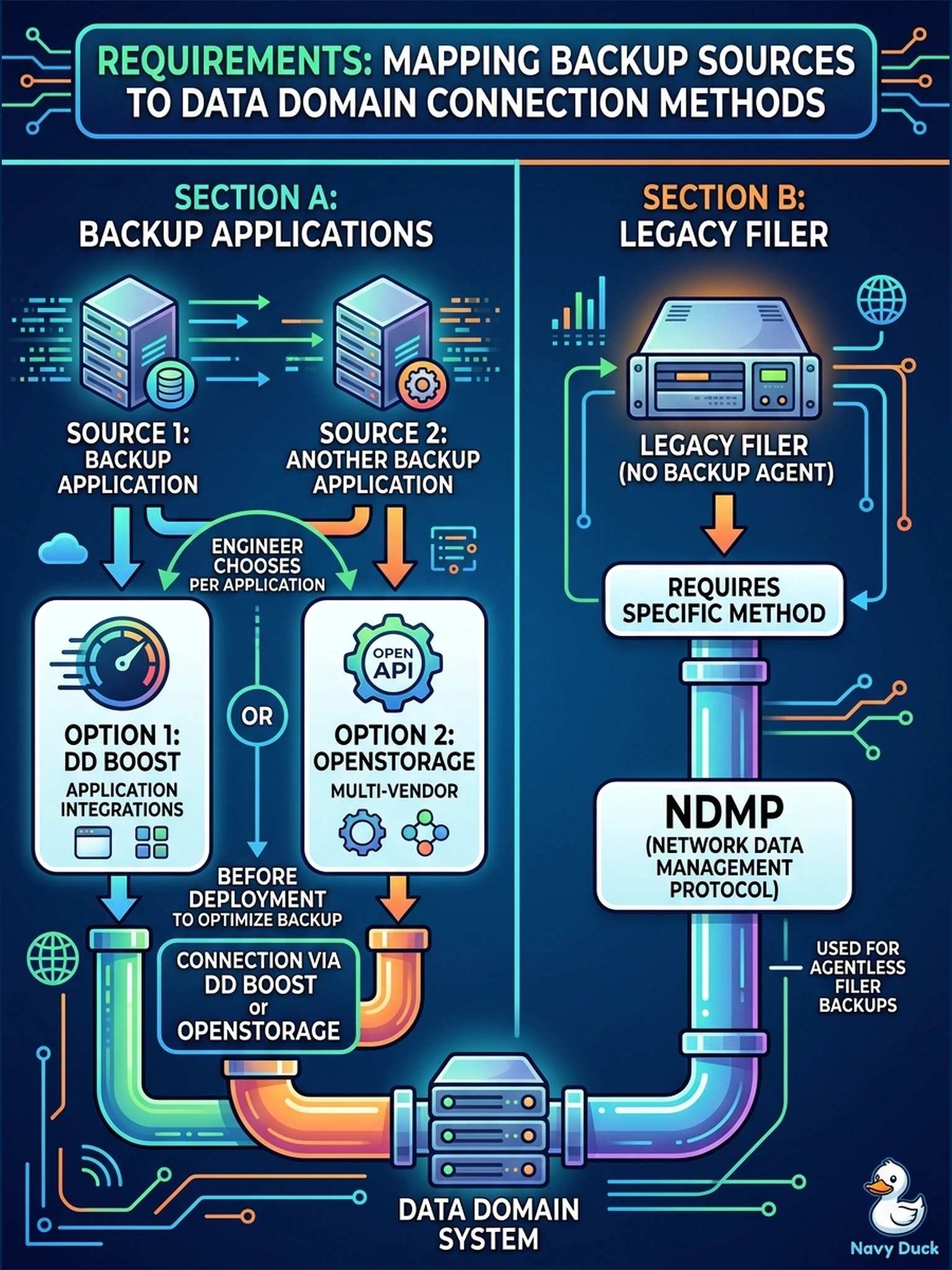
You wouldn't hand every visitor the same badge for a building with three different entrances. Boost-aware applications like NetBackup and Veeam talk to Data Domain through DD Boost or OpenStorage, while an agentless filer rides in over NDMP. Write those per-source protocol choices down before the box ever ships.
Full Explanation
Connection planning is per source, because each source class has a native path to Data Domain. NetBackup and Veeam are backup platforms with supported Data Domain integrations: DD Boost distributes dedupe processing to the media server or proxy layer, and OpenStorage lets the application manage the storage unit intelligently, so the interview records those applications as Boost-capable consumers. The agentless NetApp filer is instead read at the filer level through NDMP sessions, so NDMP is captured for it. Inverting that mapping fails as a concept because NDMP is a protocol for reading filer storage while Boost is an application-side library, and assigning either to the wrong class of source simply will not connect. Mounting NFS from every client fails because a generic file share surrenders application awareness, Boost efficiencies, and tapeless filer backup. Standardizing everything on VTL fails because tape emulation is a legacy target that adds media-server complexity when better native paths exist. Exam caveat: the exact supported combinations still need verification against the current interoperability matrix. Operational check: list every source from the interview, annotate each with its planned protocol, and confirm nothing is still sitting on a default assumption.