In an actor-critic reinforcement learning algorithm, what specific role does the critic play?
Select an answer to reveal the explanation.
Short Explanation and Infographic
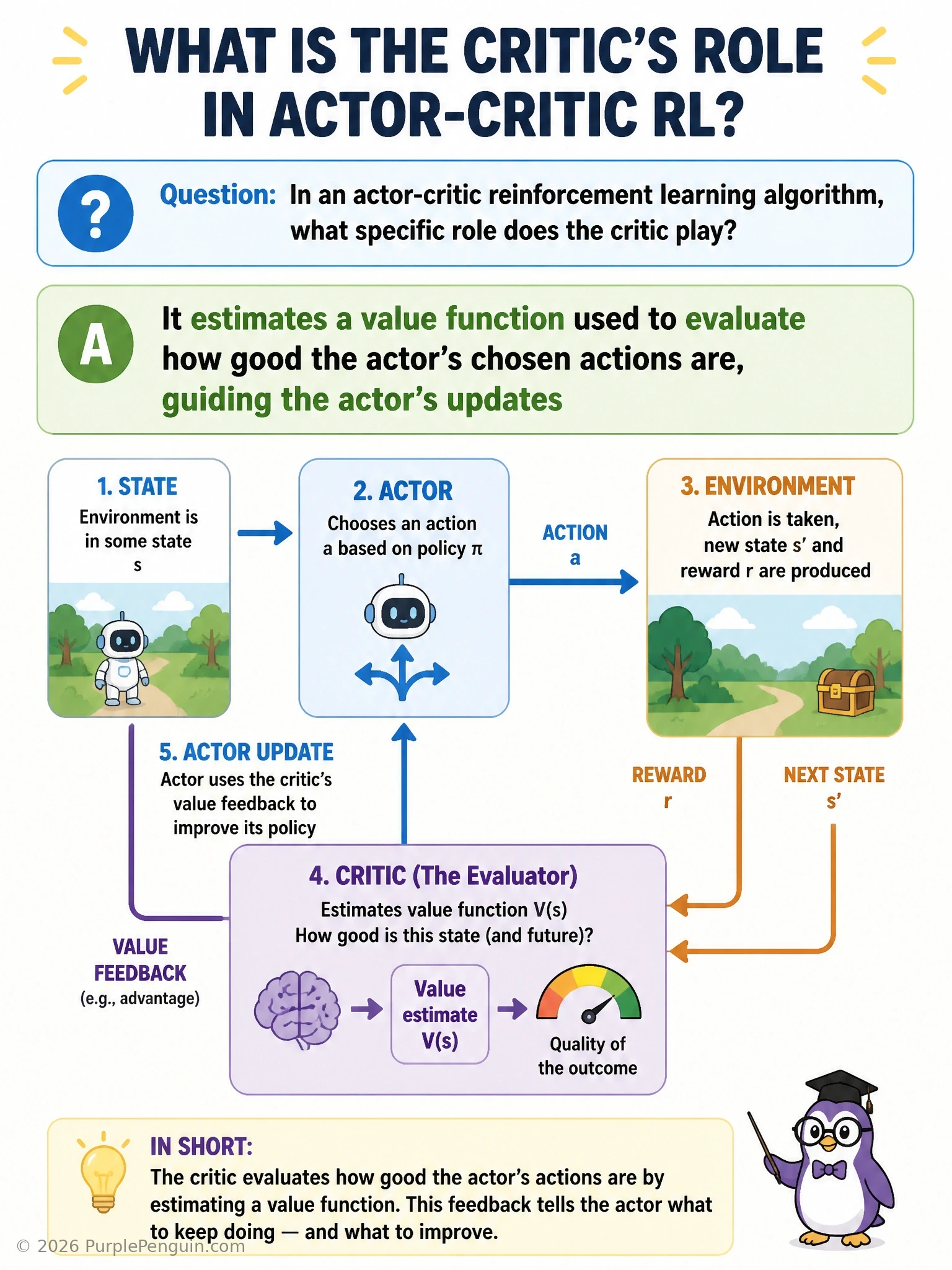
In an actor-critic setup, think of it like a coach and a player. The actor is the player, it's the policy that actually picks and executes actions in the environment. The critic is the coach on the sidelines, it estimates a value function, usually the state-value or advantage, and uses that to judge how good the actor's action turned out to be, then feeds that judgment back so the actor knows whether to reinforce or move away from that behavior. That's the critic's whole job, evaluation, not action selection. It's not the one choosing actions, that's the actor. It's not a replay buffer, that's a separate data-storage mechanism sometimes used alongside actor-critic methods but not what 'critic' refers to. And it's not generating synthetic data either, that's more of a data-augmentation or generative-modeling concern, unrelated to the critic's evaluative role.
Full explanation below image
Full Explanation
Actor-critic algorithms combine two complementary components to reduce the variance and improve the sample efficiency of pure policy-gradient methods. The actor is a parameterized policy that selects actions given the current state, directly determining the agent's behavior in the environment. The critic is a separate function approximator, typically estimating a state-value function V(s) or an action-value function Q(s,a), whose job is to evaluate the quality of the states the actor visits or the actions the actor takes. The critic's value estimate is used to compute an advantage signal, roughly capturing how much better or worse an action was compared to the average expected outcome from that state, and this advantage is then used to scale the policy-gradient update applied to the actor. This division of labor allows the actor to receive a lower-variance, more informative learning signal than relying solely on raw episodic returns, since the critic's value estimates are updated more frequently and can bootstrap from single-step transitions rather than waiting for full episode rollouts, as in vanilla REINFORCE.
The action-selection distractor is incorrect because selecting actions to execute in the environment is specifically the actor's responsibility; the critic never outputs actions itself; it only outputs an evaluative signal (a value estimate) that shapes how the actor's parameters are updated. The replay-buffer distractor is incorrect because a replay buffer is a data structure used in certain off-policy algorithms (such as DQN or off-policy actor-critic variants like DDPG or SAC) to store and later resample past transitions for more sample-efficient training; while some actor-critic implementations may use a replay buffer as an auxiliary component, the buffer itself is not what defines or constitutes 'the critic,' which specifically refers to the value-estimating network. The synthetic-data-generation distractor is incorrect because generating new training examples to augment a dataset describes data augmentation or generative modeling techniques, entirely different concerns from evaluating the quality of actions within an ongoing reinforcement learning loop; the critic does not fabricate new transitions, it evaluates the ones the actor actually experiences.
A helpful memory aid: 'actor acts, critic critiques,' the actor decides what to do, and the critic estimates how good that decision was, feeding a cleaner, faster-updating signal back to the actor than raw environment rewards alone would provide.