An autoencoder is trained to reconstruct 256x256 images after passing them through a narrow bottleneck layer of only 32 values. Which component of the autoencoder is responsible for compressing the image down to that low-dimensional representation?
Select an answer to reveal the explanation.
Short Explanation and Infographic
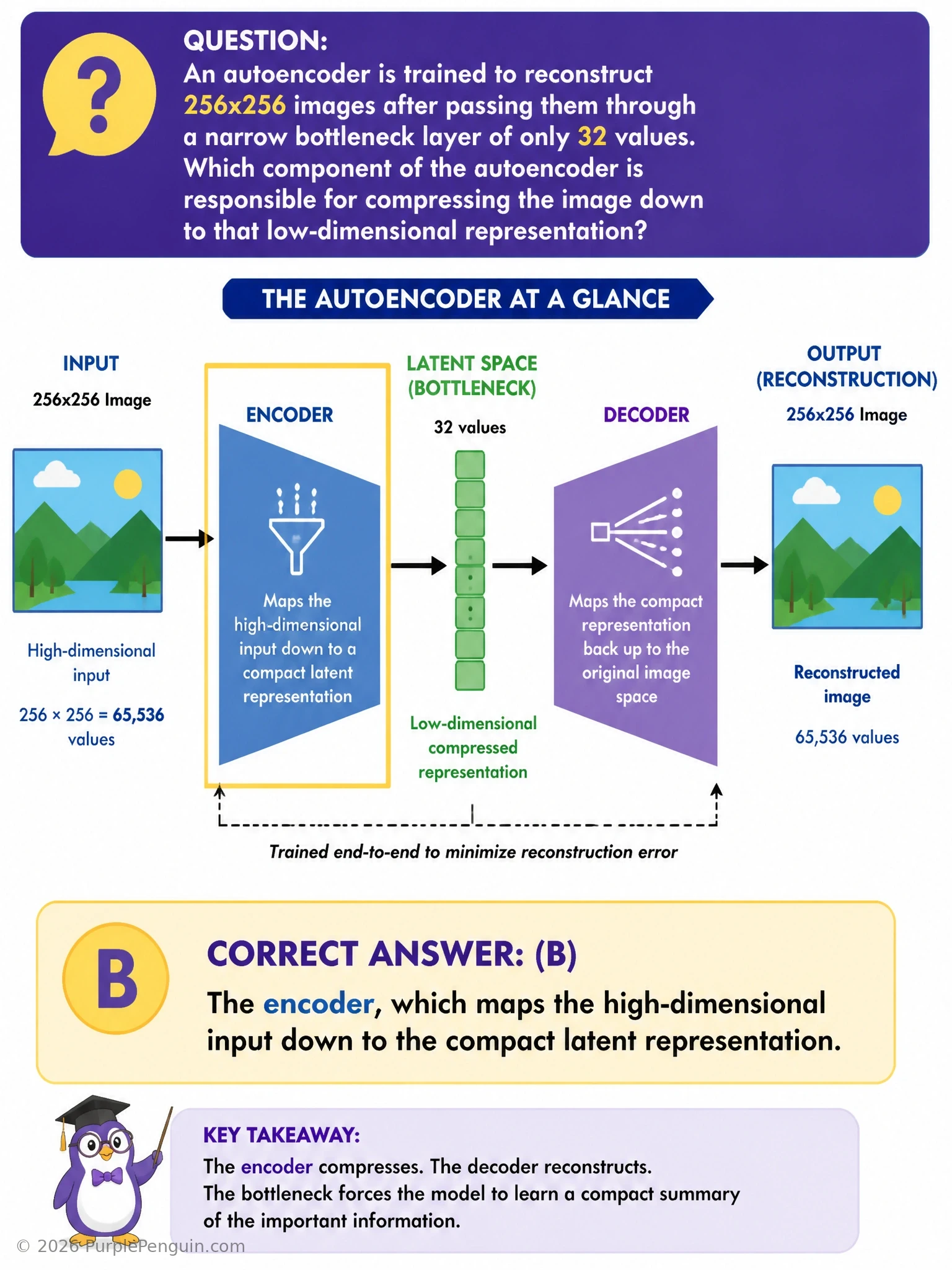
That compression job belongs to the encoder. The encoder is the first half of the autoencoder, it takes the full 256x256 image and squeezes it down, layer by layer, into that narrow 32-value bottleneck, also called the latent representation. Whatever comes out of that bottleneck has to capture enough information for the network to rebuild the image, so the encoder is forced to learn an efficient, compressed encoding of the important structure. The decoder does the opposite job, expanding that compact vector back out to full resolution, so it's not the compressor, it's the reconstructor. There's no discriminator in a standard autoencoder at all, that's a GAN component. And the reconstruction loss is just the training signal used to judge how good the reconstruction is, it doesn't perform any compression itself.
Full explanation below image
Full Explanation
In a standard autoencoder architecture, the network is split into two halves: an encoder and a decoder, joined by a narrow bottleneck (or latent) layer. The encoder's job is to take the high-dimensional input, in this case a 256x256 image, and progressively transform it through a series of layers that reduce dimensionality at each step, ultimately producing a compact latent representation, here a vector of only 32 values. Because this bottleneck is so much smaller than the input, the encoder is forced during training to learn which features of the input are most important for reconstruction, effectively performing a form of learned, nonlinear dimensionality reduction or compression. The decoder then takes over from that compressed latent vector and progressively expands it back through a mirrored series of layers to reconstruct an approximation of the original 256x256 image. The entire network is trained end-to-end by minimizing a reconstruction loss, typically mean squared error or a similar pixel-wise metric, between the original input and the decoder's output, which indirectly shapes what the encoder learns to preserve in the bottleneck.
The decoder distractor is incorrect because the decoder performs the inverse operation of compression, expansion, taking the already-compressed latent vector and reconstructing it back up to the original high-dimensional space; it does not perform the initial compression step, which is entirely the encoder's responsibility. The discriminator distractor is incorrect because a discriminator is a component specific to generative adversarial networks, not standard autoencoders; a vanilla autoencoder has no adversarial classification component judging real versus fake, its only two parts are the encoder and decoder trained jointly via reconstruction loss (variants like adversarial autoencoders do add a discriminator, but that is not the standard architecture being described here). The reconstruction-loss distractor is incorrect because the loss function is a training signal, a scalar quantity computed by comparing input and output to compute gradients for backpropagation; it is a measurement and optimization target, not a network component that performs any transformation or compression of the data itself.
A useful memory aid: think of the encoder as 'packing a suitcase' by figuring out the smallest set of essentials that still lets you recreate the full outfit later, while the decoder is 'unpacking the suitcase' back into the complete original form, and the reconstruction loss is simply the judge scoring how well the unpacked outfit matches what went in.