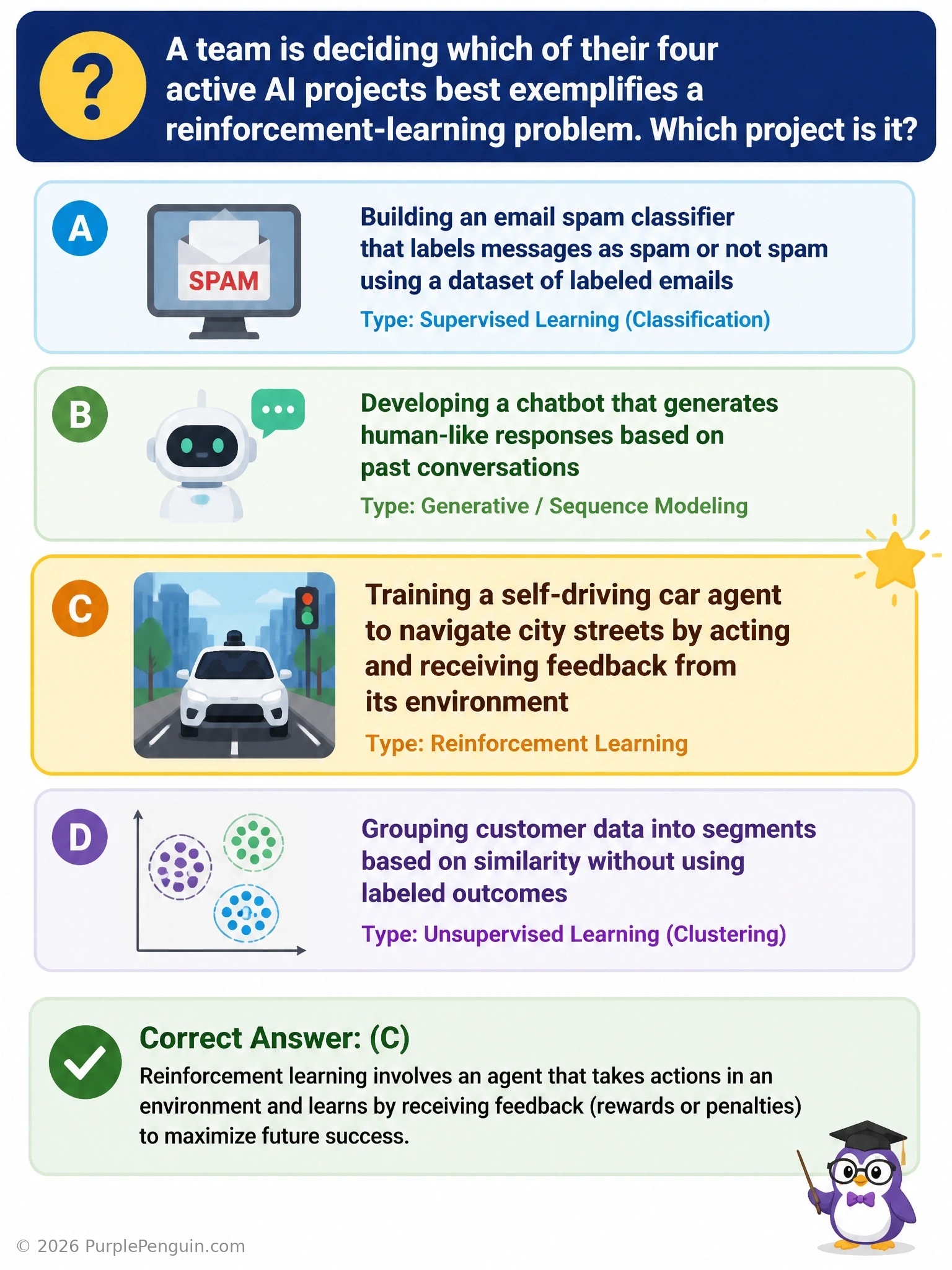
A team is deciding which of their four active AI projects best exemplifies a reinforcement-learning problem. Which project is it?
Select an answer to reveal the explanation.
Short Explanation and Infographic
The self-driving car is the reinforcement-learning example, hands down. Why? Because the car isn't handed a labeled answer key, it takes actions, like steering or braking, and the environment hands back consequences, staying in lane is good, drifting into oncoming traffic is very bad, and over time it learns a policy that maximizes safe, efficient driving. That trial-and-error-with-feedback loop is the heart of RL. The spam filter is supervised learning, it's trained on emails that are already labeled. Clustering transactions with no labels is unsupervised learning. And PCA-based compression is also unsupervised, it's about finding structure, not maximizing a reward through interaction.
Full explanation below image
Full Explanation
Reinforcement learning is defined by an agent that learns to make sequential decisions by interacting with an environment, taking actions, observing resulting states, and receiving reward or penalty signals, with the goal of learning a policy that maximizes cumulative reward over time. Training a self-driving car to navigate is a textbook example: the vehicle (agent) perceives its surroundings (state), chooses actions like accelerating, braking, or steering, and receives feedback in the form of rewards for safe, efficient, rule-abiding driving and penalties for collisions, lane violations, or excessive braking. Because there is no fixed 'correct answer' provided for every situation, and the agent must learn through repeated interaction and delayed consequences, this scenario captures the exploration, credit-assignment, and sequential-decision-making hallmarks of RL.
The spam-filter example is incorrect because it is supervised learning: the model is trained on a dataset of emails that already carry ground-truth labels (spam or not-spam), and the objective is to minimize a classification loss on those labels, with no notion of an agent taking sequential actions or receiving delayed rewards. The customer-transaction clustering example is incorrect because it is unsupervised learning: there are no labels and no reward signal at all; the algorithm's goal is to discover latent structure or grouping in the data based on similarity, an entirely different objective from reward maximization. The PCA-based sensor-log compression example is also unsupervised learning, specifically dimensionality reduction, aimed at finding a lower-dimensional representation that preserves variance in the data; again, there is no agent, no environment interaction, and no reward being optimized.
A good way to distinguish these paradigms: if the problem has labeled input-output pairs, it is supervised learning; if the problem seeks structure in unlabeled data, it is unsupervised learning; if the problem involves an agent acting within an environment and learning from reward signals produced by consequences of its own actions over time, it is reinforcement learning. The self-driving car scenario satisfies only the reinforcement-learning definition.