In TensorFlow, what fundamentally is a Tensor, the central data structure the framework is named after?
Select an answer to reveal the explanation.
Short Explanation and Infographic
It's right there in the name — TensorFlow is literally built around tensors flowing through a computation graph. Strip away the jargon and a Tensor is just a multidimensional array: a scalar is a 0-D tensor, a vector is 1-D, a matrix is 2-D, and you can keep going up from there — a batch of color images might be a 4-D tensor (batch, height, width, channels). Every input, every weight, every activation, every gradient in TensorFlow is represented as a Tensor. So 'multidimensional array holding and flowing data through the graph' is correct. It's not a config file — that's just a settings artifact, unrelated to the data structure itself. It's not an activation function — those are operations applied to tensors, not tensors themselves. And it's definitely not a logging callback; that's something like TensorBoard's callback, a completely different concern.
Full explanation below image
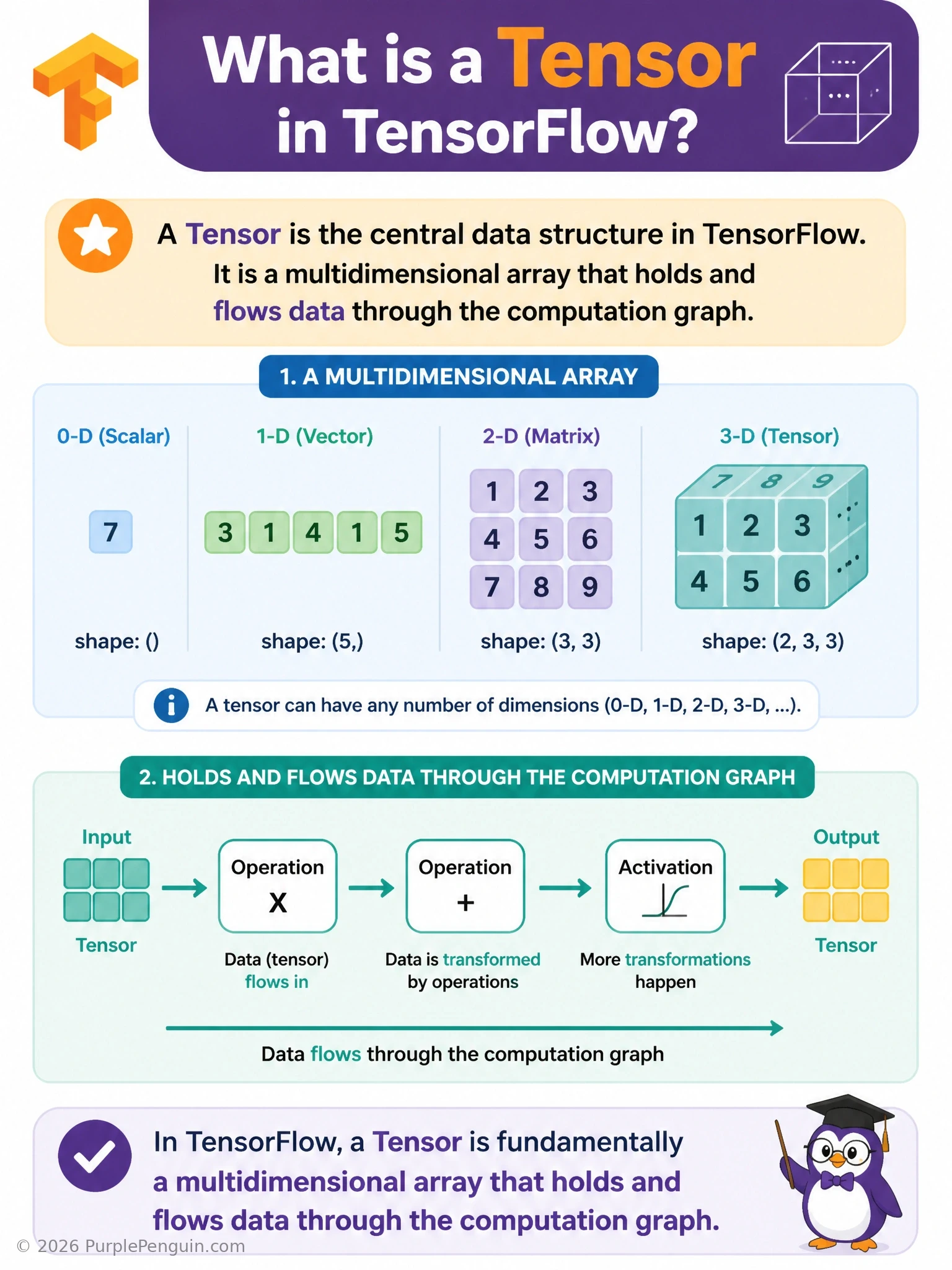
Full Explanation
A Tensor is the fundamental data structure in TensorFlow (and, under a different class name, in PyTorch as well): a multidimensional array of numerical values, generalizing the concepts of scalars, vectors, and matrices to arbitrary numbers of dimensions. A scalar is a rank-0 tensor (a single value), a vector is rank-1 (one axis), a matrix is rank-2 (two axes, rows and columns), and higher-rank tensors extend this further — for example, a batch of RGB images is commonly represented as a rank-4 tensor with dimensions for batch size, height, width, and color channels. Every piece of data that flows through a TensorFlow model — inputs, learned weights, intermediate activations, gradients, and outputs — is represented as a Tensor, and the framework's name itself reflects this: it describes how these tensors 'flow' through a computation graph made up of mathematical operations (like matrix multiplication, convolution, and activation functions) that transform one tensor into another. Tensors in TensorFlow carry not just numeric values but also metadata such as shape (the size along each dimension) and dtype (the data type of the elements, such as float32 or int32), and operations on tensors are typically accelerated on GPUs or TPUs for performance.
A configuration file storing hyperparameters (such as learning rate, batch size, or number of layers) is an entirely separate artifact from a Tensor — it is typically a plain text, JSON, or YAML file used to record settings, not a data structure that holds or transforms numeric values during computation.
An activation function (such as ReLU, sigmoid, or softmax) is a mathematical operation applied to a tensor's values to introduce non-linearity or produce a specific output distribution; it acts on tensors but is not itself the data structure. Confusing the operation with the data it operates on is a common conceptual mix-up.
A callback that logs training progress (such as a TensorBoard callback or a custom logging callback) is a utility object invoked at specific points during training (e.g., end of epoch) to record metrics or save checkpoints; it is unrelated to the Tensor data structure and operates at a workflow-management level rather than a data-representation level.
Understanding Tensors as the universal, multidimensional-array data structure underlying all computation is foundational to reading TensorFlow (and PyTorch) code, since shape mismatches between tensors are one of the most common sources of runtime errors in deep learning code.