Why is a dataset typically split into training, validation, and test sets rather than using all available data for training?
Select an answer to reveal the explanation.
Short Explanation and Infographic
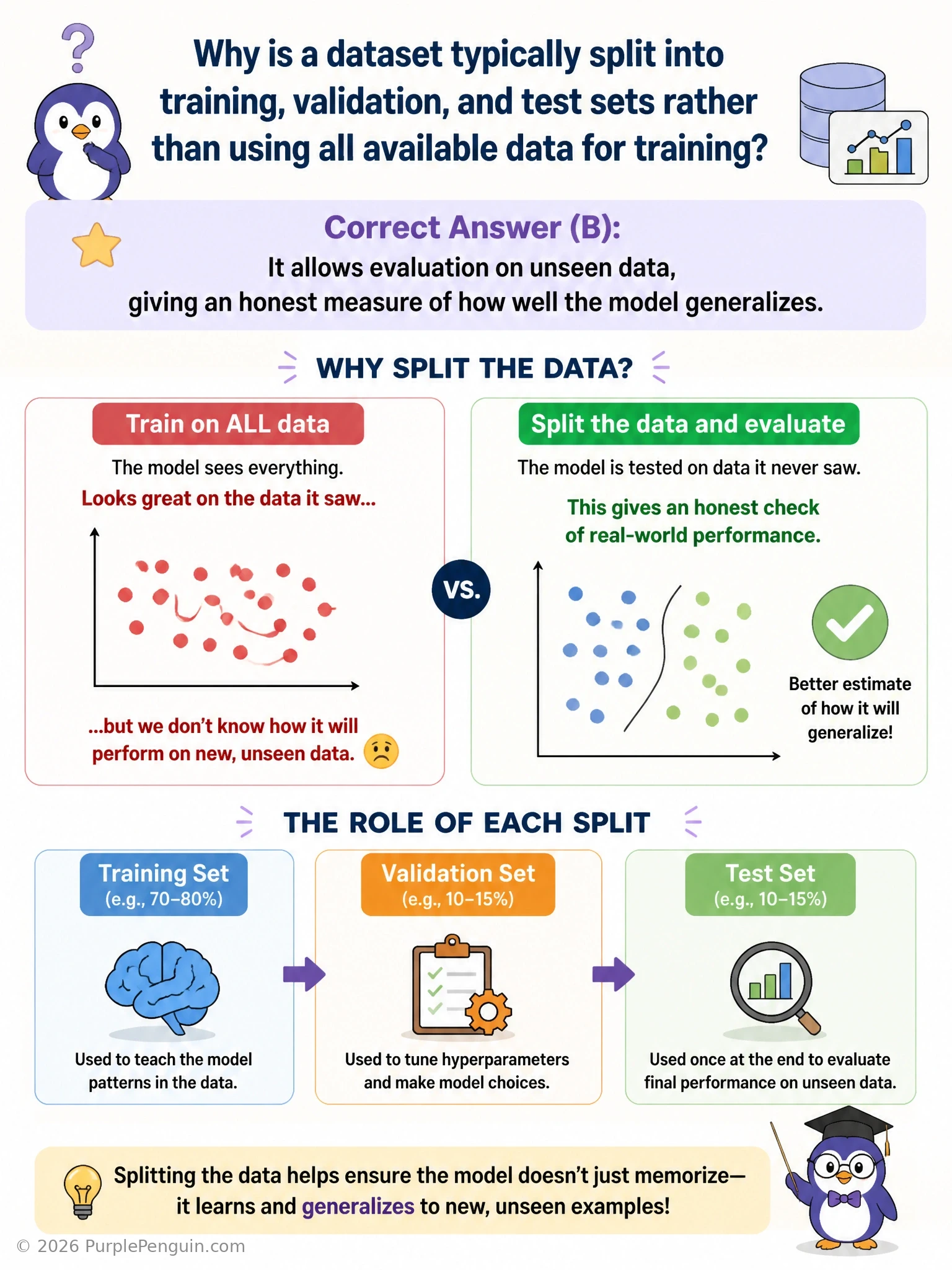
If you train on 100% of your data and then test on that same data, of course the model looks great — it's basically just recalling what it memorized. That tells you nothing about how it'll perform on a new customer, a new image, a new anything it hasn't seen. Splitting off validation and test data gives you an honest way to check: validation lets you tune along the way, and test gives a final, unbiased read on unseen examples. That's why 'evaluation on unseen data, honest generalization measure' is correct. Splitting obviously doesn't make your dataset bigger — you're dividing what you have, not creating new data. It doesn't guarantee you'll never overfit either; you can still overfit, the split just lets you catch it. And no framework forces you to split data — plenty of quick experiments train on everything; it's a best practice, not a technical requirement.
Full explanation below image
Full Explanation
Splitting a dataset into training, validation, and test subsets exists to produce an honest measurement of how well a model generalizes to data it has not seen, rather than merely how well it has memorized the data it was trained on. If a model is evaluated only on the exact same data it was trained on, its reported performance will typically look artificially strong, because the model has had a direct opportunity to fit closely to those specific examples (including their noise and idiosyncrasies), which does not reflect how it will behave on genuinely new inputs after deployment. By reserving a validation set (used during development for tuning hyperparameters, comparing architectures, and deciding when to stop training) and a separate test set (used exactly once, after all development decisions are finalized, purely to report final performance), practitioners can estimate real-world generalization performance with much greater confidence and can also detect overfitting: a large gap between training performance and validation/test performance is a clear signal that the model has learned patterns specific to the training data that do not transfer.
Splitting the data does not increase its total size; it is a partition of the existing dataset into disjoint subsets. The union of train, validation, and test data equals the original dataset (or close to it, accounting for any data withheld or discarded), and no new samples are created by the act of splitting itself.
Splitting the data does not guarantee that overfitting will never happen. The model can still overfit to the training set even when a validation and test set exist; the split doesn't prevent overfitting on its own, it merely gives you the visibility to detect overfitting by comparing performance across sets and the ability to respond to it (e.g., via early stopping, regularization, or more data).
No deep learning framework technically requires a dataset to be split before training can begin; it is entirely possible, and sometimes done for quick sanity checks or extremely small experiments, to train a model using 100% of the available data with no held-out sets at all. The split is a modeling best practice for producing trustworthy, generalizable results, not a hard technical constraint imposed by frameworks like PyTorch, TensorFlow, or Keras.