Before feeding pixel values and other numeric features into a neural network, a data scientist rescales them so all values fall within a common range such as [0, 1]. What is this preprocessing step generally called, and what does it accomplish?
Select an answer to reveal the explanation.
Short Explanation and Infographic
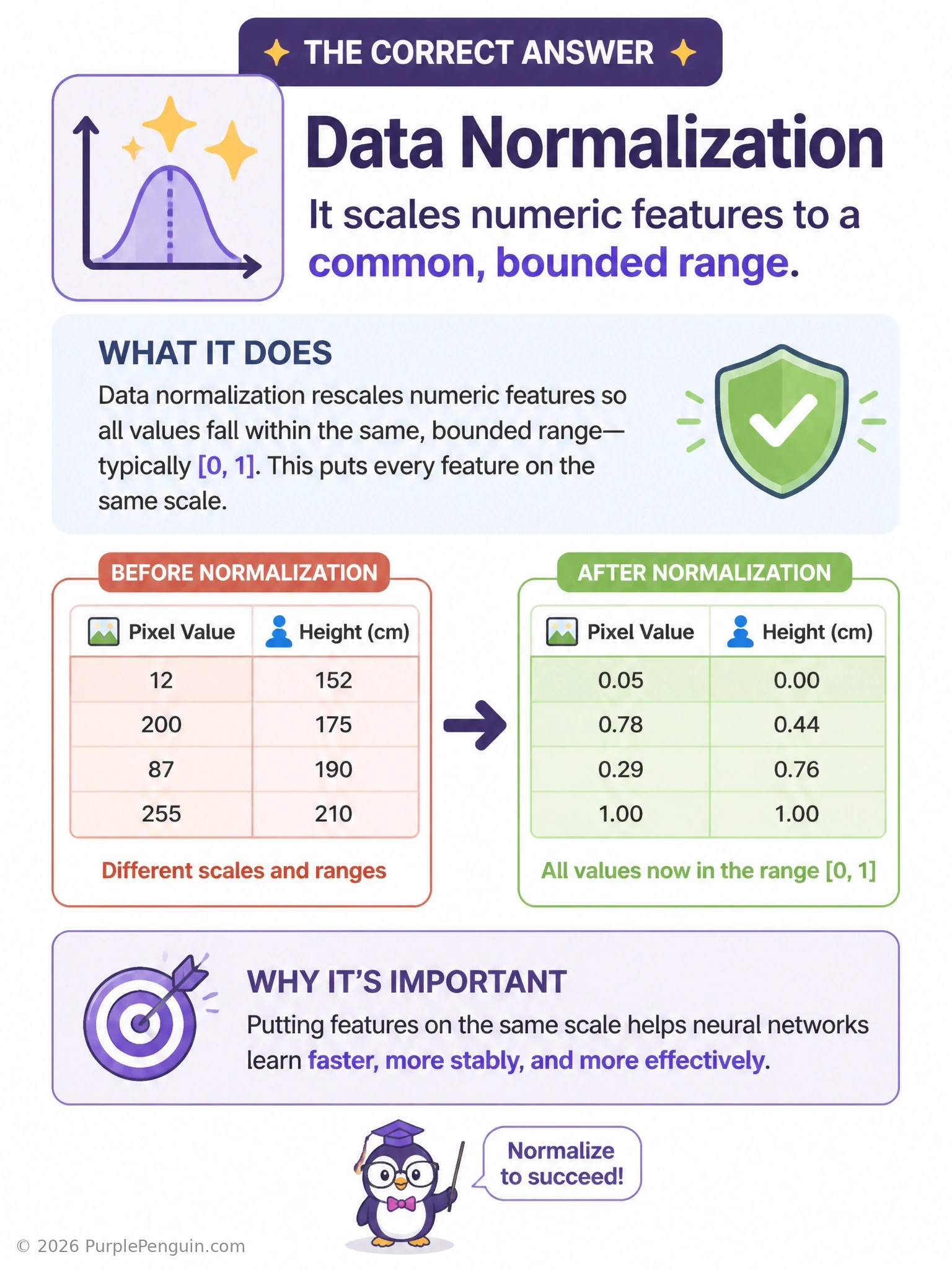
This is normalization, plain and simple — taking numeric features that might live on wildly different scales (pixel values 0–255, some other feature 0–10,000) and squashing them all into a shared, bounded range like [0, 1]. Why bother? Because neural nets train faster and more reliably when inputs are on comparable scales — gradients behave better, and no single feature accidentally dominates just because its raw numbers are bigger. So 'data normalization, scales to a common range' is correct. One-hot encoding is a totally different animal — that's for turning categorical labels into binary vectors, not for rescaling numbers you already have. Data augmentation makes new training examples through transformations, it doesn't touch scale. And tokenization is a text-preprocessing term for splitting text into words or subwords, unrelated to numeric rescaling.
Full explanation below image
Full Explanation
Data normalization is the preprocessing technique of rescaling numeric feature values so they fall within a common, bounded range, most commonly [0, 1], though other bounded ranges are also used. A typical implementation is min-max normalization, computed as x_scaled = (x - min) / (max - min), which maps the minimum observed value to 0 and the maximum to 1, with all other values proportionally in between. For image data, a very common form of normalization is dividing raw pixel values (which range from 0 to 255) by 255 so every pixel lies in [0, 1]. The main benefit of normalization is that it puts all features on comparable numeric scales, which helps neural network training in several ways: it prevents features with naturally larger raw magnitudes from dominating the loss landscape or gradient updates simply due to scale rather than actual importance, it tends to make gradient descent converge faster and more stably, and it reduces the risk of numerical instability during training (such as exploding activations or gradients) that can arise when input scales vary wildly.
One-hot encoding is a distinct preprocessing technique used for categorical (not already-numeric, continuous) features. It converts a category, such as 'red,' 'green,' or 'blue,' into a binary vector with a single 1 in the position corresponding to that category and 0s elsewhere. It addresses representing discrete categories as numeric input, not rescaling continuous numeric data.
Data augmentation is a technique for artificially expanding and diversifying a training dataset by applying transformations (such as rotation, flipping, cropping, or noise injection for images) to existing samples to create new, modified training examples. It is aimed at increasing data quantity and variety to improve generalization, not at rescaling feature ranges.
Tokenization is a natural language processing preprocessing step that splits text into smaller units — words, subwords, or characters — so that text can subsequently be converted into numeric representations. It operates on text data structurally, not on rescaling already-numeric features.
Standardization (z-score normalization, scaling to mean 0 and standard deviation 1) is a closely related but distinct technique from min-max normalization; both fall under the broader umbrella of feature scaling, chosen based on the data's distribution and the model's sensitivity to outliers or scale.