A dataset has one feature where 99% of values fall between 0 and 100, but a handful of extreme outliers reach 100,000. If min-max scaling is applied to squeeze this feature into [0, 1], what problem results?
Select an answer to reveal the explanation.
Short Explanation and Infographic
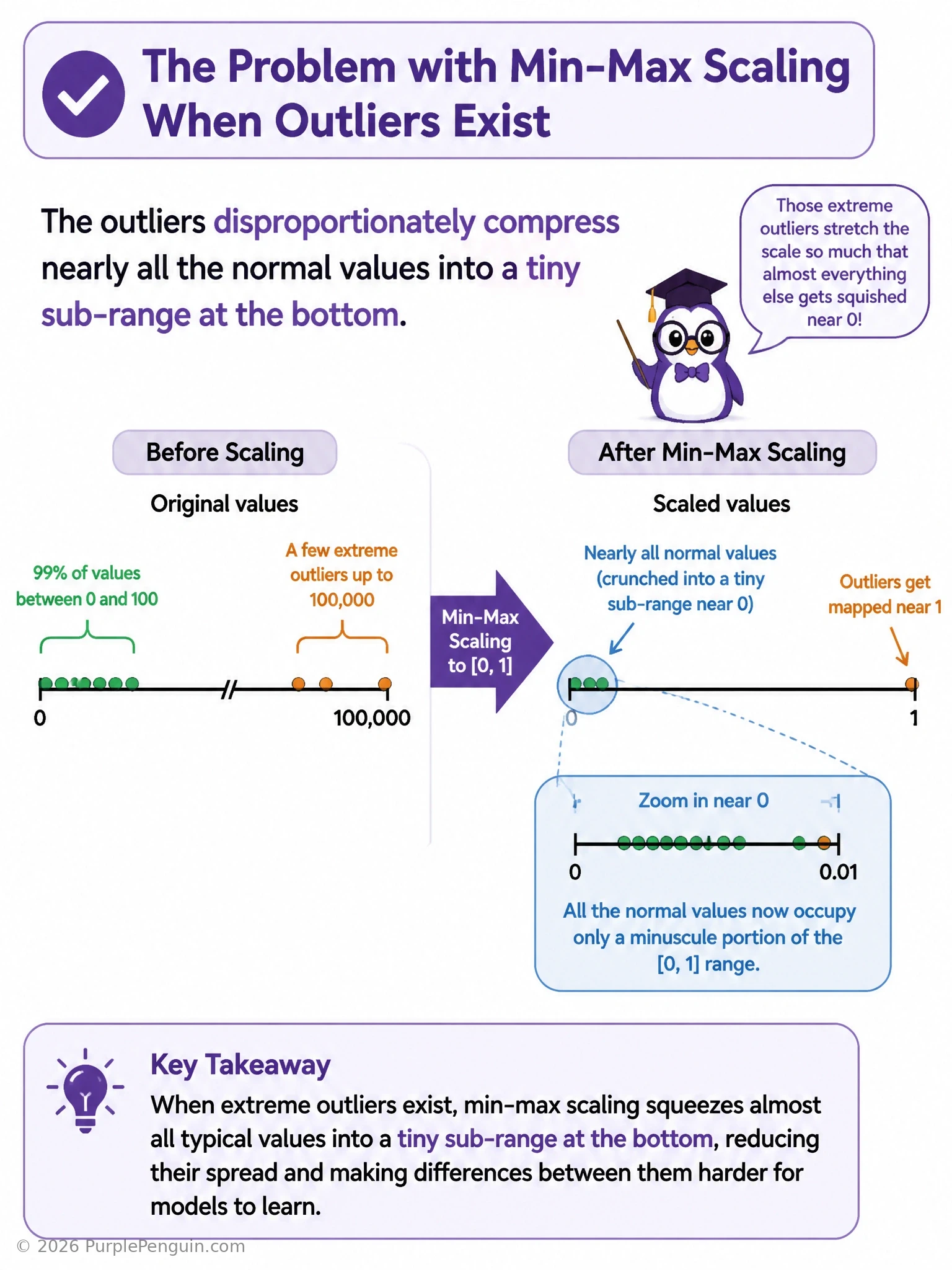
Min-max scaling is dead simple math: subtract the minimum, divide by the range (max minus min). The catch is that it uses the absolute max and min, so if you've got one wild outlier way out at 100,000, that number becomes your new max — and suddenly your entire well-behaved cluster of values between 0 and 100 gets squashed into a razor-thin sliver near zero. That's the real problem: outliers disproportionately compress everything else, which is exactly the correct answer here. Min-max scaling doesn't throw errors over outliers, it just quietly does the math and gives you a lousy result. It doesn't turn a numeric feature categorical — scaling never changes the feature's fundamental type. And it definitely doesn't remove outliers; scaling transforms values, it doesn't filter or delete rows.
Full explanation below image
Full Explanation
Min-max normalization rescales a feature using the formula x_scaled = (x - min) / (max - min), mapping the minimum value in the dataset to 0 and the maximum value to 1, with everything else scaled proportionally in between. Because this formula depends entirely on the observed minimum and maximum, it is extremely sensitive to outliers. If the vast majority of a feature's values lie in a tight, reasonable range (say 0 to 100) but a small number of extreme outliers exist far outside that range (say 100,000), those outliers become the new max used in the denominator. As a result, the normal, well-behaved 99% of values get compressed into a very narrow band close to 0, since they are all tiny relative to the extreme max. This destroys much of the useful variance and relative differences among the typical values, making it hard for a model to distinguish between them, and can significantly degrade training quality or convergence.
Min-max scaling does not throw an error in the presence of outliers; the transformation formula executes without any exception regardless of the data distribution, it simply produces a poor-quality scaling result rather than failing outright. Detecting this problem requires the practitioner to inspect the resulting distribution, not rely on an error being raised.
Min-max scaling has no effect on the type of the feature; a continuous numeric feature remains continuous and numeric after scaling; the transformation only changes the numeric range of the values, it never converts a feature into categories or bins.
Min-max scaling also does not remove or filter outliers from the dataset; every original value, including the extreme ones, is transformed and retained, just mapped into the new [0, 1] range. Handling this problem typically requires a separate step such as outlier removal or clipping, or choosing a more robust scaling technique like standardization (z-score normalization) or robust scaling based on the median and interquartile range, which are less sensitive to extreme values than min-max scaling.