A computer vision team needs to efficiently load thousands of images in shuffled mini-batches during PyTorch training, ideally using multiple worker processes in parallel. Which class is designed for this?
Select an answer to reveal the explanation.
Short Explanation and Infographic
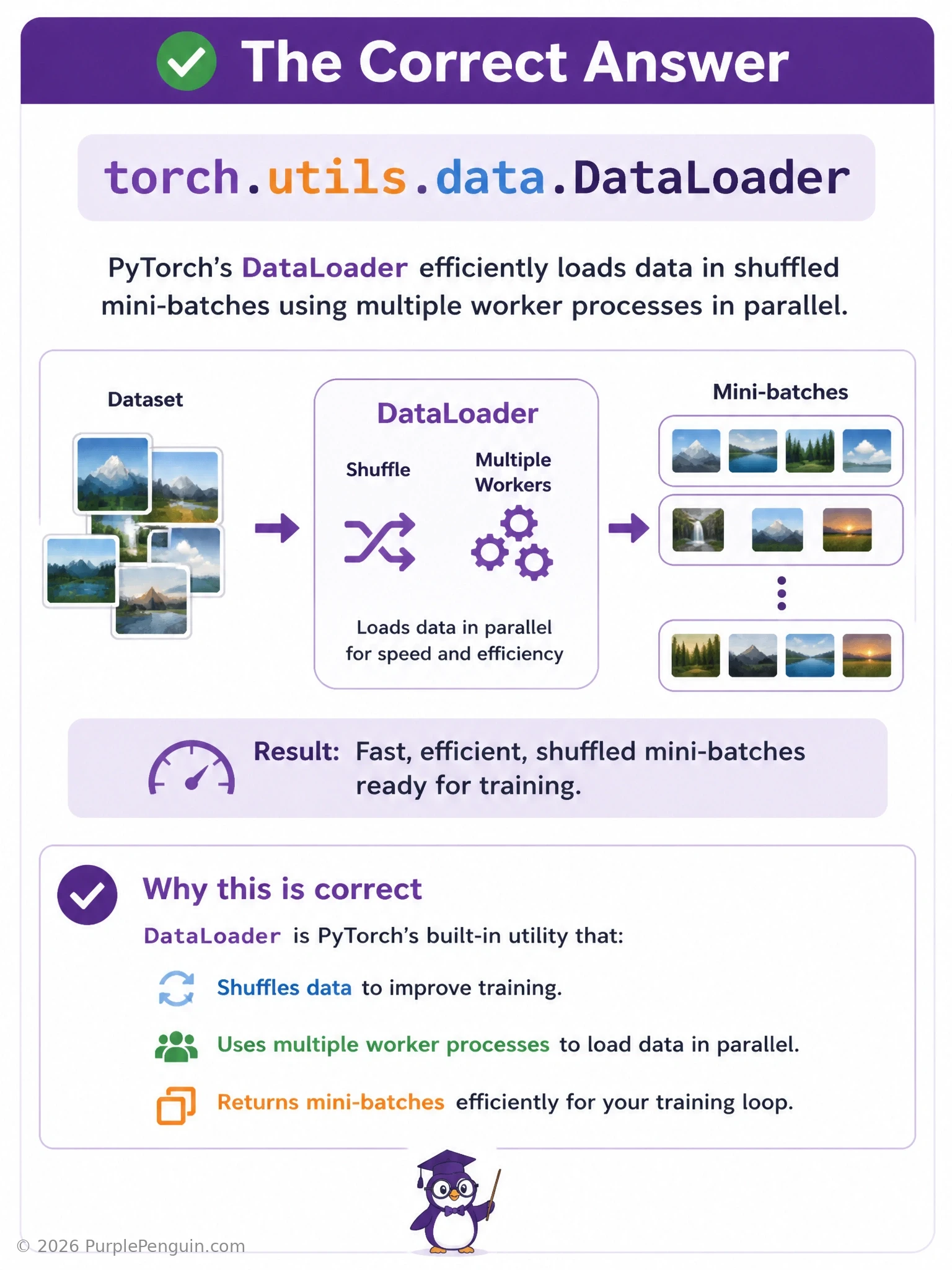
This is a textbook job for torch.utils.data.DataLoader. Pair it with a Dataset that knows how to fetch and transform one image at a time, and DataLoader takes care of the rest — grouping images into batches, shuffling the order each epoch, and, with num_workers set above zero, spinning up multiple background processes to load and preprocess images in parallel so your GPU never sits around waiting on the CPU. That's exactly the efficient, parallel, shuffled batching the team needs, making DataLoader the right answer. nn.Sequential is for stacking layers into a simple model, not for loading data. torch.optim.Adam is an optimization algorithm that updates weights, completely unrelated to reading images off disk. And torch.nn.functional is a collection of stateless operations like activation functions and convolutions — useful inside a model's forward pass, but it has nothing to do with feeding batched data into training.
Full explanation below image
Full Explanation
torch.utils.data.DataLoader is the PyTorch class specifically designed to efficiently load data — including large image datasets — in mini-batches during training or evaluation. It wraps a Dataset object (which defines how a single sample is fetched and, often, how it is transformed, e.g., resized, normalized, augmented) and provides an iterable that yields batches of a specified size. DataLoader supports shuffling the sample order at the start of each epoch (via the shuffle argument), which helps prevent the model from learning spurious patterns tied to data ordering, and it supports parallel data loading through the num_workers argument, which spawns multiple worker subprocesses to read and preprocess samples concurrently. This parallelism is especially valuable for image datasets, where decoding and transforming images (resizing, cropping, augmentation) can be CPU-intensive and would otherwise bottleneck GPU-based training if done serially on the main process.
torch.nn.Sequential is a container class used to define a model by stacking layers in order, allowing a quick way to build simple feedforward architectures without manually writing a full forward() method. It has no role in data loading, batching, or shuffling; it is purely about defining a model's structure.
torch.optim.Adam is an optimization algorithm implementing the Adam update rule, used to adjust model parameters based on computed gradients during training. It operates entirely downstream of data loading — by the time Adam's step() is called, a batch has already been loaded, passed through the model, and used to compute a loss and gradients. It has no involvement in reading or batching images.
torch.nn.functional is a module providing stateless functional implementations of operations such as activation functions (relu, softmax), convolution operations, and pooling operations, typically used inside a model's forward pass. It provides computational building blocks for the network itself, not a mechanism for loading, batching, or shuffling data from disk.
Memory aid: Dataset defines how to get one sample, DataLoader defines how to efficiently batch, shuffle, and parallelize the delivery of many samples, and both are entirely separate from the model-building tools (nn.Sequential, nn.functional) and the optimization tools (torch.optim) that operate later in the training pipeline.