During model development, why do teams hold out a separate validation set instead of just training and testing on the same data split?
Select an answer to reveal the explanation.
Short Explanation and Infographic
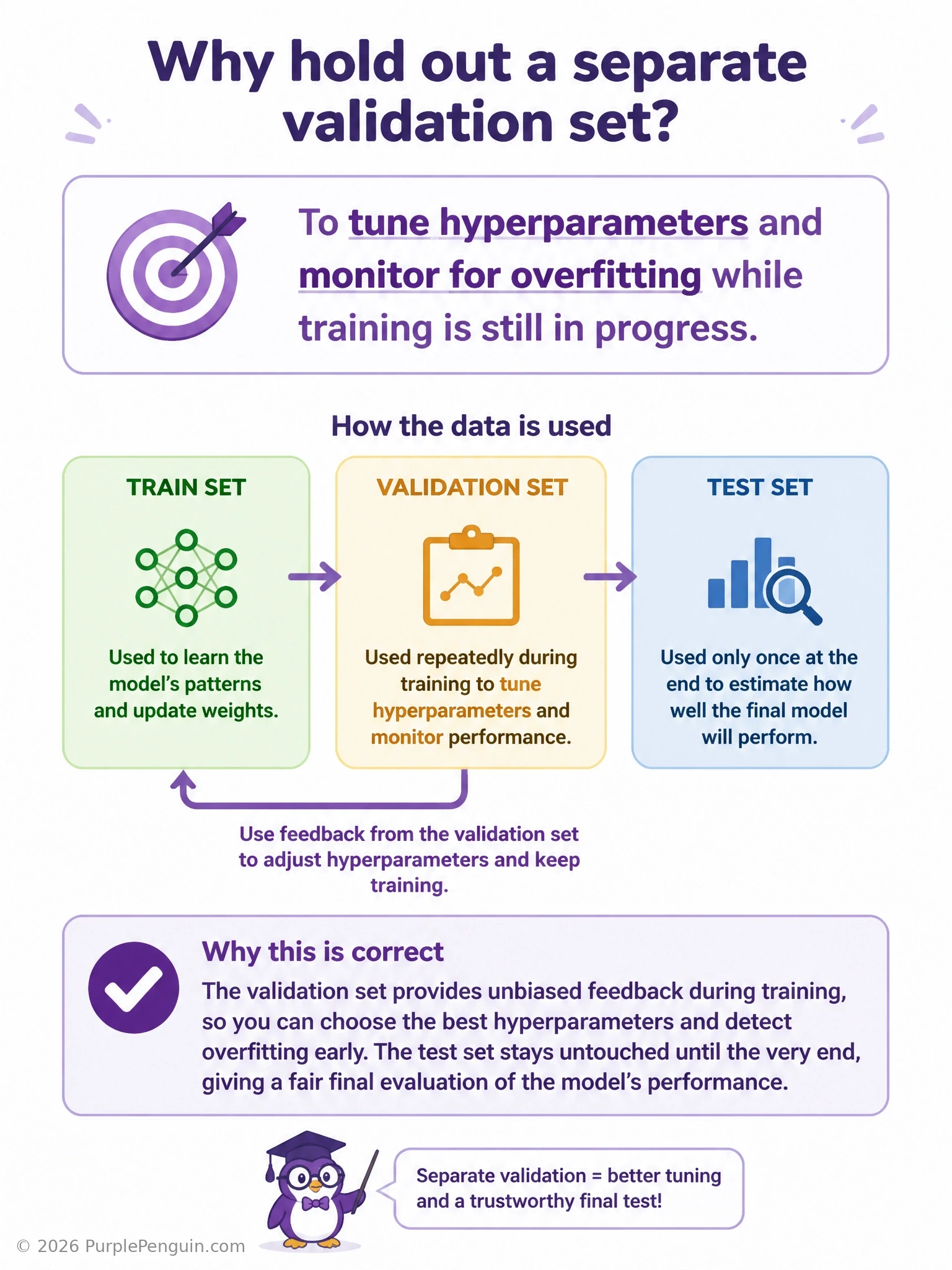
Here's why the validation set exists: you need data the model isn't directly trained on, so you can check in periodically and get an honest read on how it's actually generalizing, not just memorizing. That lets you tune learning rate, depth, regularization, or epoch count, and it's your early-warning system for overfitting — if training loss keeps dropping but validation loss climbs, the model's memorizing noise. That's answer D. It's not a place to store final weights — that's a checkpoint file, unrelated. It doesn't add more training data either — it's deliberately held out. And it doesn't replace the test set — the test set is the truly final, untouched holdout you check once at the end, after validation decisions are locked in, so they don't leak into your final performance estimate.
Full explanation below image
Full Explanation
A validation set is a portion of data deliberately withheld from the training process and used throughout model development to evaluate performance on unseen examples without ever being directly optimized against. Its primary purposes are twofold: first, to guide hyperparameter tuning (such as learning rate, network architecture choices, regularization strength, batch size, or number of training epochs) by comparing how different configurations perform on data the model has not memorized; and second, to monitor for overfitting during training by tracking validation loss or accuracy alongside training loss or accuracy. When training loss continues to improve while validation loss plateaus or worsens, that divergence is a clear signal that the model is beginning to memorize training-specific noise rather than learning patterns that generalize, prompting interventions like early stopping, added regularization, or reduced model complexity.
The first distractor confuses a validation set with a model checkpoint or saved weights file; storing final trained weights is an entirely separate engineering concern (serialization/persistence) unrelated to what a validation split is used for during development. The second distractor is incorrect because a validation set is explicitly excluded from the training data precisely so it can provide an unbiased signal about generalization; folding it back into training would eliminate the very unseen-data property that makes it useful for tuning and overfitting detection. The third distractor is incorrect because the validation set and test set serve different, complementary roles: the validation set is used repeatedly during development to make modeling decisions, which means those decisions become implicitly tailored to it over time, whereas the test set must remain completely untouched until the very end of development to provide a truly unbiased, final estimate of real-world generalization performance; using the validation set as a substitute test set would contaminate that final estimate with information the model's design has already adapted to.
The standard three-way split, training, validation, and test, exists precisely to separate three different jobs: learning parameters (training set), tuning decisions and catching overfitting mid-flight (validation set), and producing one unbiased final performance number after all decisions are locked in (test set). A common memory aid is 'train to learn, validate to tune, test to judge,' capturing that each split has a distinct, non-interchangeable role in preventing data leakage and overly optimistic performance claims.