In classification evaluation, what does the accuracy metric represent?
Select an answer to reveal the explanation.
Short Explanation and Infographic
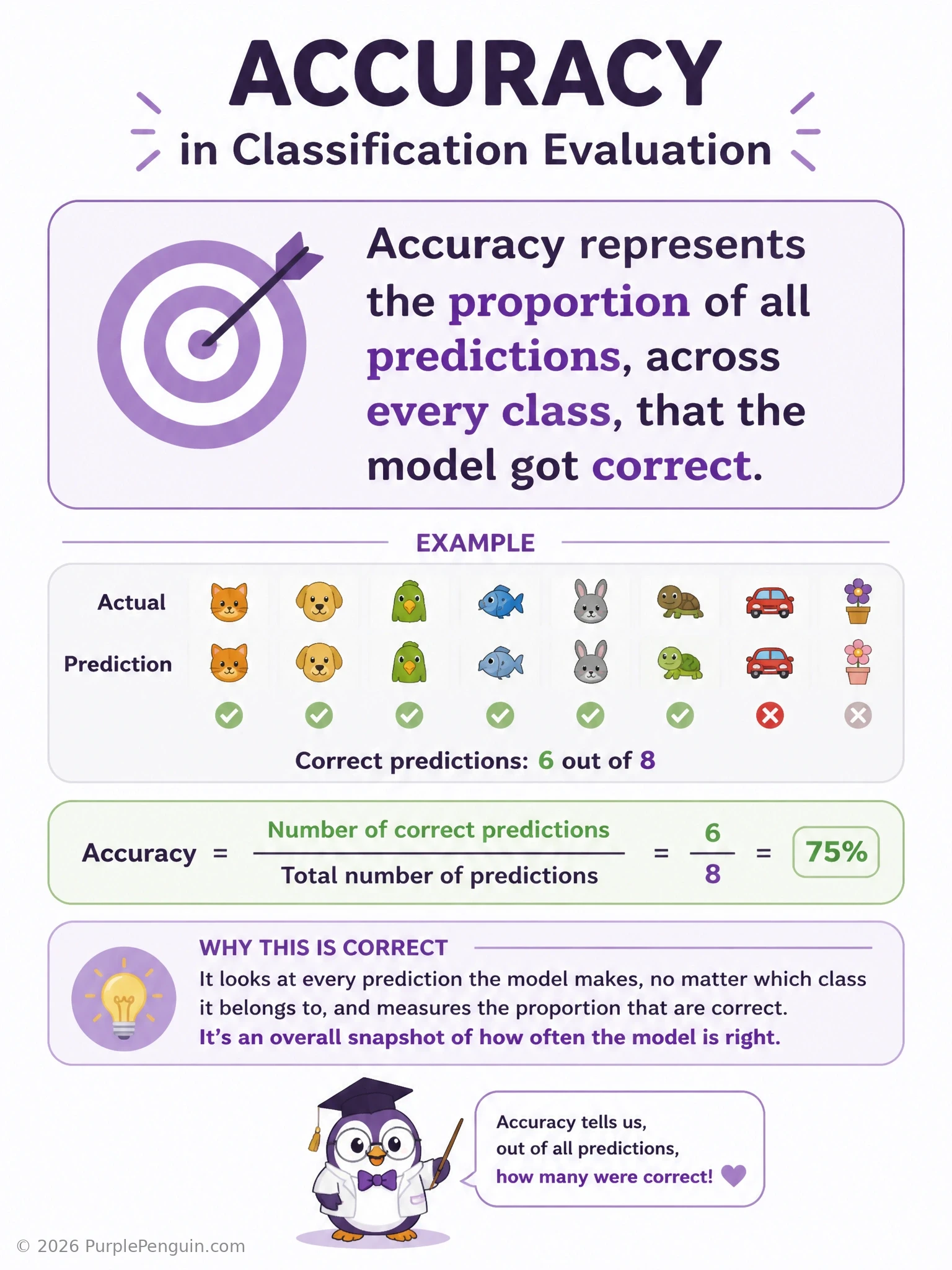
Accuracy is the simplest metric in the whole toolbox — it's just asking 'out of everything I predicted, how much did I get right, period.' Take every correct prediction, true positives plus true negatives, and divide by the total number of cases you predicted on. That's it. That's answer A. Now, don't mix that up with precision, which is a narrower question about only the positive predictions you made — of the things you called positive, how many actually were? And don't confuse it with recall either, which flips it around and asks, of all the actual positives out there, how many did you actually catch? Those are both about the positive class specifically. Accuracy doesn't care about positive versus negative at all, it just tallies every correct call across the whole dataset. And average distance between predicted and actual values is a regression concept entirely, like something you'd use for MSE or MAE, not classification accuracy.
Full explanation below image
Full Explanation
Accuracy is defined as the total number of correct predictions divided by the total number of predictions made, expressed as (true positives + true negatives) / (true positives + true negatives + false positives + false negatives). It treats every correctly classified case as equally valuable regardless of which class it belongs to, making it a simple, class-agnostic summary of overall correctness across the entire test set. This makes it easy to interpret and communicate, but it also means accuracy can be misleading on imbalanced datasets, since it does not separately reveal how well the model performs on any specific class.
The proportion of predicted positives that were actually positive describes precision, not accuracy; precision only considers the subset of cases the model labeled as positive and asks how many of those labels were correct, ignoring the negative class and any positives the model missed entirely, which makes it a fundamentally narrower measure than accuracy's whole-dataset scope. The proportion of actual positives that the model successfully identified describes recall (also called sensitivity), which looks only at the true positive population and asks how many of them were caught, again ignoring the negative class and therefore distinct from accuracy's all-encompassing calculation. The average distance between predicted and actual numeric values describes an error metric used in regression tasks, such as mean absolute error or mean squared error, and has no direct application to classification accuracy, which deals with discrete correct-versus-incorrect labels rather than continuous numeric distances.
A helpful way to keep these straight: accuracy answers 'how often was I right overall,' precision answers 'when I said yes, was I right,' and recall answers 'of all the actual yeses, how many did I find.' Accuracy is a fine headline number on balanced datasets, but on skewed class distributions it should always be reported alongside precision, recall, or a full confusion matrix so that per-class performance isn't hidden behind one aggregate percentage.