In gradient-based training, what is the primary role of the learning rate hyperparameter?
Select an answer to reveal the explanation.
Short Explanation and Infographic
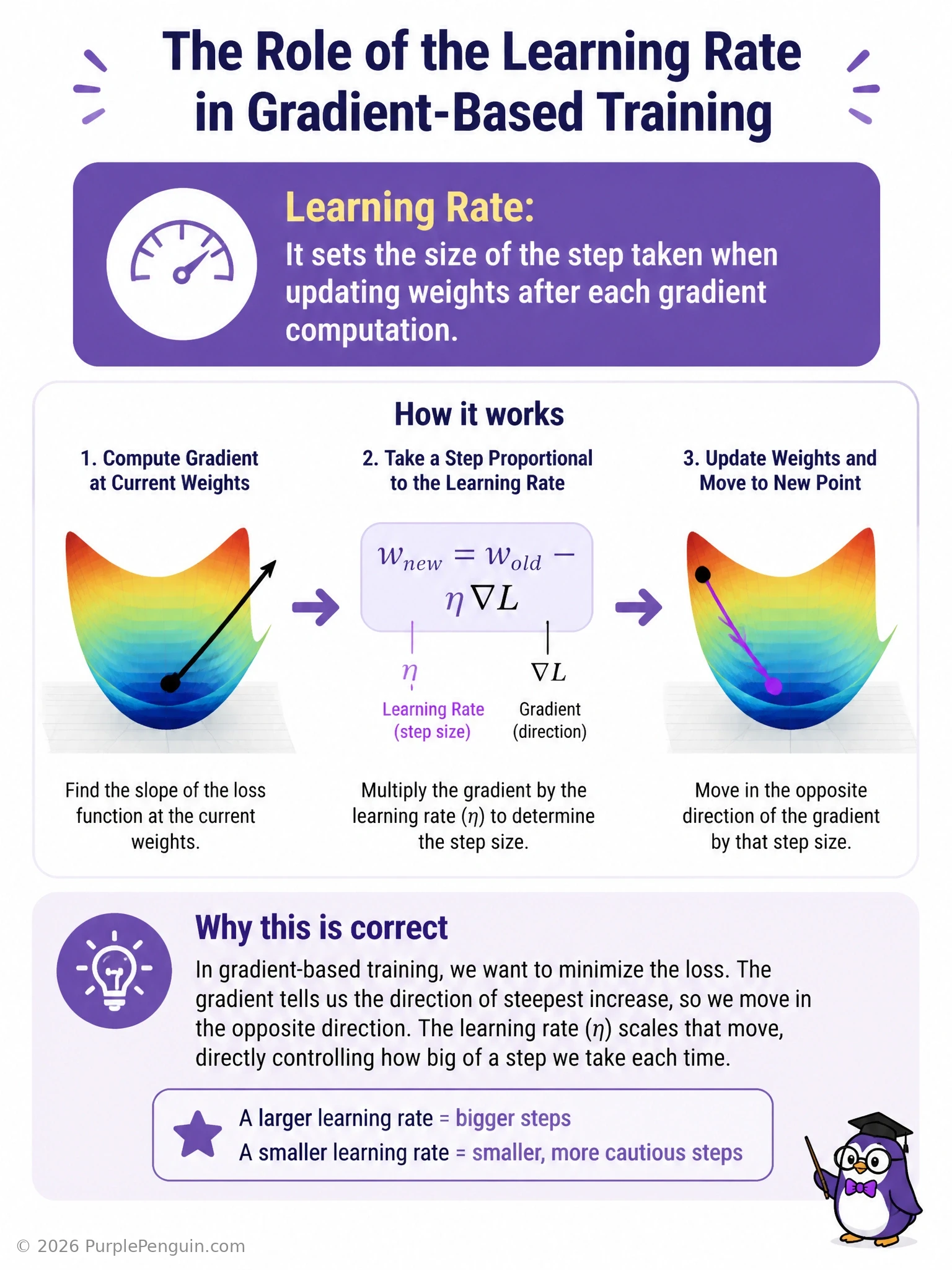
Wait, let's be honest with ourselves here for a second: the learning rate has nothing to do with how many layers your network has. That's architecture, decided before training even starts. What the learning rate actually does is control the SIZE of the step you take when you update your weights, once you've already computed the gradient. Think of the gradient as pointing you 'downhill' toward lower loss, and the learning rate as how big a stride you take in that direction. Too big a stride and you overshoot and bounce around, maybe even diverge. Too small and you crawl toward the minimum forever. So the real correct idea is: the learning rate scales the magnitude of every weight update during backprop. It doesn't touch the loss function choice — that's a separate design decision — and it definitely doesn't control dataset size, that's just however much data you collected.
Full explanation below image
Full Explanation
The learning rate is a scalar hyperparameter that multiplies the computed gradient before it is subtracted from the current weights during each update step: weight_new = weight_old - learning_rate * gradient. Its sole purpose is to control the magnitude of each parameter update once the gradient direction has already been determined by backpropagation. A well-chosen learning rate lets the optimizer take steps large enough to make meaningful progress toward the loss minimum without being so large that updates overshoot the minimum and cause the loss to oscillate or diverge, and without being so small that training crawls and requires an impractical number of iterations to converge.
The option stating it determines how many layers the network has is incorrect because network depth and layer count are architectural decisions made when the model is designed, entirely independent of the optimizer's hyperparameters; changing the learning rate never adds or removes a layer. The option stating it decides which loss function the model uses is incorrect because the loss function is a separate design choice (for example, cross-entropy for classification or mean squared error for regression) that defines what quantity the gradient is even being computed from; the learning rate only scales the resulting gradient step and has no bearing on which loss formula is used. The option stating it controls how many training examples exist in the dataset is incorrect because dataset size is fixed by the data collection and preparation process, not by any training hyperparameter — the learning rate never adds, removes, or samples data points.
A practical way to remember this: the gradient tells you which direction downhill is, and the learning rate tells you how far to step in that direction. This is also why learning rate schedules and decay strategies exist — they adjust that step size over the course of training, typically starting larger for faster early progress and shrinking later for finer convergence near the minimum, without ever touching architecture, loss function, or dataset composition.