
What is a practical benefit of using the RMSprop optimizer over plain SGD with a single fixed learning rate?
Select an answer to reveal the explanation.
Short Explanation
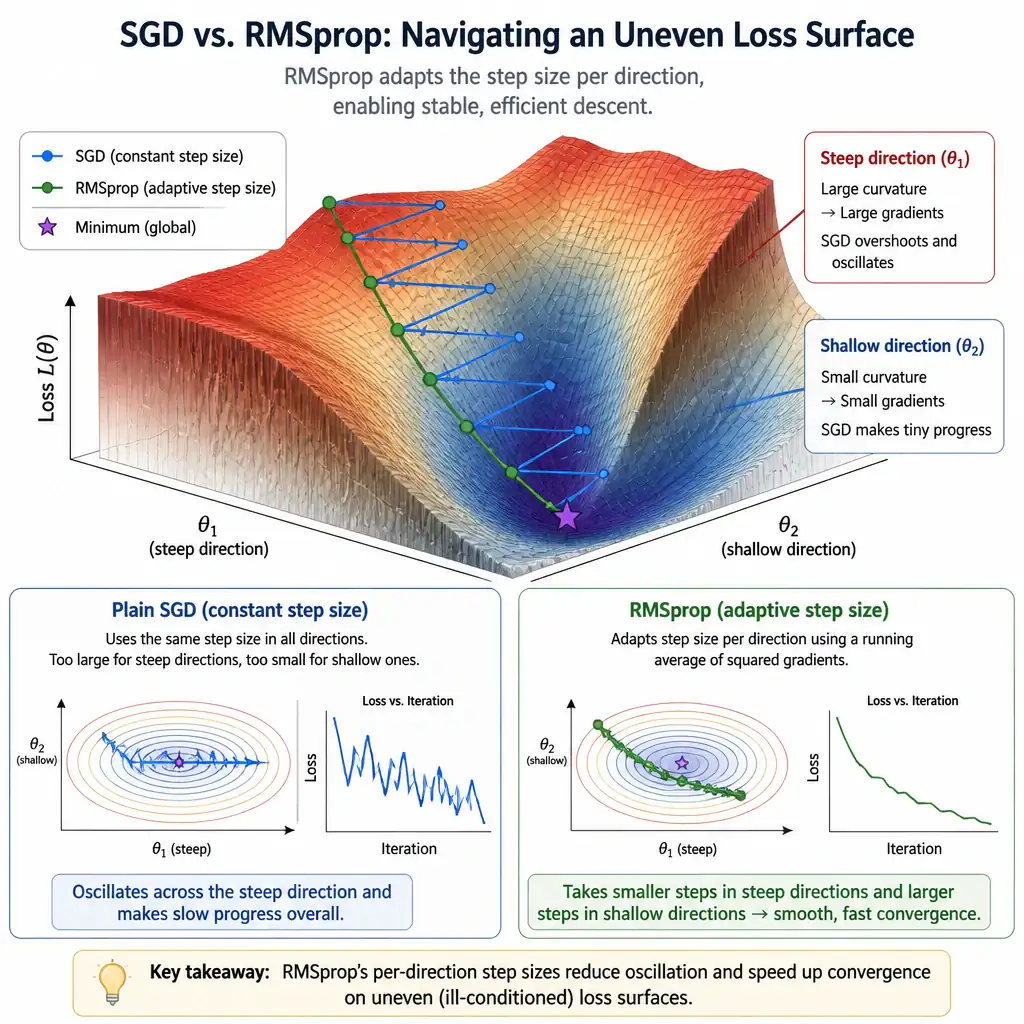
Plain SGD with one fixed learning rate treats every single parameter the same way, which is rough when your loss surface has steep cliffs in some directions and gentle slopes in others — one fixed step size just isn't right for all of them at once. RMSprop fixes that by dividing each parameter's update by a decaying average of that parameter's own squared gradients, so parameters getting big consistent gradients automatically get smaller effective steps, and parameters getting small gradients get relatively bigger steps. That's the correct answer, and it's a big reason RMSprop trains more smoothly on tricky, uneven loss landscapes — especially handy for recurrent networks. It doesn't guarantee zero oscillation, that's too strong a claim for any optimizer. It doesn't remove the need to pick an initial learning rate, you still set a base rate that RMSprop then adapts per parameter. And it has nothing to do with converting a classification problem into a regression one — that's determined by your loss function and output layer, not your optimizer.
Full Explanation
RMSprop improves upon plain SGD with a single fixed learning rate by maintaining a per-parameter, exponentially decaying moving average of squared gradients, and dividing the learning rate for each parameter by the square root of that average before applying the update. This means parameters associated with large, consistent gradients (steep directions in the loss surface) receive a smaller effective step size, while parameters with small or infrequent gradients (shallow directions) receive a relatively larger effective step. This per-parameter adaptivity helps training proceed more smoothly and stably on loss surfaces with very different curvature in different directions — a common challenge in deep and recurrent networks — compared to plain SGD, which applies the exact same learning rate uniformly to every parameter regardless of that parameter's gradient behavior.
Claiming that RMSprop guarantees the loss will never oscillate overstates its capability: while adaptive scaling helps reduce oscillation from uneven gradient magnitudes, it does not make training immune to instability under all circumstances. Claiming that RMSprop removes the need to choose an initial learning rate is incorrect because RMSprop still requires a base learning rate; what it adapts is the per-parameter scaling on top of that base rate, not the need for a base rate itself. Claiming that RMSprop converts a classification task into a regression task is incorrect because that choice is determined by the task's output representation and loss function, not by the optimizer used.
RMSprop was particularly influential for training recurrent neural networks, where gradients can vary dramatically in scale across time steps and parameters, making a single fixed learning rate poorly suited to the whole network. Its core mechanism — tracking a decaying average of squared gradients per parameter — was later combined with momentum (a decaying average of the raw gradients) in the Adam optimizer, which is now one of the most commonly used default optimizers across deep learning tasks.