
What is the main purpose of a loss function in training a deep learning model?
Select an answer to reveal the explanation.
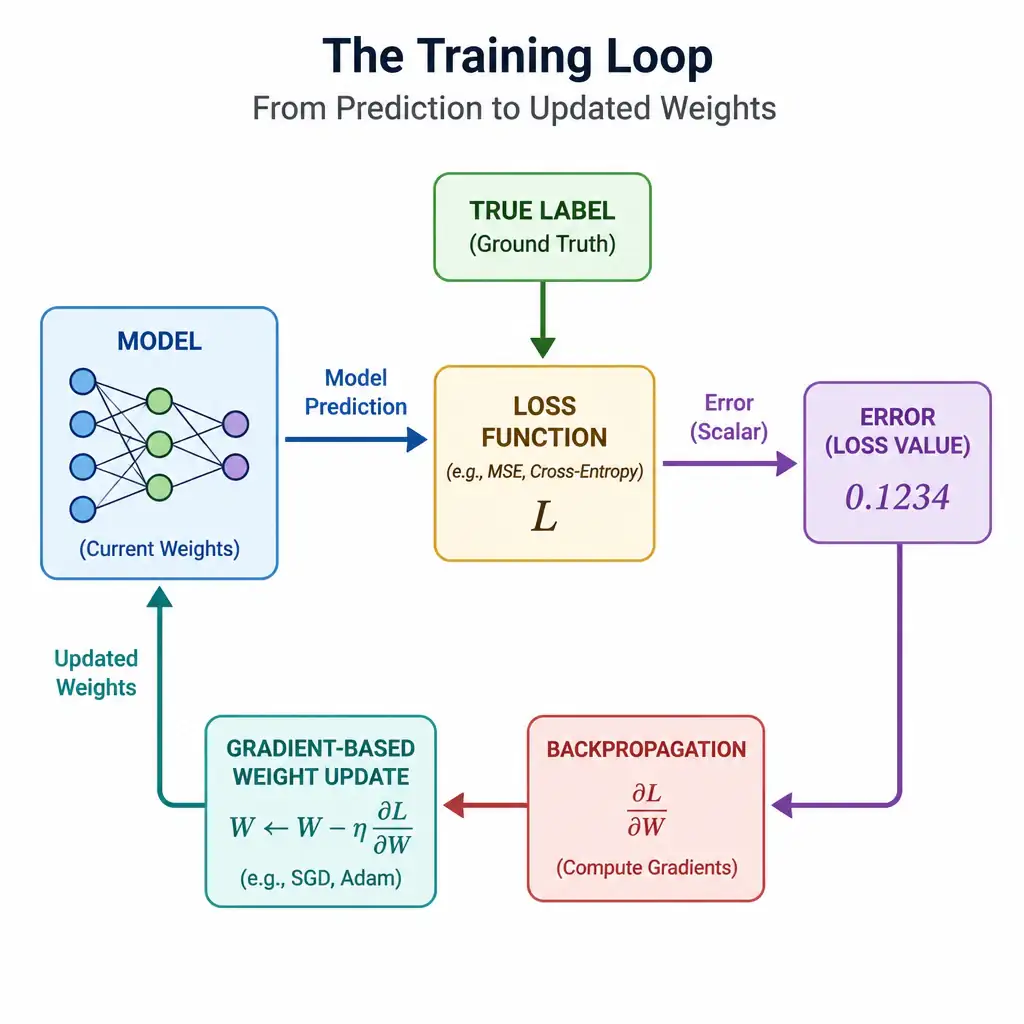
Short Explanation
A loss function is the model's report card, plain and simple. Every time the model makes a prediction, the loss function looks at how far off that prediction was from the actual answer and spits out a single number quantifying that error. That number is exactly what gradient descent uses to figure out which direction to nudge the weights. That's the correct answer, and it's the whole engine behind training. It has nothing to do with visualizing weights — that's a debugging or interpretability task, not the loss function's job. It doesn't decide how many layers your network has either — that's architecture design, a choice you or a search algorithm makes beforehand. And splitting data into train and validation sets is a data-handling step that happens completely separately from computing loss. The loss function's one job is: measure the error, feed it to the optimizer.
Full Explanation
A loss function (also called a cost function or objective function) takes the model's predictions and the corresponding ground-truth labels and produces a single scalar value representing how far off those predictions are. This scalar is the quantity that backpropagation differentiates with respect to every trainable parameter in the network, producing the gradients that gradient descent (or any optimizer built on it, such as Adam or RMSprop) uses to update weights in the direction that reduces the loss. Without a loss function, there would be no signal at all telling the optimizer whether an update improved or worsened the model's predictions.
Visualizing weights or activation maps is a separate diagnostic activity unrelated to computing training error — that is an interpretability technique, not the loss function's role. Choosing the number and type of layers in a network is architecture design, typically decided through domain knowledge, prior research, or hyperparameter/architecture search — not something the loss function determines. Splitting data into train/validation/test partitions is a data-preparation step that happens before training begins and is unrelated to the loss function's role of scoring predictions during training.
Different tasks call for different loss functions because they define "error" differently: mean squared error or mean absolute error for regression, cross-entropy (log loss) for classification, hinge loss for certain margin-based classifiers, and specialized losses like focal loss for imbalanced detection tasks. Choosing an appropriate loss function that matches the task and target distribution is one of the most consequential decisions in setting up a training pipeline, since it directly shapes what the optimizer is trying to minimize.