What does the mean squared error (MSE) loss function do?
Select an answer to reveal the explanation.
Short Explanation and Infographic
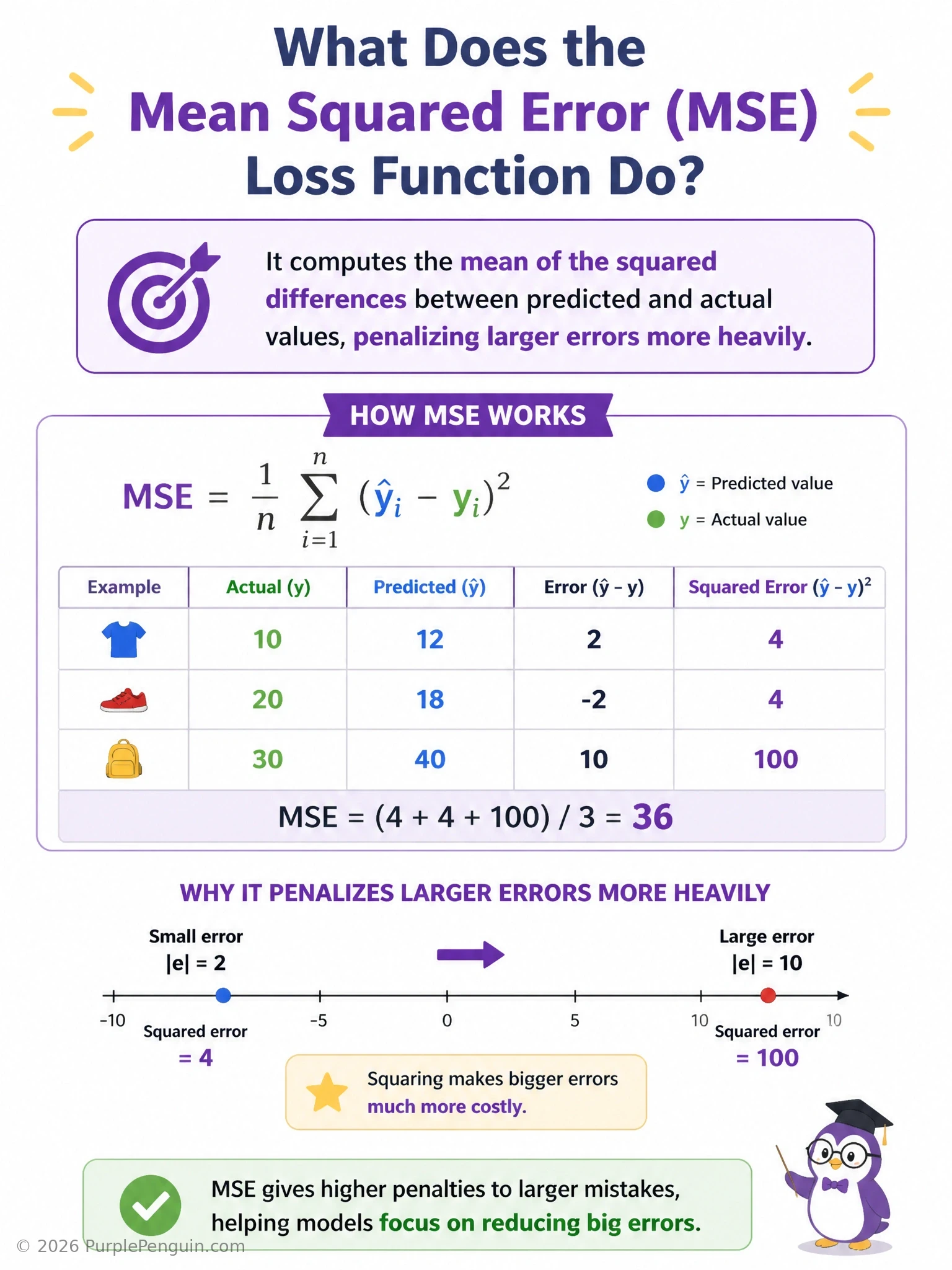
MSE does exactly what its name says: take each prediction's error, square it, then average all those squared errors. That's answer B. Why square it? Because squaring blows up big mistakes way more than small ones — miss by 2 and you get a penalty of 4, miss by 10 and you get slapped with 100. That makes MSE great when large errors are genuinely worse than small ones and you want the model to really hate big misses. The harmonic mean of precision and recall is the F1 score, a classification metric, totally different territory. Counting correctly classified examples out of the total is accuracy, again a classification concept, not a regression loss. And the average absolute distance without squaring is MAE, MSE's more outlier-tolerant cousin. Keep MSE and MAE straight by remembering: MSE squares, MAE doesn't.
Full explanation below image
Full Explanation
Mean squared error is computed as MSE = (1/n) * sum((y_actual - y_predicted)^2), averaging the squared residual for every prediction in the dataset. Because each error term is squared before averaging, larger errors contribute disproportionately more to the final loss value than smaller errors do — an error of 10 contributes 100 to the sum, while an error of 2 contributes only 4. This property makes MSE a natural default loss for regression tasks where large deviations from the true value are considered especially undesirable and should be penalized more aggressively than small ones.
The first distractor describes the F1 score, the harmonic mean of precision and recall used to evaluate classification models on tasks with class imbalance; it has nothing to do with measuring numeric prediction error in regression. The second distractor describes accuracy, the proportion of correctly classified examples over the total number of examples, another classification metric rather than a regression loss function. The third distractor describes mean absolute error (MAE), which computes the average of the absolute value of each residual rather than squaring it; MAE penalizes all errors linearly and is therefore more robust to outliers than MSE, which is the key practical distinction between the two.
MSE's sensitivity to large errors is both its strength and its weakness: it is desirable when outliers represent genuinely important cases that must be minimized (for example, in safety-critical forecasting), but it can be undesirable when the dataset contains noisy outliers that shouldn't dominate the training signal, in which case MAE or a robust loss like Huber loss (which behaves like MSE for small errors and like MAE for large ones) may be preferred. MSE is also mathematically convenient because it is smooth and differentiable everywhere, making it easy to optimize with gradient-based methods, and it corresponds to the maximum likelihood estimate under an assumption of Gaussian-distributed errors.