Why do most image-classification CNN architectures end with one or more fully connected layers after the convolutional and pooling layers?
Select an answer to reveal the explanation.
Short Explanation and Infographic
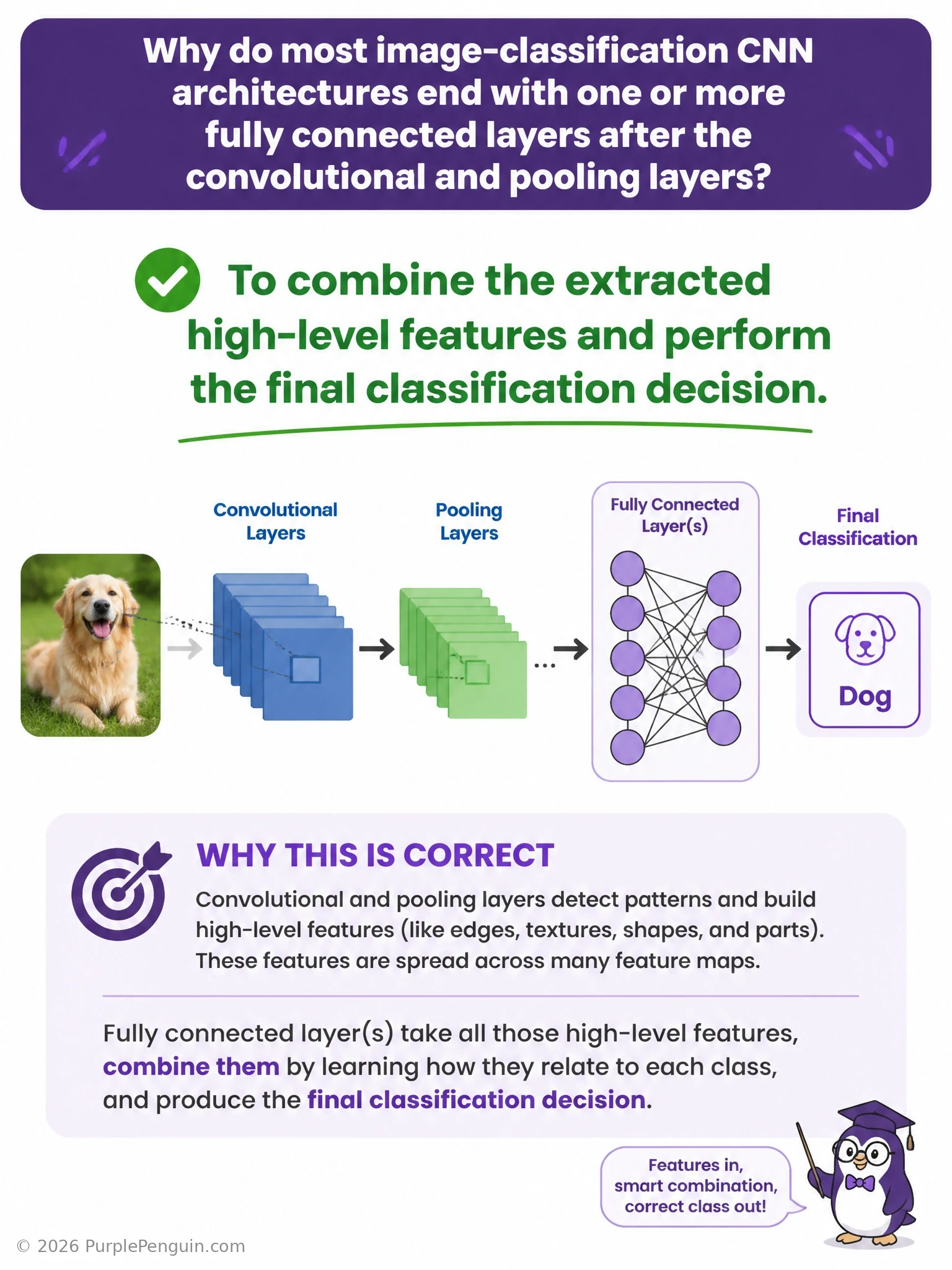
By the time data reaches the end of a CNN's convolutional and pooling stack, it's already been distilled into a rich set of high-level features — shapes, object parts, textures, all the good stuff the network learned to detect. The fully connected layers at the end take those extracted features, flattened into a vector, and combine them together to make the actual classification call, like 'this is a cat' versus 'this is a dog.' That combining-and-deciding role is exactly why it's the right answer. Detecting low-level edges is the job of the earliest convolutional layers, not the final dense ones. Reducing spatial resolution is what pooling layers do, and that happens throughout the conv stack, not at the very end. And normalizing activations is batch normalization's job, a separate technique that can appear throughout a network, not something specific to the final fully connected layers.
Full explanation below image
Full Explanation
In a typical CNN designed for image classification, the convolutional and pooling layers act as a hierarchical feature extractor: early layers detect simple, low-level patterns like edges and color blobs, and progressively deeper layers combine these into increasingly complex and abstract features, such as textures, object parts, and eventually whole-object representations. Once this feature extraction is complete, the resulting feature maps are flattened into a single vector and passed into one or more fully connected (dense) layers. These final dense layers take the full set of extracted high-level features as input and learn to combine them in whatever way is most useful for producing the final classification output, typically culminating in an output layer with a softmax activation that produces a probability distribution over the target classes. The fully connected layers can be thought of as the 'decision-making' portion of the network, translating rich extracted features into a specific classification outcome.
The first distractor is incorrect because detecting low-level features such as edges is characteristically the job of the earliest convolutional layers operating close to the raw pixel input, not the fully connected layers that appear at the very end of the network after feature extraction is already complete.
The second distractor is incorrect because reducing spatial resolution is the role of pooling layers (such as max pooling or average pooling), which are interspersed throughout the convolutional portion of the network to progressively downsample feature maps; fully connected layers operate on an already-flattened 1D vector and have no spatial structure left to reduce.
The third distractor is incorrect because normalizing activations describes batch normalization, a separate technique that can be inserted after convolutional (or dense) layers throughout a network to stabilize and speed up training; it is not a defining or exclusive characteristic of the fully connected layers placed at the end of a CNN.
Memory aid: think of the convolutional/pooling stack as the CNN's 'eyes,' extracting and building up features, while the fully connected layers at the end act as the 'brain,' weighing all those extracted features together to reach a final classification decision.