In the context of a convolutional neural network, what does the term 'receptive field' refer to?
Select an answer to reveal the explanation.
Short Explanation and Infographic
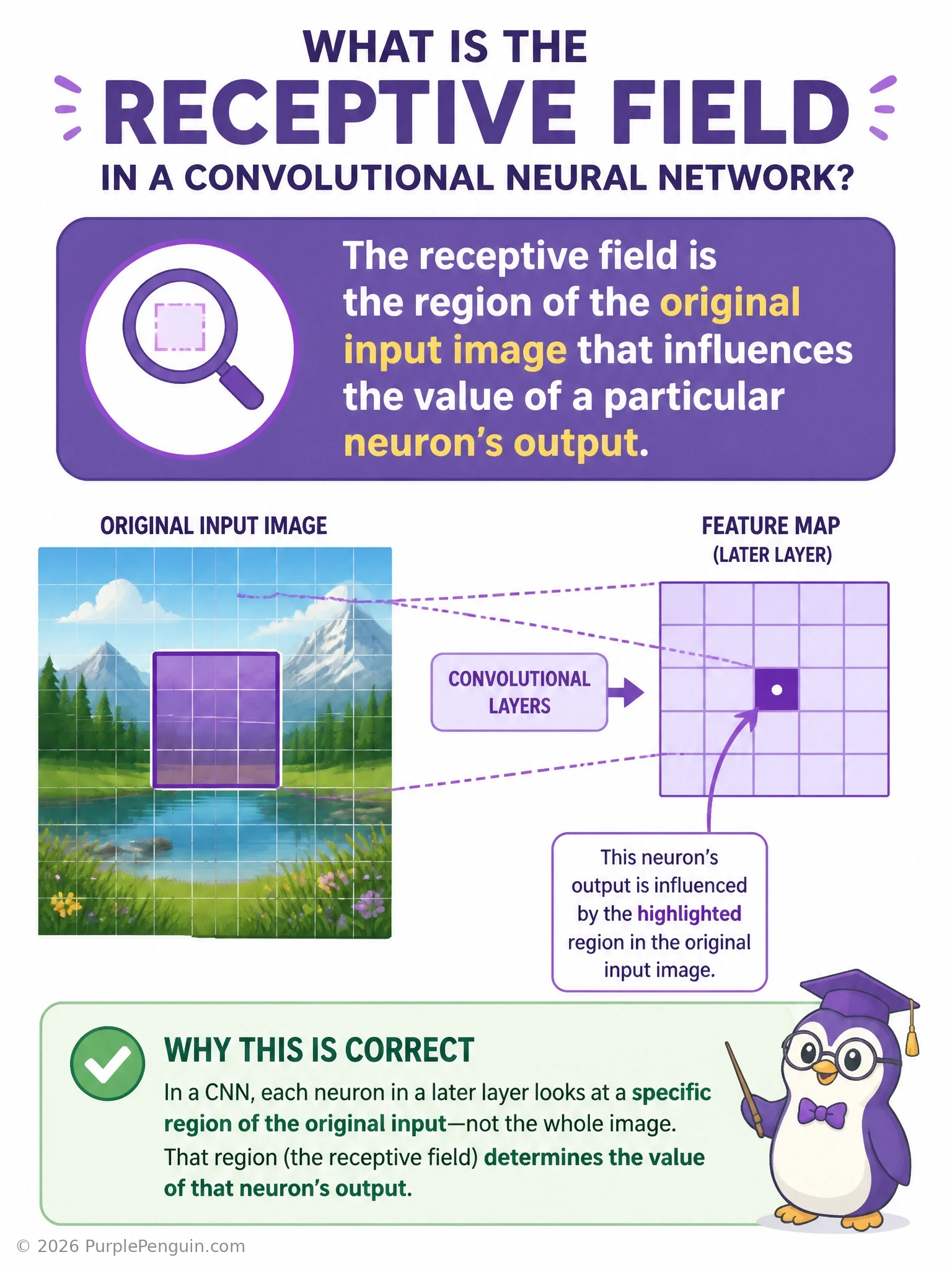
Think of the receptive field as a neuron's 'field of view' back into the original image. As you stack convolutional and pooling layers deeper into the network, each neuron ends up being influenced by a larger and larger patch of the original input, even though it's only directly connected to a small local region in the layer right before it. That growing 'field of view' back to the input is the receptive field, so the region-of-input answer is correct. It has nothing to do with counting trainable parameters — that's about weights and biases, a separate concept. It's not a learning rate schedule either, which governs how fast weights update. And it's definitely not about batch size, which is about how many samples you process together, not spatial influence on a neuron.
Full explanation below image
Full Explanation
The receptive field of a neuron in a convolutional neural network is the region of the original input (such as pixels in an input image) that can influence that neuron's activation. In the first convolutional layer, a neuron's receptive field is simply the size of the filter applied directly to the input (for example, a 3x3 filter gives a 3x3 receptive field at that layer). However, as the network gets deeper, each subsequent layer's neurons are computed from a local window of the previous layer's feature map, and because that previous layer's neurons themselves each depend on a region of the original input, the effective receptive field with respect to the original input grows with depth. Stacking multiple convolutional (and pooling) layers therefore allows deeper neurons to be influenced by, and thus 'see,' progressively larger regions of the original image, which is essential for a network to be able to recognize larger, more complex structures rather than just small local edges or textures.
The first distractor, the number of trainable parameters in a layer, refers to the count of weights and biases that layer learns (which for a convolutional layer depends on filter size, number of input channels, and number of filters), a completely separate concept from the spatial region of input that affects a neuron's output.
The second distractor, a learning rate schedule for convolutional layers, describes a training hyperparameter strategy governing how the optimizer's step size changes over time; it has no direct relationship to receptive fields, which are a purely architectural, geometric property of the network.
The third distractor, maximum batch size, refers to how many independent training examples are processed together in one forward and backward pass, a memory and throughput consideration unrelated to what portion of a single input image influences a given neuron.
Memory aid: receptive field equals 'how much of the original picture can this one neuron see,' and it naturally expands the deeper you go in a CNN, which is why deep CNNs can capture large-scale patterns like whole objects, not just edges.