
In a typical image-classification CNN, the convolutional layers extract low- and mid-level visual features like edges and textures. Which part of the network is responsible for combining those extracted features into the final, high-level representation used to make the classification decision?
Select an answer to reveal the explanation.
Short Explanation
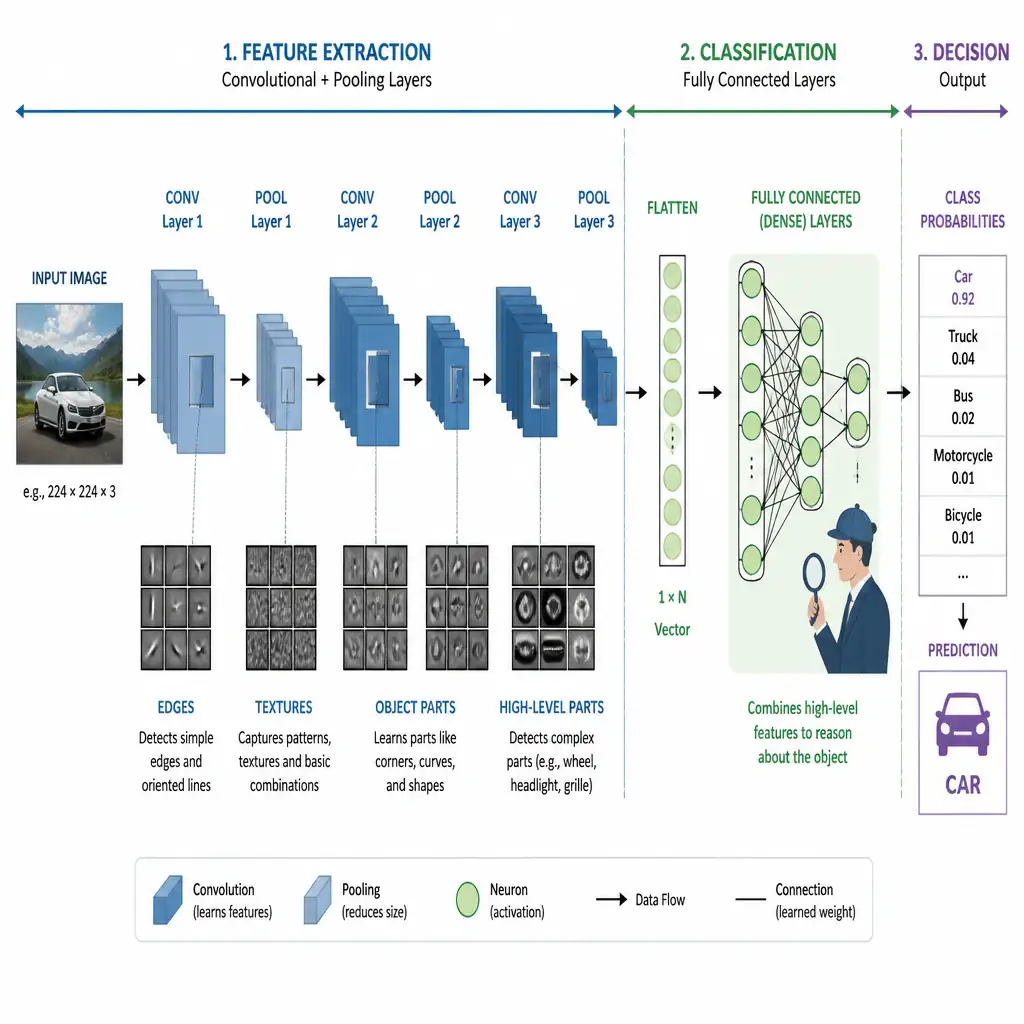
By the time your image data reaches the end of a CNN, the convolutional layers have already done the heavy lifting of pulling out edges, textures, and increasingly complex shapes. But those are still spatially organized feature maps — they need to get combined into an overall judgment. That's the fully connected layers' job: after flattening, every extracted feature gets connected to every neuron in the dense layer, letting the network learn how combinations of features (a wheel-like shape here, a windshield-like texture there) add up to 'this is a car.' Pooling just downsamples, it doesn't classify. Early convolutional filters only catch simple, low-level patterns like edges, not the whole picture. And stride is just a step-size setting for the convolution operation — it has nothing to do with combining features for a decision.
Full Explanation
In a standard CNN classifier, the convolutional and pooling layers act as a hierarchical feature extractor: early layers detect simple, low-level patterns (edges, color gradients), middle layers combine these into more complex shapes and textures, and later convolutional layers detect high-level, object-part-like features. However, these feature maps remain spatially structured. The fully connected (dense) layers near the end of the network take the flattened output of this feature-extraction hierarchy and learn to combine those high-level features into the final decision boundary for classification, weighing which combinations of detected features correspond to which output class. This is why CNN classifiers are typically structured as: convolution/pooling blocks for feature extraction, followed by a flattening step, followed by one or more fully connected layers, ending in a softmax (or similar) output layer.
The first distractor, pooling layers, perform spatial downsampling (e.g., max pooling selects the strongest activation in a local region) to reduce computation and add translation invariance, but they do not perform the classification combination step — they operate on and reduce feature maps, not combine them into a decision. The second distractor, the earliest convolutional layer, is responsible for detecting the simplest, most local visual patterns (like edges or color blobs); it operates far too early in the pipeline to be responsible for the final high-level classification decision, and its receptive field is much too small to see the whole object. The fourth distractor, the stride parameter, is simply a hyperparameter controlling how many pixels a convolutional filter shifts between applications — it affects the output feature-map size and computational cost, but it is not itself a layer or a mechanism for combining features into a decision.
Memory aid: think of the CNN as a factory line — convolution/pooling stages are the assembly stations building up parts (edges to shapes to object-parts), and the fully connected layers at the end are the inspector who looks at all the assembled parts together and decides what the final product is.
Prefer to study offline? Printable PDF study book + test engine ($7.50, unofficial). These questions stay free here.