An engineer builds a network with a single sigmoid output neuron trained to answer one question for each input image: is this digit a "9" or not? What kind of task is this?
Select an answer to reveal the explanation.
Short Explanation and Infographic
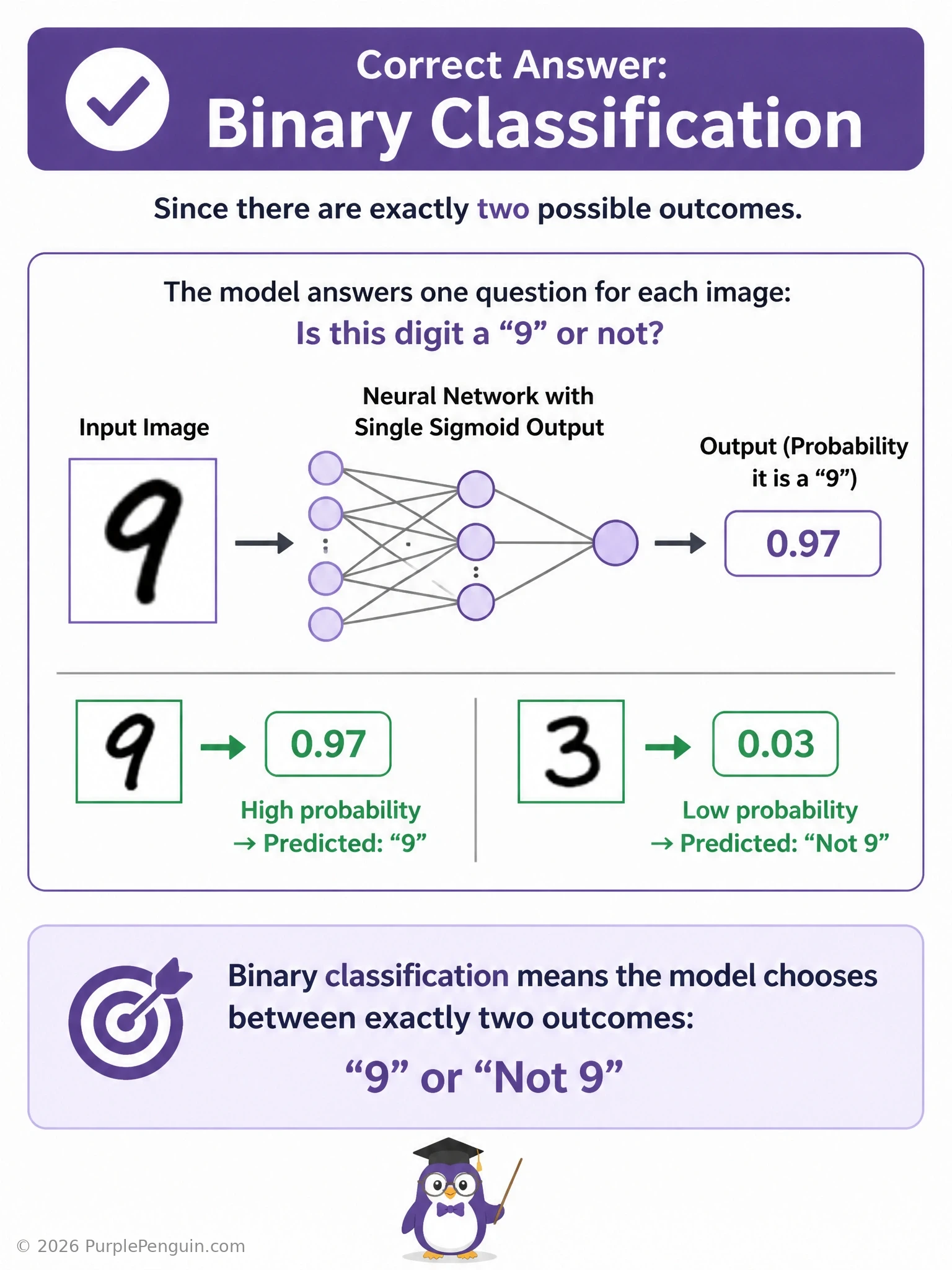
Think about what the model is really being asked: is it a 9, yes or no? That's exactly two possible outcomes, and a single sigmoid neuron squashes its output into a 0-to-1 value that we interpret as the probability of the positive class. That combination — one sigmoid neuron, two mutually exclusive outcomes — is the signature of binary classification, so that's your answer. It's not multi-class classification, because the model has collapsed the original ten digit classes down to just "9" versus "everything else" — only two buckets remain. It's not regression either; yes, the sigmoid output is a number between 0 and 1, but that number represents a probability used for a yes/no decision, not a continuous quantity we're trying to predict for its own sake. And there's no anomaly detection happening — the model was trained with explicit labels for both classes, not by learning what "normal" data looks like and flagging outliers.
Full explanation below image
Full Explanation
This is a binary classification task because the model is being trained to distinguish between exactly two mutually exclusive outcomes: "is a 9" versus "is not a 9." A single sigmoid output neuron is the standard architecture for binary classification because the sigmoid function maps any real-valued input to the range (0, 1), which can be interpreted as the estimated probability that the input belongs to the positive class. A threshold (commonly 0.5) is then applied to convert that probability into a hard yes/no decision.
The multi-class classification option is incorrect because, although the original dataset contains ten possible digit classes (0 through 9), this particular task has been reformulated as a one-vs-rest problem with only two labels: "9" and "not 9." Multi-class classification would require a softmax output layer with one neuron per class and would be used if the model were predicting which specific digit (0-9) an image represents, not a single yes/no distinction.
The regression option is incorrect because, despite the sigmoid producing a continuous-looking value between 0 and 1, that value is not itself the target of interest — it is used purely as a probability estimate for a categorical decision. Regression tasks predict continuous quantities like price, temperature, or age, where the numeric value itself is the answer, not a probability threshold used to assign a discrete label.
The unsupervised anomaly detection option is incorrect because the model in this scenario is trained with explicit ground-truth labels for both the "9" and "not 9" classes, making this supervised learning. Anomaly detection typically works by modeling what normal data looks like (often without labeled anomalies) and flagging inputs that deviate significantly from that learned normal distribution, which is a fundamentally different training setup.
Memory aid: a single sigmoid neuron plus two mutually exclusive labels equals binary classification; multiple softmax neurons plus multiple mutually exclusive labels equals multi-class classification.