Which core calculus concept provides the mathematical foundation that makes it possible to train a multi-layer neural network by propagating error signals backward through the network?
Select an answer to reveal the explanation.
Short Explanation and Infographic
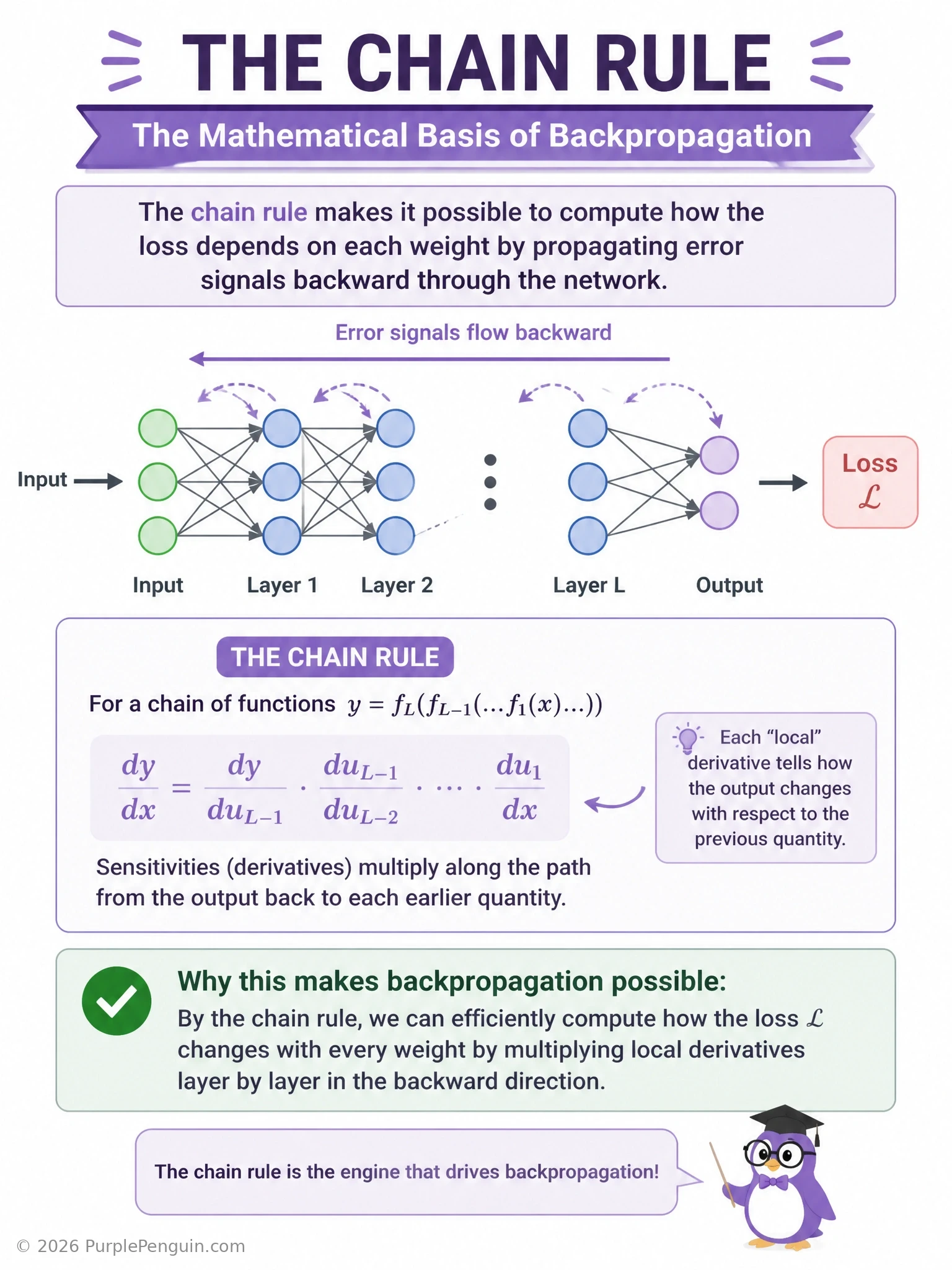
Here's the deal: a deep network is just a long stack of functions nested inside each other — layer 1 feeds layer 2, which feeds layer 3, and so on. To figure out how the final loss depends on a weight buried deep inside that stack, you need to multiply together a chain of local derivatives, layer by layer, all the way back to that weight. That's literally the chain rule from calculus, and it's the algorithm we call backpropagation, answer A. The fundamental theorem of calculus connects derivatives and integrals in a totally different context and isn't what powers backprop, despite the tempting-sounding name. L'Hopital's rule is a tool for evaluating tricky 0/0 or infinity/infinity limits, not for computing gradients through a network. And integration by parts is a technique for solving certain integrals, which has nothing to do with summing a batch's loss — that's just plain averaging or summation, no integral needed.
Full explanation below image
Full Explanation
Backpropagation is the algorithm used to train neural networks by computing the gradient of the loss function with respect to every weight in the network, and its mathematical foundation is the chain rule of calculus. A neural network is a composition of many functions: each layer applies a linear transformation followed by a nonlinear activation, and the output of one layer becomes the input to the next. The loss is therefore a deeply nested composite function of all the weights in the network. The chain rule states that the derivative of a composite function is the product of the derivatives of its constituent functions, evaluated at the appropriate points. Backpropagation applies this rule systematically, starting from the loss at the output layer and working backward, multiplying local derivatives (of activations and linear transformations) layer by layer to obtain the gradient with respect to every weight, no matter how deep it is in the network. This is what makes efficient, exact gradient computation possible in networks with many layers.
The fundamental theorem of calculus is incorrect because it establishes the relationship between differentiation and integration (that integration and differentiation are inverse operations), which is not the mechanism used to compute gradients through a composition of functions in a neural network.
L'Hopital's rule is incorrect because it is a technique for evaluating limits that produce indeterminate forms like 0/0 or infinity/infinity; it has no role in computing the gradients used to update neural network weights.
Integration by parts is incorrect because it is a technique for evaluating integrals of products of functions; it is unrelated to gradient computation, and aggregating a loss over a batch is simply a sum or average of per-example losses, not an integral requiring this technique.
Memory aid: 'network = nested functions; chain rule = the tool for differentiating nested functions; backprop = the chain rule applied systematically, layer by layer, from output back to input.' This is why backpropagation is sometimes described simply as 'the chain rule, implemented efficiently and automatically.'