A neural network's final layer applies a softmax activation to produce output for a 3-class image classification problem. Which of the following best describes what the resulting output vector looks like?
Select an answer to reveal the explanation.
Short Explanation and Infographic
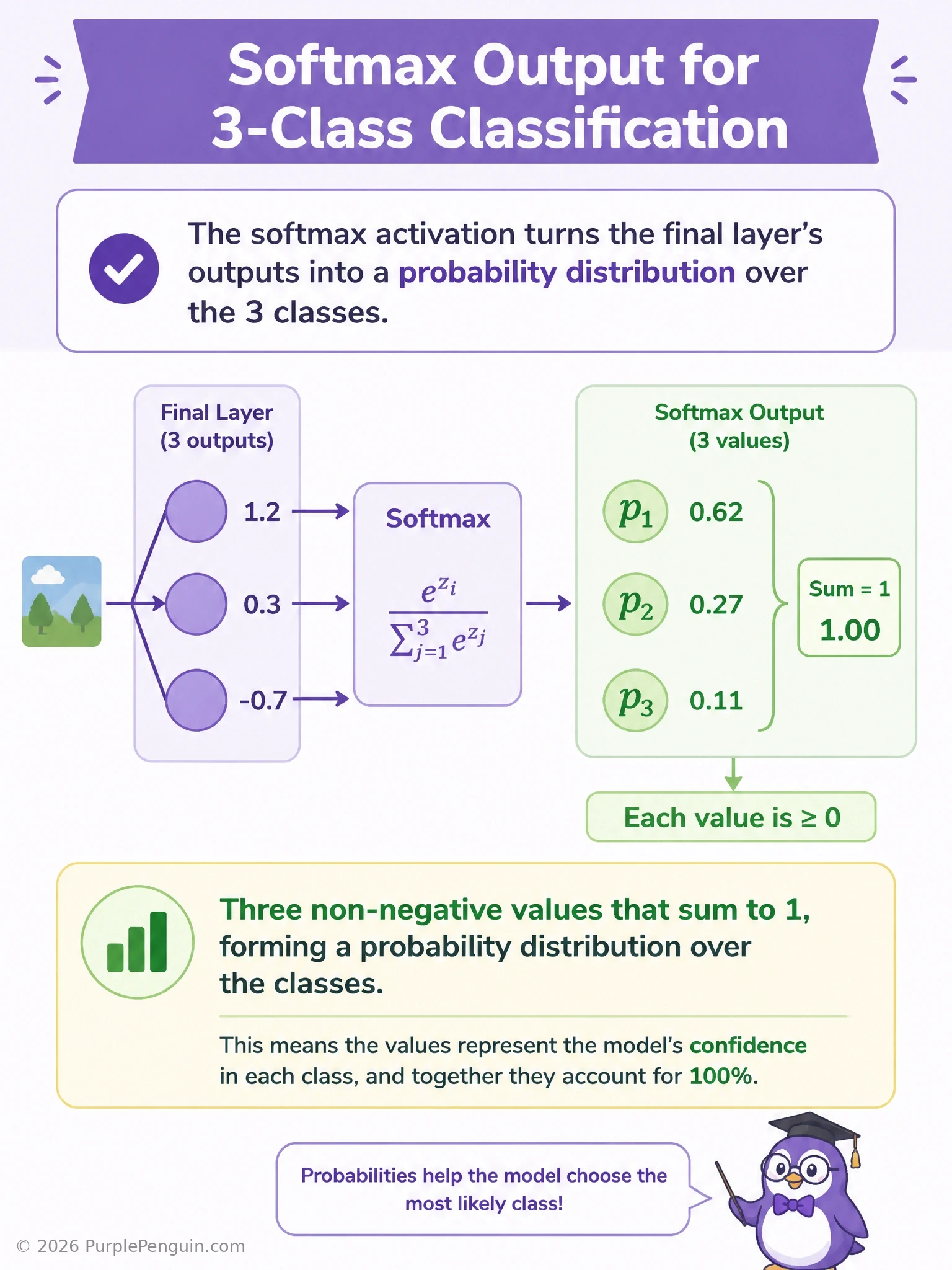
Softmax has one job: turn a handful of raw scores into something that behaves like probabilities. For 3 classes, you get out exactly 3 numbers, each one between 0 and 1, and here's the key part — they all add up to 1. That's what makes it a genuine probability distribution over your classes, not just three unrelated confidence scores. Raw logits before softmax can be any real number, positive or negative, and don't sum to anything meaningful — that's before the transformation. A single binary output would only make sense for a yes/no decision, not three classes. And independent sigmoids per class (each between 0 and 1 but not summing to 1) describes multi-label classification, where classes aren't mutually exclusive — different setup entirely.
Full explanation below image
Full Explanation
Softmax converts a vector of raw scores (logits) z1, z2, ..., zk into a probability distribution by computing softmax(zi) = exp(zi) / sum(exp(zj)) for all j. For a 3-class problem, this produces exactly three output values, each strictly between 0 and 1, and critically, all three values sum to exactly 1. This makes the output a valid categorical probability distribution across mutually exclusive classes, which is exactly what's needed when a single input belongs to exactly one of several possible classes (as is typical in standard multi-class image classification, paired with categorical cross-entropy loss). 'Three raw, unbounded logits' describes the state of the network's output before softmax is applied — logits can be any real number, including negative values, and are not directly interpretable as probabilities; softmax's entire purpose is to transform these into the bounded, normalized values described in the correct answer, so this option describes the pre-activation state, not the softmax output itself. 'A single binary value indicating the most likely class' is incorrect because softmax over 3 classes always outputs 3 values, not 1; collapsing to a single predicted class label (e.g., via argmax) is a separate downstream decision step, not what the softmax function itself produces, and it discards the probabilistic information entirely. 'Three independent values each squashed by sigmoid, with no constraint on their sum' describes multi-label classification, where an input can belong to multiple non-exclusive categories simultaneously (e.g., an image tagged with both 'outdoor' and 'daytime'); in that architecture, each output neuron uses its own independent sigmoid and the values do not need to sum to 1, which is fundamentally different from softmax's joint normalization across all classes. The key distinguishing principle: softmax couples all the outputs together through a shared normalization term (the denominator sums over every class), which is exactly why the outputs must sum to 1 and why softmax is the correct choice specifically for single-label, mutually-exclusive multi-class problems.