A researcher needs to know whether a 2x2 weight transformation matrix can be inverted before using it in a normalizing-flow layer. Which property of the matrix should the researcher compute to answer this?
Select an answer to reveal the explanation.
Short Explanation and Infographic
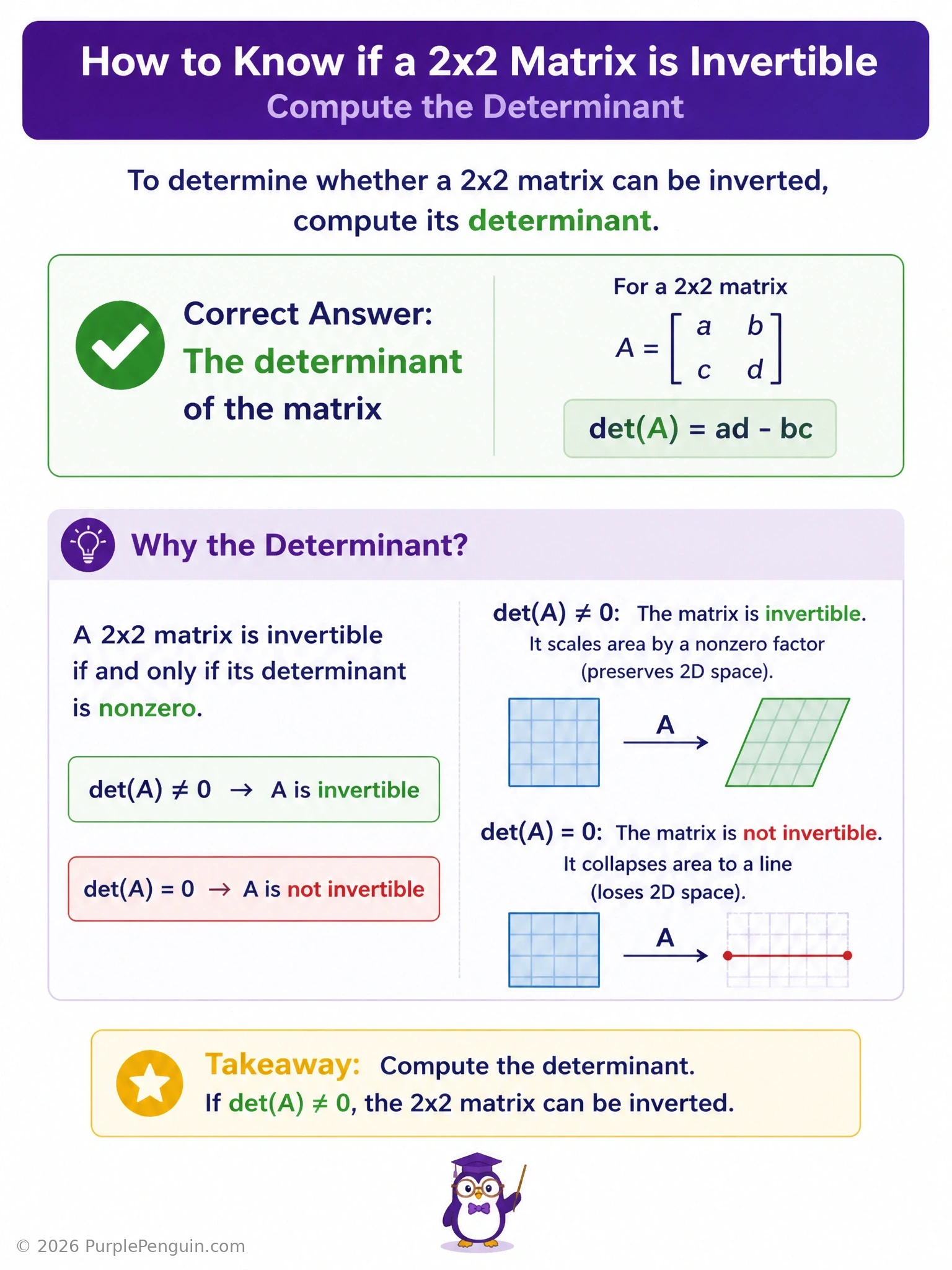
Here's the deal: a matrix has an inverse only when its determinant is nonzero. For a 2x2 matrix [[a,b],[c,d]], the determinant is just ad − bc, and if that comes out to zero, the matrix is singular — no inverse exists, period. That's exactly what the researcher needs to check before relying on that transformation being reversible in a normalizing flow. The trace just adds the diagonal entries and tells you nothing about invertibility. Summing all entries is even less meaningful. And the transpose is just a reshuffled version of the same matrix — flipping rows and columns doesn't tell you whether it's invertible either.
Full explanation below image
Full Explanation
The determinant is the specific scalar quantity that determines whether a square matrix is invertible. For a 2x2 matrix M = [[a, b], [c, d]], the determinant is computed as det(M) = ad − bc. If det(M) is nonzero, the matrix is invertible (non-singular), and its inverse can be computed as (1/det(M)) times the adjugate matrix. If det(M) equals zero, the matrix is singular, meaning it collapses the plane onto a lower-dimensional subspace (a line or a point), and no inverse exists because that information loss cannot be undone. This matters directly in deep learning contexts like normalizing flows, where invertible transformations are required so that a probability density can be mapped forward and backward exactly, and where the determinant (specifically its absolute value, the Jacobian determinant) is also used to correctly rescale probability density under the change-of-variables formula. The trace of a matrix, the sum of its diagonal entries (a + d for a 2x2 matrix), reflects things like the sum of eigenvalues but says nothing about whether the matrix is singular — a matrix can have a nonzero trace and still be non-invertible (e.g., [[1,1],[1,1]] has trace 2 but determinant 0). Summing all matrix entries (a + b + c + d) is not a meaningful linear-algebra invariant at all and has no established connection to invertibility. The transpose operation merely swaps rows and columns to produce Mᵀ; a matrix and its transpose always share the same determinant, but transposition itself is a structural operation, not a computed scalar test, and does not by itself reveal invertibility. The memory aid worth keeping: 'zero determinant, zero chance of an inverse' — determinant is the single number that tells you whether a linear transformation can be undone.