A team trains a deep neural network and finds it scores 99% accuracy on the training set but only 68% on the held-out test set. What best explains this gap?
Select an answer to reveal the explanation.
Short Explanation and Infographic
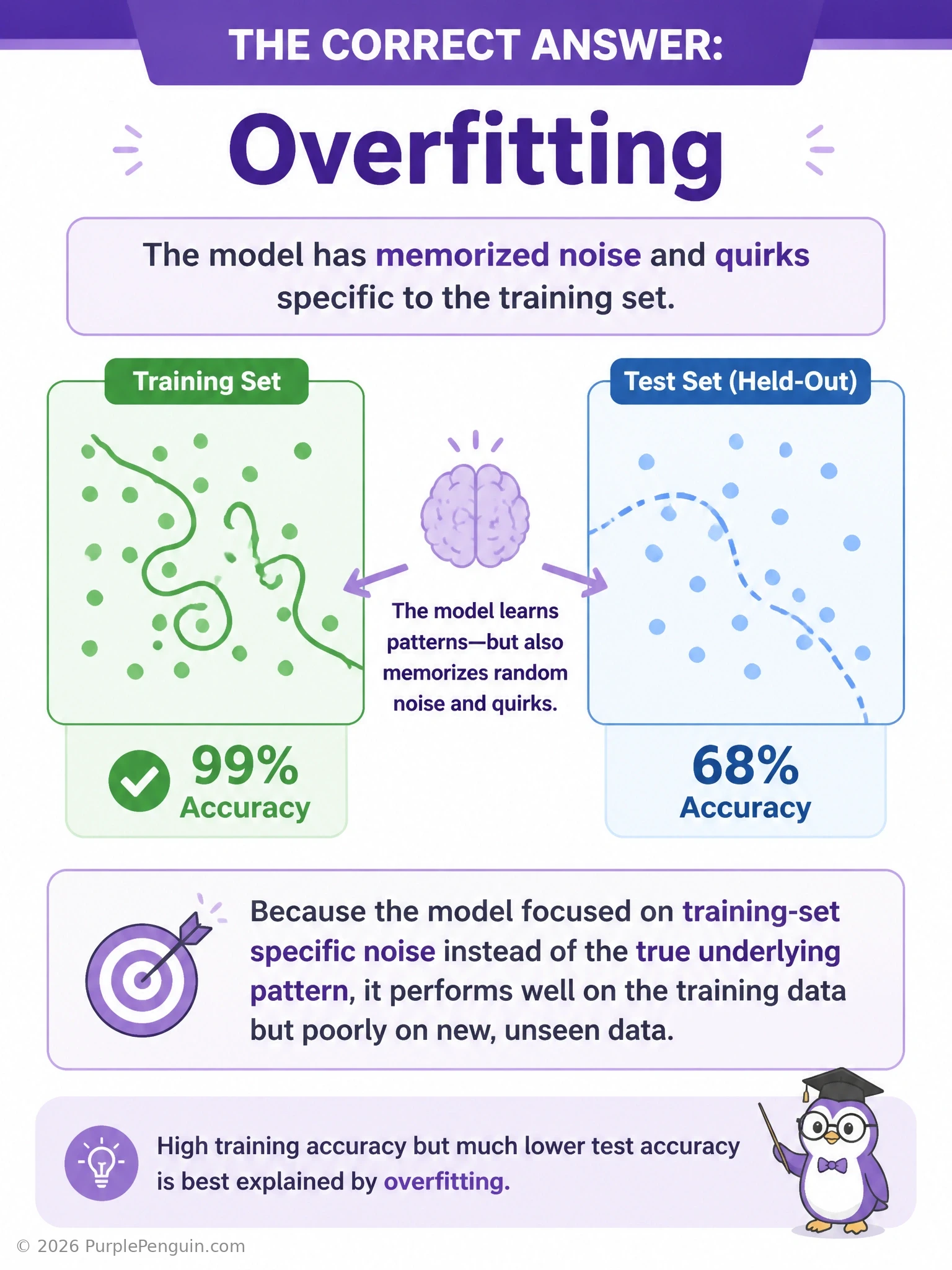
Let's think about what a huge train-test gap is actually telling you. If the model crushes the training set but stumbles on new data, it didn't learn the general rule — it memorized the answer key. That's overfitting, plain and simple: the network fit itself to noise and quirks that only exist in the training examples, so it can't generalize. Underfitting is the opposite story — that's when a model does poorly on both training and test data because it never captured the pattern at all. Reverse data leakage doesn't really make sense as a mechanism — leakage helps you cheat on the test, not hurt it. And a low learning rate would slow convergence, hurting training accuracy too, not just test accuracy. The 99-vs-68 split is the classic fingerprint of overfitting.
Full explanation below image
Full Explanation
When a model achieves near-perfect accuracy on training data but performs substantially worse on unseen test data, this is the textbook signature of overfitting. Overfitting occurs when a model has enough capacity to memorize idiosyncratic patterns, noise, and outliers present only in the training sample rather than learning the true underlying relationship that generalizes to new data. As a result, training error becomes very low while test (generalization) error remains high, producing a large gap between the two — exactly the pattern described.
The underfitting distractor is incorrect because underfitting describes a model that is too simple or under-trained to capture the pattern, which produces poor performance on BOTH the training and test sets, not a large discrepancy between them. Since training accuracy here is 99%, the model clearly captured the training data extremely well, ruling out underfitting.
The 'reverse data leakage' distractor is not a real phenomenon in this context; leakage typically refers to test or future information inadvertently contaminating the training process, which would artificially inflate test performance, not depress it. It does not explain a model performing worse on the test set.
The learning-rate distractor is incorrect because an improperly low learning rate typically manifests as slow or stalled convergence, which would depress training accuracy as well, not create a scenario where training accuracy is exceptionally high while test accuracy lags far behind.
Common remedies for overfitting include gathering more training data, applying regularization (L1/L2, dropout), early stopping, data augmentation, and reducing model complexity. A useful memory aid: overfitting is 'acing the practice exam but bombing the real one' — the model has memorized the practice questions instead of understanding the subject.