In linear algebra as applied to machine learning (for example, in principal component analysis), what is the significance of a matrix's eigenvectors and eigenvalues?
Select an answer to reveal the explanation.
Short Explanation and Infographic
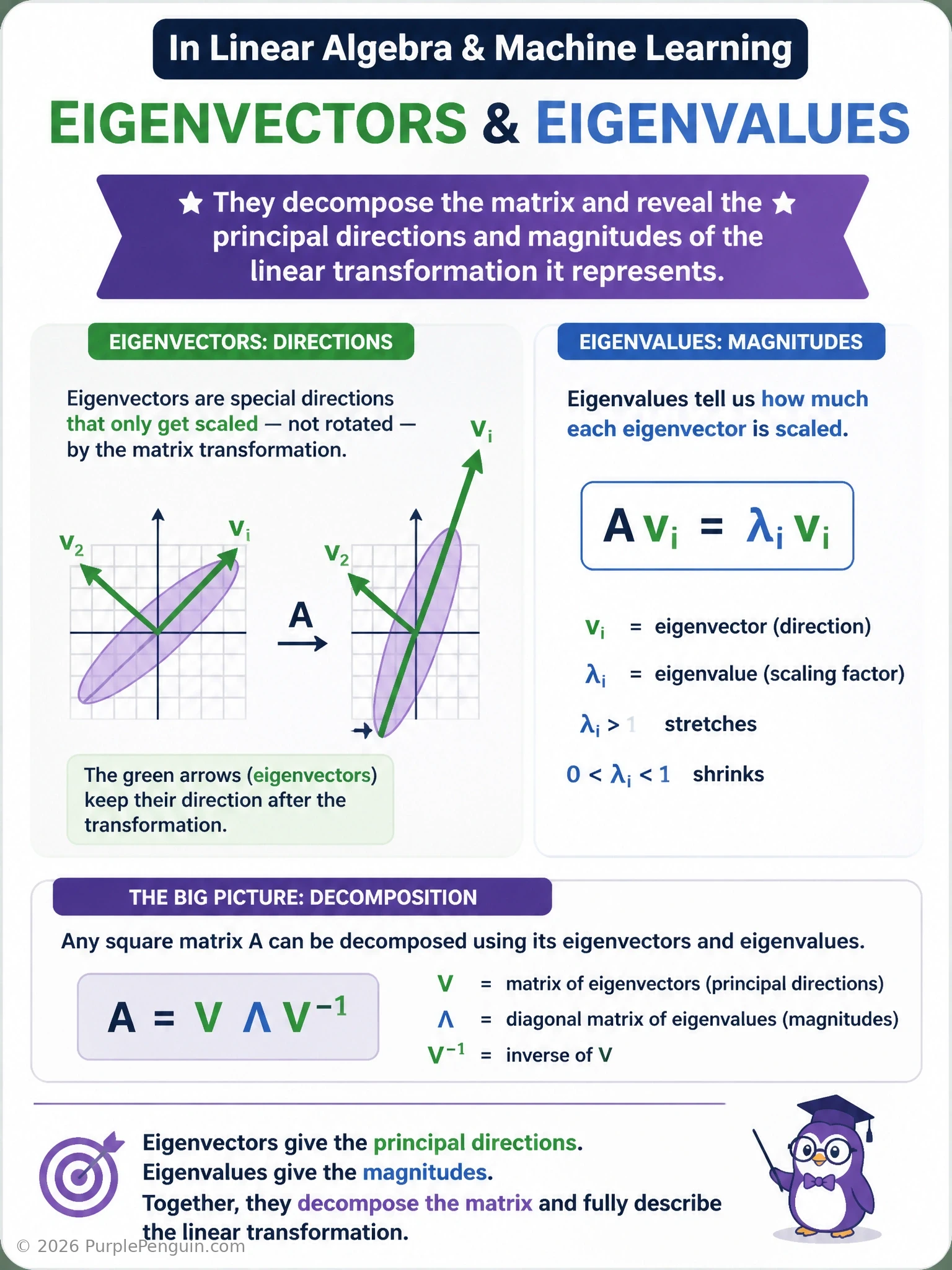
Think of a matrix as a machine that stretches and rotates space. Eigenvectors are the special directions that machine doesn't rotate at all — it only stretches or squishes along them — and the eigenvalues tell you by how much. Put together, they decompose the matrix and reveal the principal directions and strength of the transformation it performs — that's answer D, and it's exactly why PCA uses them to find the directions of greatest variance in your data. Summing to zero has nothing to do with invertibility; that's not a real rule. Diagonalization is a nice possible outcome in some cases, but it's not guaranteed 'with no loss of information under any circumstances' — not every matrix is diagonalizable. And eigenvectors/eigenvalues have nothing to do with storage size or matrix dimensions.
Full explanation below image
Full Explanation
For a square matrix A, an eigenvector v is a nonzero vector whose direction is unchanged when the matrix is applied to it — the transformation only scales v by a factor, called the eigenvalue (lambda), satisfying Av = lambda * v. Collectively, a matrix's eigenvectors point along the "principal axes" of the linear transformation it represents, and the corresponding eigenvalues quantify how much stretching, shrinking, or flipping happens along each of those axes. This decomposition is central to techniques like Principal Component Analysis (PCA), where the eigenvectors of a data covariance matrix identify the directions of greatest variance, and the eigenvalues quantify how much variance lies along each direction, enabling dimensionality reduction that keeps the most informative axes.
The first distractor is incorrect: invertibility is related to whether zero is among the matrix's eigenvalues (a matrix with a zero eigenvalue is singular/non-invertible), not to the eigenvalues summing to zero, which is not a general rule.
The second distractor overstates what eigendecomposition guarantees. While some matrices (specifically diagonalizable matrices, such as all real symmetric matrices) can be fully expressed as a diagonal matrix of eigenvalues via a similarity transform using their eigenvectors, not every matrix is diagonalizable — some (called defective matrices) lack a full set of linearly independent eigenvectors, so this cannot be claimed to hold "under any circumstances."
The third distractor confuses eigen-analysis with matrix storage/dimensionality bookkeeping, which is unrelated; the number of rows and columns is simply the matrix's shape, not something derived from eigenvectors or eigenvalues.
Memory aid: "eigen" is German for "own" or "characteristic" — eigenvectors are a matrix's own special directions, and eigenvalues are how much it stretches along them. This is the mathematical backbone of PCA, spectral clustering, and stability analysis in dynamical systems.