What key architectural characteristic sets a Recurrent Neural Network (RNN) apart from a standard feedforward network when processing sequential data like sentences or time series?
Select an answer to reveal the explanation.
Short Explanation and Infographic
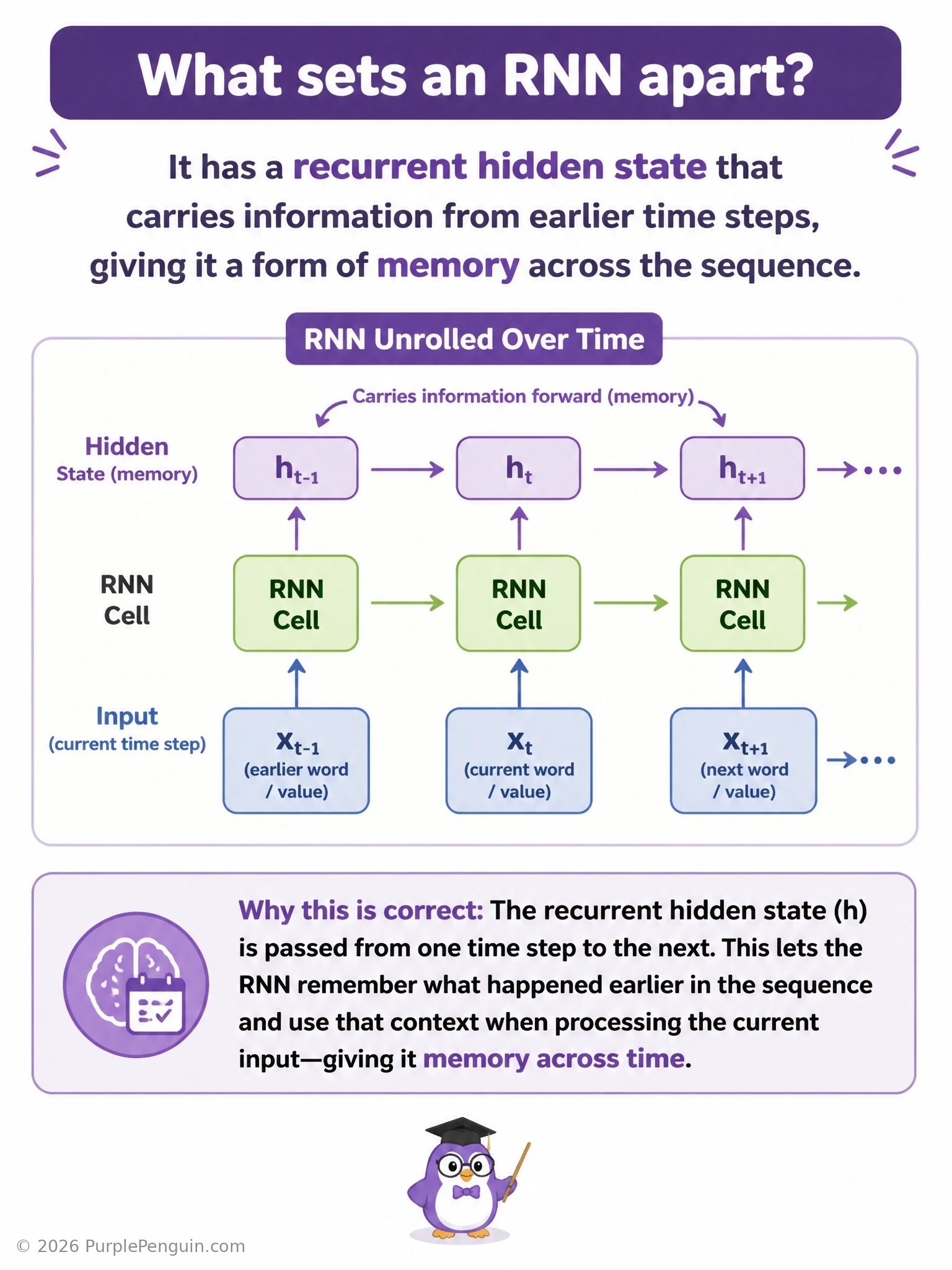
The whole point of an RNN is memory. As it moves through a sequence one element at a time, it keeps a hidden state that gets updated at every step and gets carried forward, so what the network 'knows' at word 10 is influenced by everything it saw at words 1 through 9. That's fundamentally different from a feedforward network, which has no sense of order or history at all — every input is treated in isolation. It's also not about sliding convolutional filters; that's a CNN's trick for spatial or local patterns, not the recurrent loop that defines an RNN. And RNNs absolutely aren't independent step-by-step processors with no shared parameters — they reuse the very same weights at every time step, which is what lets them generalize across sequence positions. There's no requirement to squash the whole sequence into one fixed vector before you even start; the hidden state updates incrementally as each element arrives.
Full explanation below image
Full Explanation
The correct answer is that an RNN maintains a recurrent hidden state, updated at each time step and fed back into the network as it processes the next element of the sequence, effectively giving the network a form of short-term memory. This hidden state acts as a compressed summary of everything the network has seen so far in the sequence, which lets the network's output at any given time step depend not just on the current input but on the accumulated context from prior inputs — essential for tasks like language modeling, where the meaning of a word often depends heavily on the words that came before it, or time-series forecasting, where past values inform future predictions. The same weight matrices are reused at every time step (parameter sharing across time), which both keeps the model compact and allows it to generalize its learned dynamics regardless of where in the sequence a pattern occurs. The first distractor, sliding convolutional filters for local pattern detection, describes a 1D convolutional neural network approach to sequences, not an RNN — CNNs applied to sequences detect fixed-size local windows (like n-grams) in parallel and have no persistent memory that carries information arbitrarily far across the sequence, which is the opposite of an RNN's defining mechanism. The second distractor, processing every sequence element completely independently with no shared parameters, is a direct contradiction of how RNNs work: RNNs explicitly do share parameters across every time step, and the entire reason they can model sequential dependencies is that each step's computation depends on the hidden state carried over from the previous step, not independent, isolated processing. The third distractor, requiring the whole sequence to be squashed into a fixed-length vector before processing starts, misdescribes RNN mechanics; RNNs process sequences incrementally, one element at a time, updating the hidden state as they go, rather than needing a pre-computed fixed-size summary before any computation begins — that kind of fixed-length pre-encoding is more characteristic of certain non-recurrent aggregation approaches, not the recurrent design itself. A useful memory aid: think of the RNN's hidden state as a running notebook that gets updated after reading each word and is then carried into reading the next word, which is precisely the mechanism that gives RNNs their capacity to model order and context in sequences.