What is the main purpose of an autoencoder?
Select an answer to reveal the explanation.
Short Explanation and Infographic
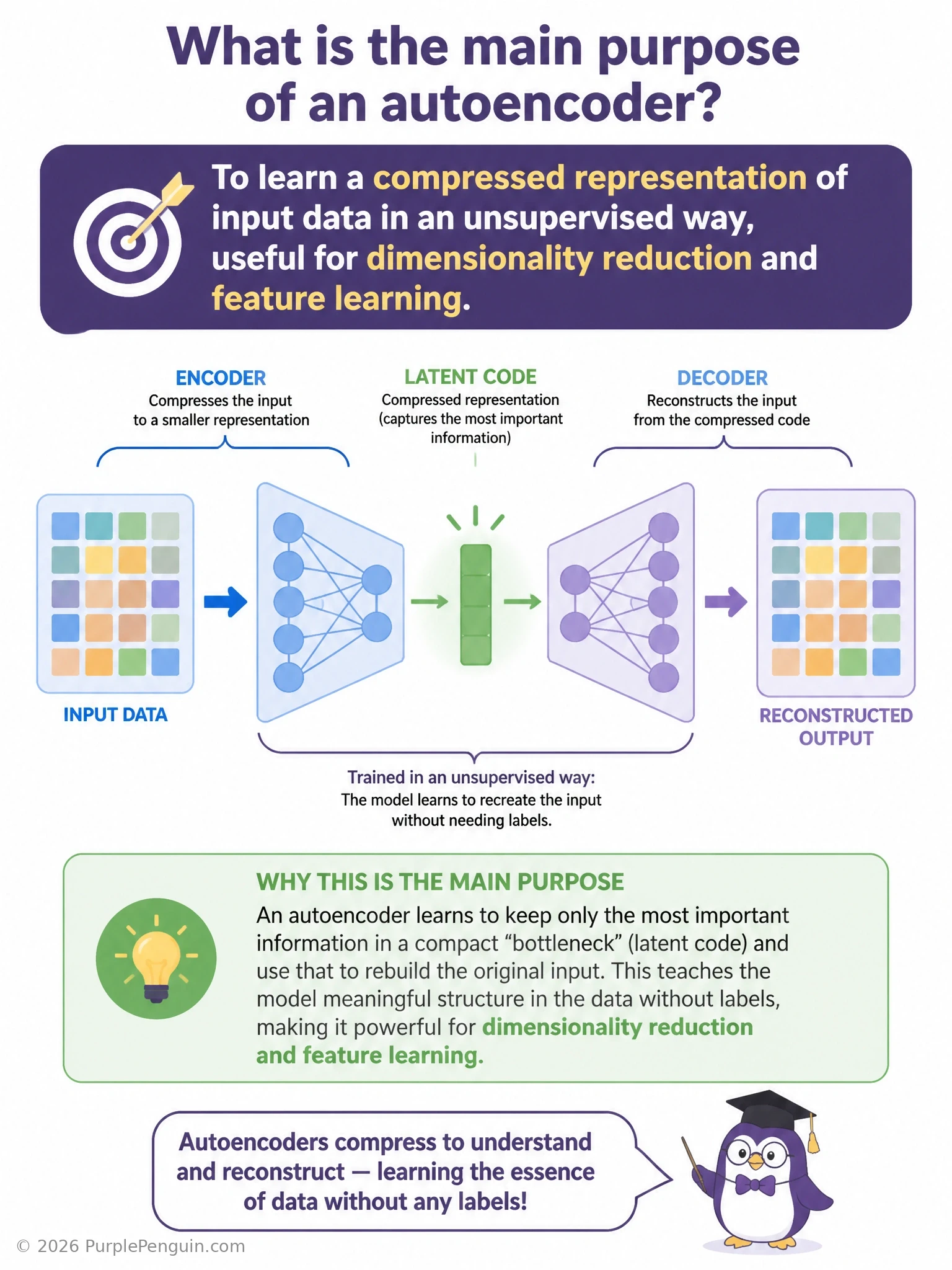
An autoencoder is basically two networks glued together: an encoder that squeezes the input down into a small, compressed representation, and a decoder that tries to rebuild the original input from that squeeze. Since it just needs the input to reconstruct itself, there's no need for labels — that's why the first option is correct, calling out unsupervised dimensionality reduction and feature learning. It's not about assigning labeled classes; that's supervised classification, which needs labeled examples to compare against. It's not generating a reward signal either — that's reinforcement learning's territory, driven by an agent-environment loop. And it's not machine translation, which needs paired source-target sentences and a very different sequence-to-sequence architecture, typically an encoder-decoder built for language, not for reconstructing raw input.
Full explanation below image
Full Explanation
An autoencoder is an unsupervised neural network architecture composed of two parts: an encoder, which compresses the input into a lower-dimensional latent representation (the bottleneck), and a decoder, which attempts to reconstruct the original input from that compressed representation. The network is trained by minimizing the reconstruction error between the original input and the decoder's output, and because the input itself serves as the training target, no external labels are required. This structure makes autoencoders useful for dimensionality reduction (compressing high-dimensional data into a compact latent space), feature learning (the bottleneck representation often captures the most salient structure in the data), denoising (when trained to reconstruct clean inputs from corrupted versions), and anomaly detection (inputs that reconstruct poorly are flagged as unusual). This makes the first option correct. The second option, describing the goal as assigning class labels using a labeled dataset, describes supervised classification instead; classification requires labeled examples and a loss function that compares predictions to ground-truth labels, whereas an autoencoder's loss compares reconstructed output to the original input, with no external labels involved at all. The third option, describing the goal as generating a reward signal to train an agent, describes reinforcement learning, where an agent learns a policy through interaction with an environment and reward feedback; autoencoders have no notion of an agent, an environment, or a reward signal. The fourth option, describing the goal as translating text between languages using paired sentence data, describes a sequence-to-sequence machine translation task, which is typically implemented with an encoder-decoder architecture as well, but one trained on paired source-target language data with the explicit goal of producing a different output sequence, not reconstructing the same input; this is a superficial architectural similarity (both use encoder-decoder structure) but a fundamentally different objective. A useful memory aid: think of an autoencoder as a photocopier that first shrinks a document down to a tiny thumbnail and then tries to redraw the full document from that thumbnail alone — the quality and usefulness of that thumbnail is exactly the compressed feature representation the autoencoder learns.