In the context of an artificial neural network, what is a neuron?
Select an answer to reveal the explanation.
Short Explanation and Infographic
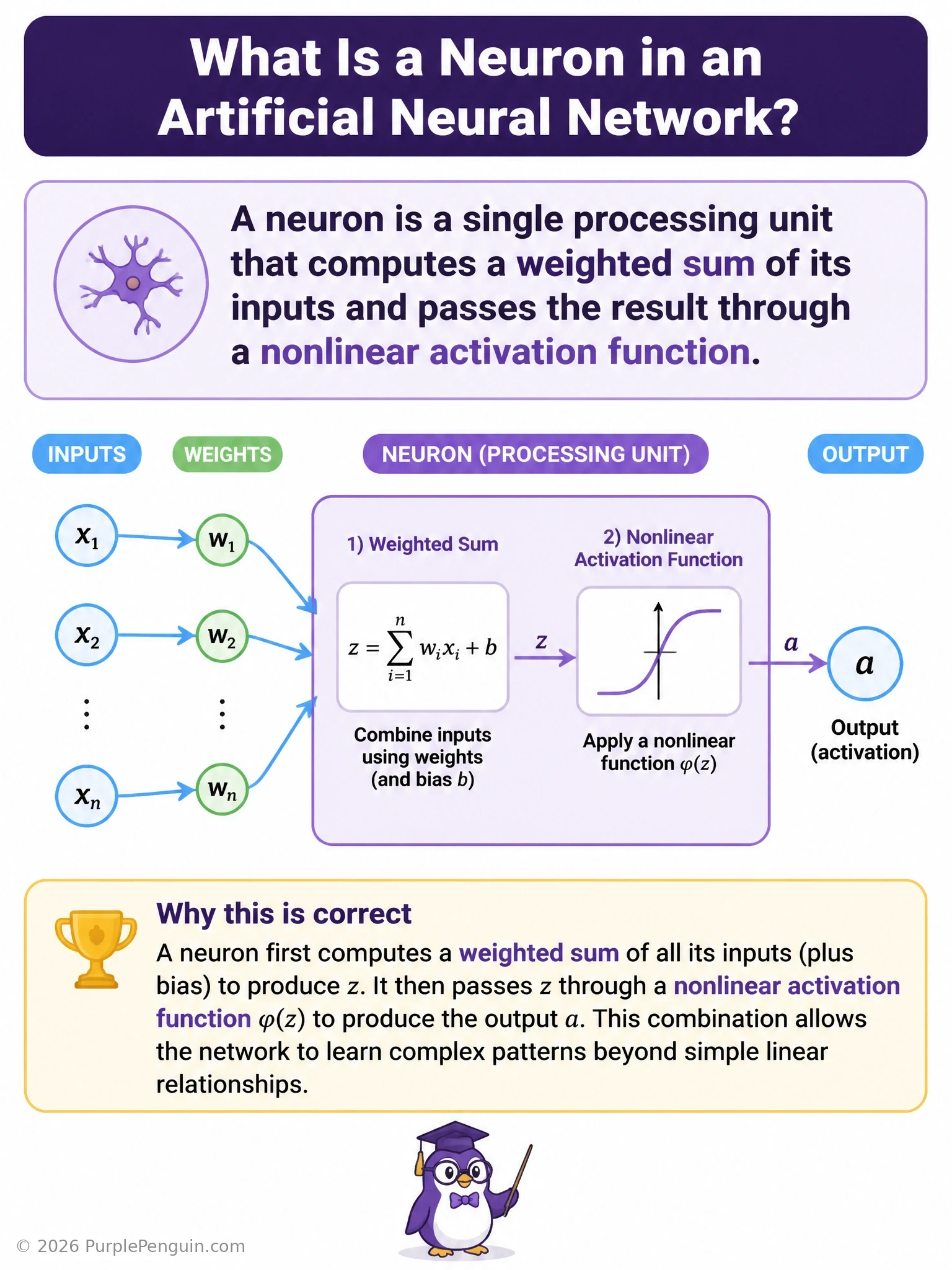
A neuron is the smallest working piece of a neural network — it's the basic unit, not the whole engine. Each neuron takes in a bunch of inputs, multiplies each one by a learned weight, adds them up along with a bias, and then runs that sum through a nonlinear activation function like ReLU or sigmoid to produce its output. That's the third option, and it's correct. It's not a storage container for your dataset — that's just memory management, unrelated to the neuron's computation. It's also not a bundle of layers; a neuron is one unit, and stacking many of them side by side is what makes up a single layer, with multiple layers stacked further making the whole network. And it's definitely not an optimizer — optimizers like SGD or Adam update the weights across the whole network, they aren't tied to one neuron.
Full explanation below image
Full Explanation
An artificial neuron is the fundamental computational unit of a neural network, modeled loosely on biological neurons. Each neuron receives one or more numeric inputs, multiplies each input by an associated learnable weight, sums these weighted inputs together with an additional learnable bias term, and then passes that sum through a nonlinear activation function (such as ReLU, sigmoid, or tanh) to produce a single output value. This output can then be passed as an input to neurons in the next layer. This description matches the third option, which is correct. The first option, describing a neuron as a container that stores the entire training dataset before each epoch, confuses a neuron with a data-loading mechanism; storing and batching training data is handled by a data pipeline or data loader, an entirely separate part of the training process unrelated to how a single unit computes its output. The second option, describing a neuron as a group of several layers combined into a reusable block, actually describes something closer to a module or a residual block in modern architectures; a neuron is a single unit within one layer, not a composite of multiple layers, and conflating the two obscures the hierarchical structure of neuron, layer, and network. The fourth option, describing a neuron as a separate optimizer instance tied to one layer, is incorrect because optimizers (such as SGD, Adam, or RMSprop) are algorithms that update the weights of the entire network based on computed gradients; a single optimizer typically manages all trainable parameters in a model, and there is no concept of a per-neuron optimizer in standard practice. Understanding the neuron as the atomic unit is foundational: many neurons operating in parallel on the same inputs form a layer, and many layers stacked in sequence form the full network. A helpful memory aid is to think of a neuron as a tiny voting station: it collects weighted opinions (inputs times weights), tallies them with a bias, and then decides how strongly to 'fire' by passing that tally through a nonlinear activation function.